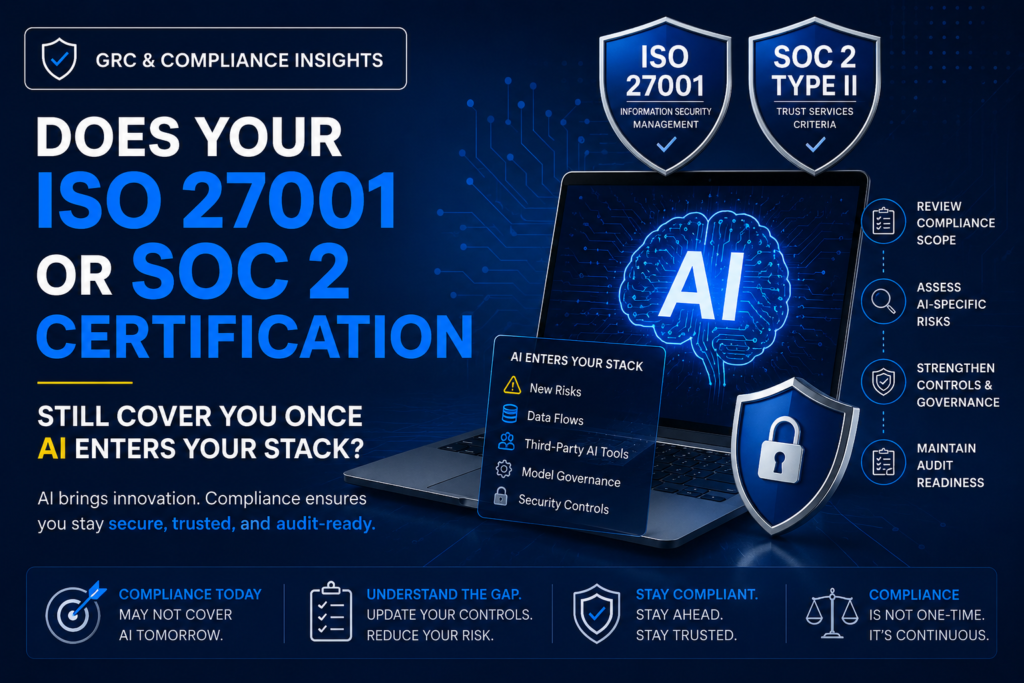
Does Your ISO 27001 or SOC 2 Report Still Cover You Once AI Enters Your Stack?
Here’s a question I’ve started hearing in almost every compliance call this year, usually asked with a slightly nervous laugh: “We’re SOC 2 certified, we’re fine, right?”
The honest answer is: probably not entirely, and most compliance leads don’t find that out until an auditor, a customer security questionnaire, or worse, an incident, forces the issue.
For close to two decades, SOC 2 and ISO 27001 have been the two certifications that let a business say “you can trust us with your data” without having to prove it line by line to every customer. They were stable. Predictable. You built your controls once, you renewed on a cycle, and you moved on with your life.
Then AI got bolted onto everything. Customer support chatbots, internal copilots, AI powered analytics, vendor tools with embedded machine learning you didn’t even choose. And the frameworks that were built for a pre AI world are now being quietly stretched to cover systems they were never designed to evaluate.
The uncomfortable truth nobody’s saying loudly enough: your existing certification might still be valid on paper, and still be leaving real gaps that an auditor, or worse, an attacker, will eventually find.
GCAI’s compliance desk summed it up this way: “The certificate hasn’t expired. The coverage has.”
Let’s actually walk through what’s changed, what hasn’t, and where the real exposure sits.
ISO 27001 Explained: Scoping, Risk, Audits:
Why This Question Is Suddenly Everywhere
A year ago, the conversation in security circles was mostly philosophical, should companies even use AI in their security stack, is it safe, is it hype. That debate is over. In 2026, the question is operational and much harder to dodge: if your company is building, buying, or deploying AI, what actually proves the system is governable, defensible, auditable, and safe enough to trust with real business data and real world actions.
That question is now colliding directly with procurement. Terms like SOC 2, ISO 27001, ISO 42001, and “AI SOC” are getting thrown around interchangeably in vendor questionnaires and board updates, and most people using them don’t actually know which one covers what.
Meanwhile, the frameworks themselves are visibly straining under the load. A few numbers make the shift concrete:
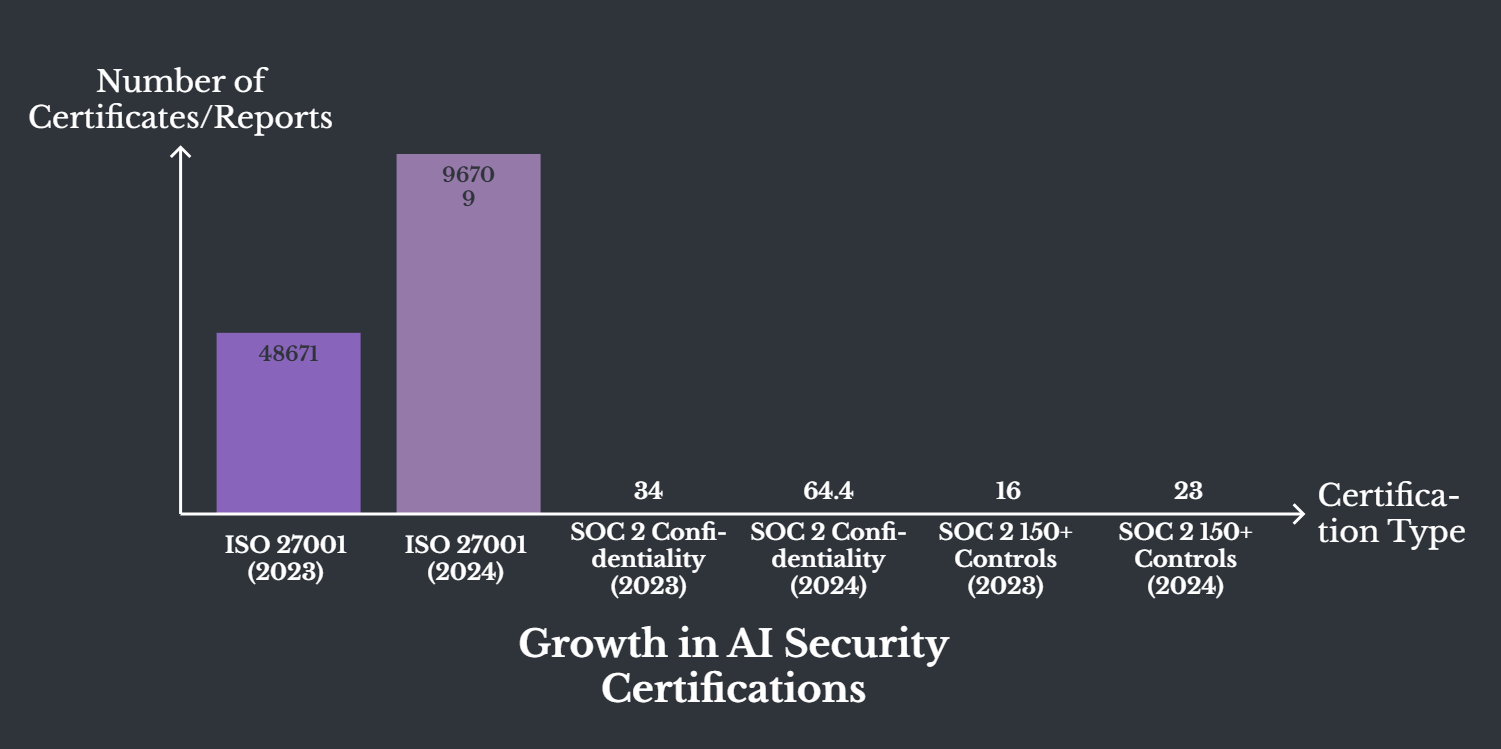
- The number of valid ISO 27001 certificates nearly doubled from 48,671 in 2023 to 96,709 in 2024, adoption is surging as buyers increasingly treat certification as baseline, not differentiator.
- In SOC 2 reporting, confidentiality criteria jumped from being included in 34% of reports in 2023 to 64.4% in 2024. Availability now appears in 75.3% of reports. Organizations are visibly widening scope to keep up with what customers are demanding.
- Reports containing more than 150 individual security controls rose from 16% to 23% of all SOC 2 reports, a clear sign that “standard scope” no longer covers what buyers expect.
- Major AI infrastructure providers, OpenAI and AWS Bedrock among them, are now publicly stacking SOC 2 Type 2, ISO 27001, and ISO 42001 together as baseline product assurance, not back office paperwork.
Put simply: the frameworks aren’t broken, but the boundary of what they actually examine hasn’t kept pace with what companies are actually running.
GCAI’s compliance desk again: “We used to get asked ‘how long does certification take.’ Now we get asked ‘does our certification even cover this AI tool we just deployed.’ That’s a completely different conversation, and most companies haven’t had it yet.”
What SOC 2 and ISO 27001 Actually Cover, and What They Don’t
Both frameworks are still fundamentally sound. What’s changed is the honest answer to “does this cover AI,” which is: partially, and only if you’ve deliberately extended it.
| Framework | What It Was Built To Evaluate | What It Does Not Automatically Cover |
|---|---|---|
| SOC 2 | Security, availability, processing integrity, confidentiality, and privacy of customer data handled by a service organization, examined by an independent CPA firm | Model behavior, training data provenance, algorithmic bias, AI-specific incident response, or whether an AI system’s outputs are reliable |
| ISO 27001 | A risk-driven information security management system covering people, process, and technology, with a Statement of Applicability defining exact scope | AI-specific risk categories unless the organization has deliberately updated its Statement of Applicability to include AI assets and AI-related controls |
| ISO 42001 | Purpose-built AI management system standard, covering AI lifecycle governance, risk management, and ethical use | Traditional information security controls, this is not a replacement for SOC 2 or ISO 27001, it is a complement |
The line I keep coming back to when I explain this to clients: SOC 2 and ISO 27001 ask whether your organization runs a defensible security program. Neither one was written to ask whether your AI model behaves the way you think it does, or whether the data feeding it was collected and used lawfully. That’s a different question entirely, and increasingly, it’s the one your customers actually care about.
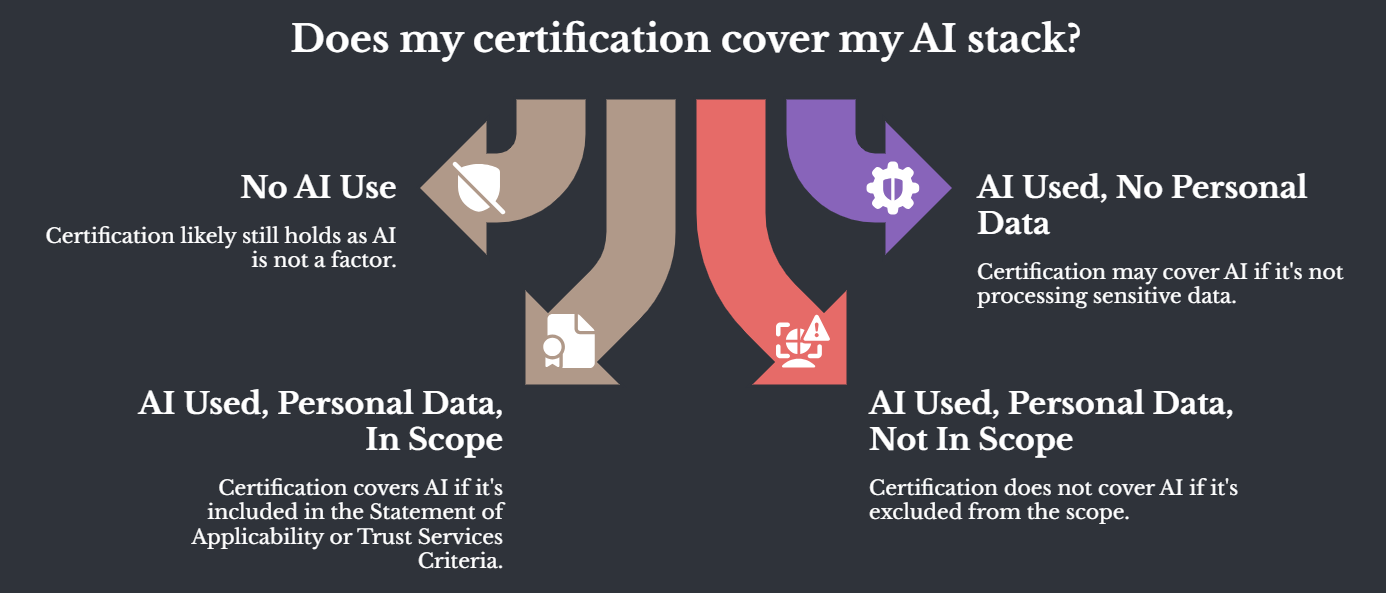
The Decision Tree: Does Your Certification Actually Cover Your AI Stack?
This is the exercise I’d run with any compliance lead before their next audit cycle.
Does your organization use AI anywhere in the business, internally or customer facing?
│
├── NO → Your existing SOC 2 or ISO 27001 scope likely still holds.
│         Revisit this the moment any team adopts an AI tool, shadow AI is
│         the most common way this changes without anyone noticing.
│
└── YES → Does your AI system process, store, or generate output based on
    customer or personal data?
    │
    ├── YES → Is that AI system explicitly named in your ISO 27001
    │         Statement of Applicability, or covered under your SOC 2
    │         Trust Services Criteria scope?
    │         │
    │         ├── YES → Good baseline. But do your controls address AI
    │         │         specific risks: model access control, training
    │         │         data lineage, output monitoring, prompt injection
    │         │         defenses?
    │         │         │
    │         │         ├── YES → You're ahead of most of the market.
    │         │         │         Maintain and document continuously.
    │         │         │
    │         │         └── NO → You have a certification that's
    │         │                   technically valid and practically
    │         │                   incomplete. This is the most common
    │         │                   gap GCAI finds during reviews.
    │         │
    │         └── NO → Your AI system is currently outside your certified
    │                   scope entirely. Auditors and enterprise buyers are
    │                   increasingly asking about this directly, expect
    │                   it to surface in your next renewal or vendor
    │                   questionnaire.
    │
    └── NO (AI used internally, no customer data involved) → Lower urgency,
              but still worth documenting, internal AI tools are a common
              path for data leakage that eventually touches customer data
              anyway.
If you walked through that tree and landed anywhere other than “yes, yes, yes,” you have a gap. You’re not alone, most organizations are between what one industry report calls Level 1 and Level 2 of AI compliance maturity, still managing things manually or just starting to introduce automation, with almost nobody fully at the mature end of that curve yet.
The Real Gaps, Broken Down
1. Your Statement of Applicability Probably Doesn’t Mention AI
For ISO 27001, the Statement of Applicability is the document that defines exactly what’s in scope. If it was written before your organization adopted AI tools, and most were, it simply doesn’t address them. That’s not a violation of your certification, technically you’re still compliant with what you scoped, but it means the certificate is quietly narrower than what your business actually looks like today.
Leading organizations are now updating their Statement of Applicability specifically to address AI assets, which supports a single unified audit covering both ISO 27001 certification and SOC 2 Type II reporting rather than treating them as separate efforts.
2. SOC 2 Trust Services Criteria Weren’t Written With Models in Mind
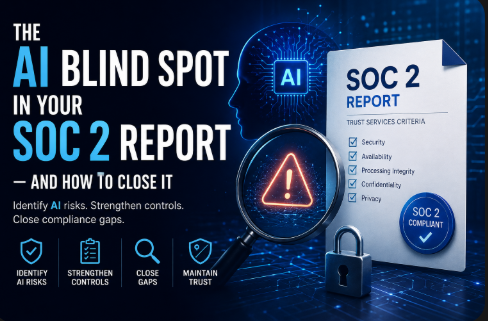
SOC 2’s five Trust Services Criteria, security, availability, processing integrity, confidentiality, and privacy, are broad enough to stretch toward AI, but they don’t ask AI specific questions by default. An auditor examining your access controls isn’t automatically asking whether your AI model can be manipulated through prompt injection, or whether your training data included information it shouldn’t have.
3. Shadow AI Is the Silent Scope Killer
This is the one that catches organizations off guard most often. Someone on the marketing team starts using an AI writing tool. Someone in support plugs in an AI chatbot vendor. Someone in engineering wires an LLM into an internal workflow. None of it goes through security review, none of it gets added to the Statement of Applicability, and none of it shows up until an auditor, or a breach, surfaces it.
4. Continuous Compliance Is Replacing Point in Time Audits
SOC 2 is visibly moving toward continuous compliance, with reliance on internal audit dropping and greater integration expected with adjacent regimes like DORA, HIPAA, and GDPR. A once a year audit cycle increasingly reads as outdated to sophisticated buyers, particularly when the systems being certified, AI included, change on a weekly basis.
GCAI’s compliance desk: “A SOC 2 report from eight months ago telling a customer nothing has changed since is a much harder sell now, especially if the vendor has shipped three new AI features since the report was issued.”
SOC 2 vs ISO 27001 vs ISO 42001: A Clean Comparison
Because this is the exact confusion showing up in procurement calls right now, here’s the side by side.
| Question | SOC 2 | ISO 27001 | ISO 42001 |
|---|---|---|---|
| What does it certify | Controls around security, availability, and data handling, examined by a CPA firm | A full information security management system, risk based, auditable | An AI management system, governance, risk, and ethical use of AI specifically |
| Who typically needs it | SaaS and service companies selling to US enterprise buyers | Any organization wanting an internationally recognized ISMS | Any organization building, deploying, or heavily relying on AI systems |
| Does it cover AI by default | No, unless scope is deliberately expanded | No, unless the Statement of Applicability is updated | Yes, this is its entire purpose |
| Renewal model | Type I point in time, Type II period of time, annual renewal typical | Three year certification cycle with annual surveillance audits | Certification cycle similar to ISO 27001, annual surveillance expected |
| Best combined with | ISO 27001 for full coverage | SOC 2 for US market credibility, ISO 42001 for AI specific assurance | ISO 27001 and SOC 2, not a replacement for either |
The honest advice here, and it’s not a popular one because it sounds like more work: if AI is a meaningful part of your product or operations, you don’t choose between these frameworks. You layer them, deliberately, and you map the overlap so you’re not repeating the same evidence collection three separate times.
What Auditors Are Starting to Flag
This is shifting fast, and it’s worth knowing before your next audit cycle rather than during it.
| Emerging Auditor Focus Area | Why It’s Coming Up Now |
|---|---|
| AI vendor risk in the supply chain | If you use a third party AI tool, its security posture is now effectively part of your own risk surface |
| Access controls around model and training data | Who can query, retrain, or fine tune your AI systems is becoming a standard control question |
| Logging and monitoring of AI outputs | Auditors are starting to ask whether AI generated outputs are logged and reviewable, the same way human actions are |
| Algorithmic accountability | Whether decisions influenced by AI can be explained, traced, and defended |
| Data pipeline security for training data | Whether the data feeding your models was collected, stored, and used with the same rigor as customer data elsewhere |
None of these are formally mandated line items in SOC 2 or ISO 27001 yet, in the strict sense. But auditors, and increasingly enterprise procurement teams, are asking about them anyway, because the risk is real regardless of whether the checklist has caught up.
The Fines and Business Risk Nobody’s Pricing In
Unlike a regulation with a fixed penalty schedule, the risk here isn’t a fine from a regulator. It’s quieter and, in some ways, more expensive: lost deals, failed vendor security reviews, and the slow erosion of trust that happens when a customer’s security team finds a gap your certification didn’t catch.
Enterprise buyers are now routinely asking AI specific questions during vendor security reviews, regardless of what your SOC 2 report says on its cover page. A clean SOC 2 report that doesn’t address your AI stack is increasingly read by sophisticated buyers as an incomplete picture, not a clean bill of health.
Common Misconceptions Showing Up in Client Conversations Right Now
| What People Are Saying | What’s Actually True |
|---|---|
| “We’re SOC 2 certified, so our AI tools are covered” | Only if your AI systems were explicitly included in your Trust Services Criteria scope |
| “ISO 27001 is broad enough to cover anything, including AI” | It’s risk based and scope defined, if AI wasn’t in your Statement of Applicability, it isn’t covered |
| “We need ISO 42001 instead of ISO 27001 now” | ISO 42001 complements ISO 27001 and SOC 2, it doesn’t replace either |
| “Our AI vendor is certified, so we’re covered by extension” | Their certification covers their controls, not automatically your use of their tool inside your own environment |
| “This is only a concern for AI heavy companies” | Any company using AI tools internally, even just for support or content, has some exposure |
Building One Program Instead of Three Separate Ones
The mistake I see most often isn’t a missing control, it’s duplicated effort. Companies treat SOC 2, ISO 27001, and now AI governance as three separate compliance tracks, each with its own evidence collection, its own audit prep, and its own exhausted internal team re-answering the same questions in slightly different formats for three different auditors.
The fix is mapping, not multiplying. A single control, say, access management for a system that touches both customer data and an AI model, can satisfy SOC 2’s security criteria, ISO 27001’s Annex A controls, and part of an ISO 42001 risk assessment, if it’s documented once and mapped across all three frameworks rather than rebuilt three times.
GCAI’s compliance desk: “The money leak is rarely the framework itself. It’s duplicated effort, three teams collecting the same evidence in three different formats for three different auditors, when one well mapped control set could have covered all of it.”
How GCAI Helps
This is exactly the gap a certification body is built to close, not by selling automation software, but by telling you plainly where your current certification actually ends and where your real exposure begins.
GCAI runs an AI aware gap assessment against your existing certification. Rather than a generic SOC 2 or ISO 27001 refresh, GCAI reviews your current Statement of Applicability and Trust Services Criteria scope specifically against your live AI stack, surfacing exactly which AI systems, vendors, and data flows fall outside what your certificate currently covers.
GCAI helps you extend scope deliberately, not reactively. Instead of waiting for an auditor or a lost deal to surface the gap, GCAI works with your team to update your Statement of Applicability and control set to explicitly address AI assets, access controls around models and training data, and output monitoring, before it becomes a finding.
GCAI maps one control set across SOC 2, ISO 27001, and ISO 42001. For clients running AI at any meaningful scale, GCAI builds a single evidence and control framework that satisfies all three simultaneously, cutting duplicated audit prep and giving you one coherent story to tell enterprise buyers instead of three fragmented ones.
GCAI connects this work to your broader compliance picture. For clients also navigating DPDP, GDPR, or DORA, GCAI structures this AI aware security work so it feeds directly into those frameworks too, rather than becoming a fourth disconnected compliance project.
GCAI’s compliance desk: “Our clients don’t want a certificate that’s technically valid and practically outdated the moment they ship a new AI feature. We build the program so the certificate actually keeps up with the business.”
A Practical Checklist Before Your Next Audit Cycle
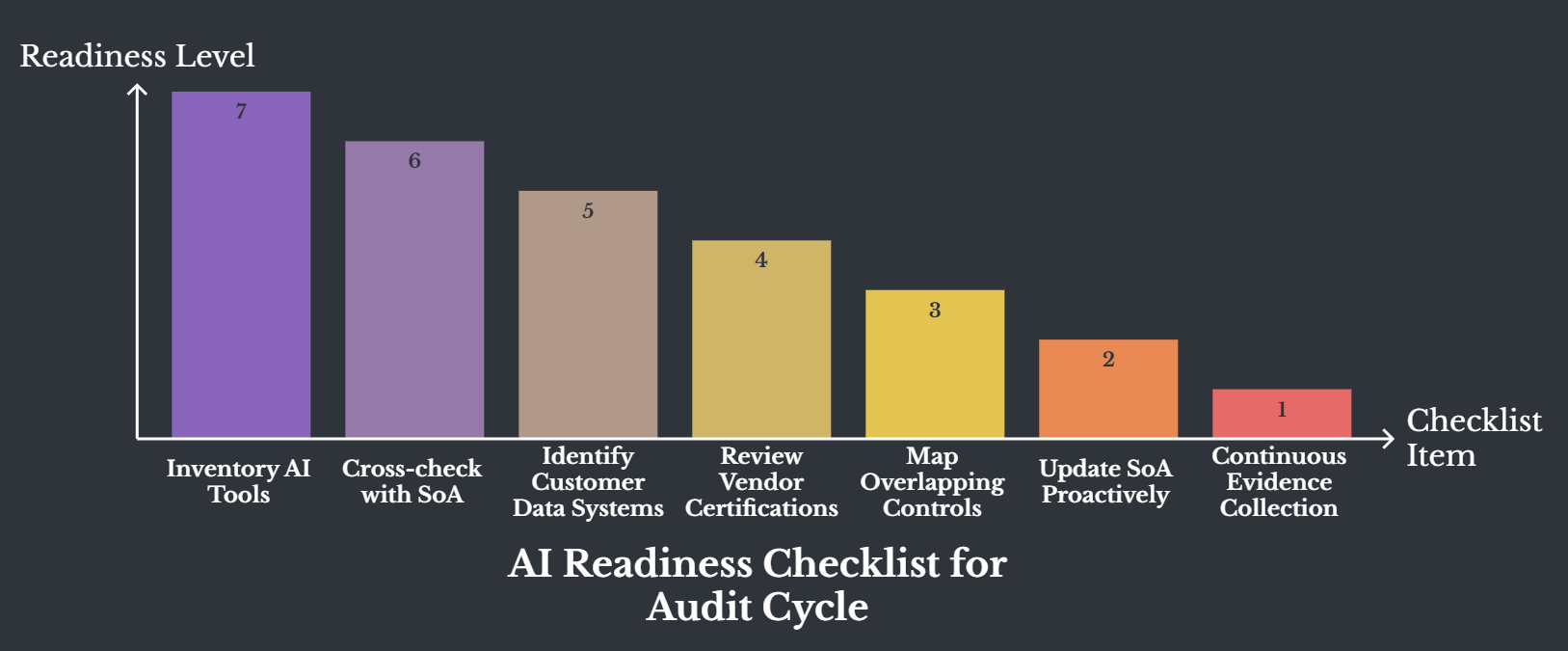
- Inventory every AI tool in use across the organization, including ones adopted informally by individual teams, shadow AI is the most common blind spot.
- Cross check that inventory against your Statement of Applicability or Trust Services Criteria scope to see what’s actually covered today.
- Identify any AI system that touches customer or personal data and confirm it has explicit access controls, logging, and monitoring in place.
- Review your AI vendor contracts for their own security certifications, and understand what their certification does and doesn’t cover for your use case.
- Map overlapping controls across SOC 2, ISO 27001, and ISO 42001 if you’re pursuing more than one, to avoid rebuilding the same evidence three times.
- Update your Statement of Applicability proactively, before an auditor or a lost enterprise deal forces the conversation.
- Move toward continuous evidence collection rather than point in time audit prep, particularly for any AI system that changes frequently.
Your SOC 2 report or ISO 27001 certificate hasn’t expired, and it isn’t fraudulent. But if it was written before AI became part of your stack, it’s very likely narrower than the business it’s supposed to represent. The gap isn’t dramatic or headline grabbing, it’s quiet, sitting in a Statement of Applicability that was never updated, or a Trust Services Criteria scope that never mentioned the chatbot your support team deployed eighteen months ago.
The organizations getting ahead of this aren’t the ones rushing to add a new certification. They’re the ones going back to the certifications they already have and asking the harder question: does this actually cover what we’re running today. That question is uncomfortable. It’s also exactly the one enterprise buyers are starting to ask on your behalf.