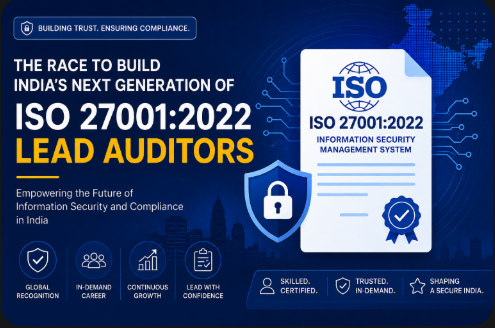
The Race to Build India’s Next Generation of ISO 27001:2022 Lead Auditors
A deep dive into why the Auditor/Lead Auditor Training Course on ISO/IEC 27001:2022 has become one of the most in demand credentials in compliance right now
There is a shift happening quietly inside compliance departments, consulting firms, and certification bodies across the country, and most people outside the industry have no idea it is underway. Organizations that spent the last decade treating information security as a defensive, background function are now placing it at the center of business strategy. Boards are asking about it. Procurement teams are demanding proof of it before signing vendor contracts. Insurers are pricing policies around it.
And every single one of these organizations, eventually, needs the same thing. A certified Information Security Management System, and someone qualified to audit it properly.
That someone is a Lead Auditor trained against ISO/IEC 27001:2022.
Here is brief on How to Implement TISAX along with ISO 27001:
A Standard That Rewrote the Rules
To understand why this training has become the hot topic it is today, you have to understand what actually happened when the International Organization for Standardization released the 2022 revision of ISO 27001.
The previous version of the standard, published in 2013, had served organizations well for nearly a decade. But the world it was written for no longer exists. Cloud infrastructure was still emerging in 2013. Threat intelligence was a niche discipline. Data masking, configuration management at scale, and information deletion protocols were not formal requirements anywhere in the standard. The 2022 revision closed those gaps, and in doing so, it changed what it means to competently audit an organization’s security posture.
Table: What Changed Between the 2013 and 2022 Versions
| Element | ISO 27001:2013 | ISO 27001:2022 |
|---|---|---|
| Annex A Controls | 114 controls | 93 controls |
| Control Structure | 14 domains | 4 unified themes |
| New Controls Added | None | 11, including threat intelligence, cloud security, data masking |
| Alignment | Standalone structure | Harmonized with Annex SL across ISO management standards |
| Audit Approach Required | Documentation verification | Evidence based effectiveness testing |
| Relevance to AI and Cloud Risk | Limited | Explicitly addressed |
That last row matters more than most people realize. Under the old standard, an auditor could largely confirm a control existed by reviewing a policy document and asking a handful of confirming questions. Under the 2022 standard, that approach simply does not hold up. Auditors are now expected to test whether controls function in practice, whether they are monitored, and whether they connect back to a documented and defensible risk assessment. That is a fundamentally different skill set, and it cannot be picked up by reading the standard cover to cover.
The Supply and Demand Problem Nobody Is Talking About
Here is the part of the story that has not gotten enough attention. Certification bodies around the world are under pressure to transition every organization still holding a 2013 certificate onto the 2022 standard before transition deadlines close. At the same time, new organizations, particularly in fintech, SaaS, healthcare technology, and AI infrastructure, are pursuing ISO 27001 certification for the first time because clients and regulators are demanding it as a baseline requirement.
Every one of those certifications requires an audit conducted by a qualified Lead Auditor. And right now, the number of professionals holding a current, 2022 aligned Lead Auditor credential is nowhere near sufficient to meet that demand.
This is the classic setup for a career window. When a standard revises significantly, there is always a period, usually twelve to twenty four months, where demand for updated auditors sharply outpaces supply. Professionals who get certified early in that window do not just gain a credential. They gain leverage, because certification bodies, consulting firms, and enterprise compliance teams are actively competing for a limited pool of qualified people.
Issue Tree: Should You Take This Course
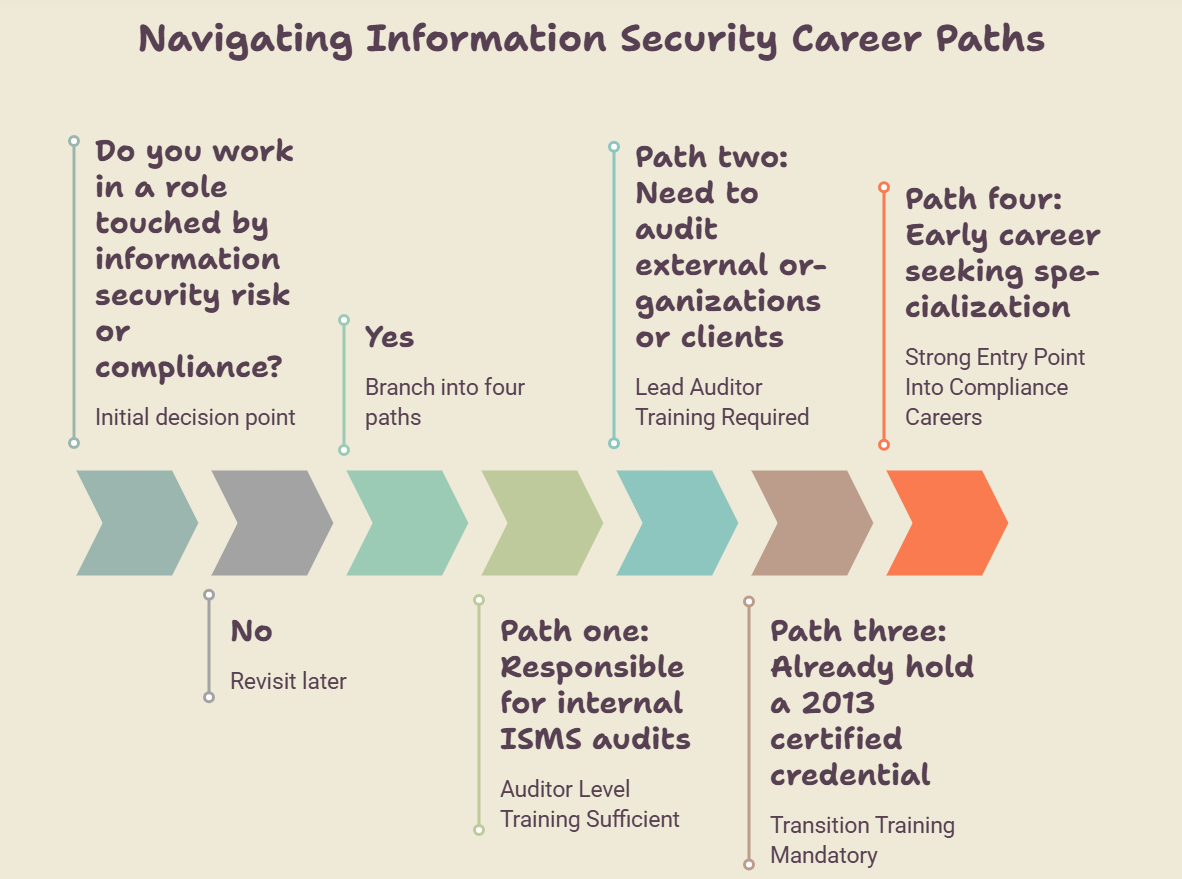
Rather than telling you generically who this course is for, here is the actual decision logic worth working through.
Do you work in a role touched by information security, risk, or compliance?
│
├── NO → This course is unlikely to be immediately relevant. Revisit if your role changes.
│
└── YES
    │
    ├── Are you responsible for auditing your own organization's ISMS internally?
    │   │
    │   ├── YES → Auditor level training is sufficient
    │   │         You will learn to conduct internal audits, gather evidence,
    │   │         and write findings that hold up to management scrutiny.
    │   │
    │   └── NO, I need to audit external organizations or clients
    │       │
    │       └── Lead Auditor level training is required
    │             This qualifies you to plan audits, lead audit teams,
    │             and take accountability for certification decisions.
    │
    ├── Are you a consultant advising organizations through ISO 27001 implementation?
    │   │
    │   └── YES → Lead Auditor certification strengthens your advisory credibility
    │             You will understand the standard from the auditor's seat,
    │             not just the implementer's seat, which changes how clients trust your advice.
    │
    ├── Do you already hold a 2013 version Auditor or Lead Auditor certificate?
    │   │
    │   └── YES → This course is effectively mandatory
    │             Certification bodies are phasing out recognition of 2013 aligned
    │             auditors. Without transition training, your existing credential
    │             loses practical relevance.
    │
    └── Are you early career and looking for a specialization with long term demand?
        │
        └── YES → This is one of the strongest entry points available right now
                  Data protection regulation is tightening globally, not loosening,
                  and every regulated organization eventually needs certified auditors.
Inside the Course: What Training Actually Looks Like
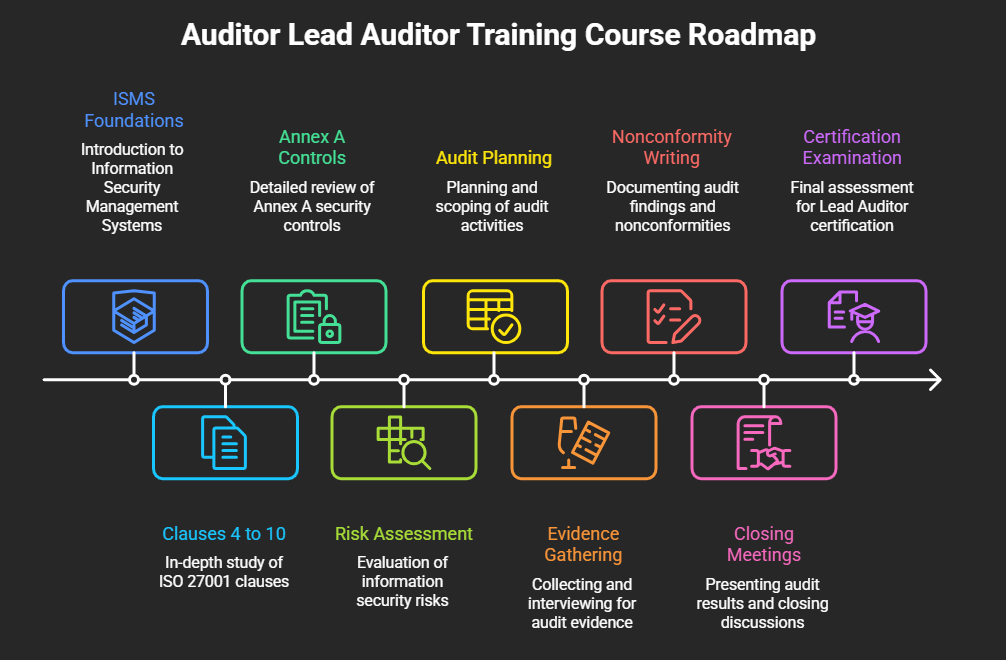
A properly designed Auditor or Lead Auditor course does not hand participants a copy of the standard and ask them to memorize clause numbers. It builds audit judgment through structured teaching combined with realistic simulation.
Table: Full Course Structure
| Module | Focus | Why It Matters |
|---|---|---|
| ISMS Foundations | PDCA cycle, risk based thinking, governance context | Establishes the mental model auditors use throughout every audit |
| Clauses 4 to 10 | Context, leadership, planning, support, operation, evaluation, improvement | These clauses form the management system backbone every certification audit assesses |
| Annex A Controls | All 93 controls across organizational, people, physical, and technological categories | Auditors must know not just what each control requires, but what genuine evidence of effectiveness looks like |
| Risk Assessment Evaluation | Assessing whether an organization’s risk methodology is rigorous or superficial | This is often where weak ISMS implementations get exposed |
| Audit Planning and Scoping | Building audit programs, defining scope boundaries, allocating time realistically | Poor planning is the most common cause of incomplete or rushed audits |
| Evidence Gathering and Interviewing | Techniques for uncovering actual practice versus rehearsed responses | The single most valuable skill separating experienced auditors from novices |
| Nonconformity Writing | Distinguishing major from minor findings, writing factual and defensible reports | Findings that cannot withstand challenge undermine the credibility of the entire audit |
| Closing Meetings | Presenting findings professionally, managing pushback, maintaining objectivity under pressure | This is where auditor composure is tested most directly |
| Certification Examination | Written assessment combining standard knowledge with applied audit scenarios | Leads to formal Auditor or Lead Auditor certification |
The distinction between Auditor and Lead Auditor certification often comes down to scope of authority. An Auditor is trained to competently execute an assigned portion of an audit as part of a team. A Lead Auditor is trained to own the entire audit, from planning through final reporting, and to take personal accountability for the audit’s conclusions. Anyone intending to lead external or third party audits needs the Lead Auditor credential specifically.
FOUNDER NOTE
┌─────────────────────────────────────────────────────────┐
A Note From Santosh Nandakumar, Founder, GCAI
“I have sat in the room for hundreds of ISO 27001 audits over the years, on both sides of the table. And if there is one thing I have learned with total certainty, it is this. The documentation an organization presents during an audit is rarely the differentiator. The competence of the auditor is.
A weak auditor checks whether a policy document exists and moves on. A strong auditor asks the one follow up question that reveals whether the control described in that policy actually functions day to day. That instinct is not something you get from reading the standard. It has to be trained, practiced, and tested under realistic conditions before someone walks into a real audit room with real consequences attached.
That is exactly the gap we built this course to close.
I would also say this to anyone weighing whether now is the right time. Every time a standard undergoes a significant revision, there is a narrow window where qualified auditors are in short supply and organizations are actively competing to find them. We are inside that window right now with ISO 27001:2022. The professionals who get certified in the next year are not just gaining a credential. They are positioning themselves at exactly the right moment in the market cycle.”
└─────────────────────────────────────────────────────────┘
The Mindset Behind Great Auditing
Ask any experienced auditor what separates a good one from a great one, and the answer rarely involves technical knowledge alone. It involves the ability to hold two things in mind simultaneously, rigorous technical understanding of the standard, and sharp human judgment about how organizations actually behave.
Technical rigor means recognizing a control gap even when the organization has produced a document that looks correct on the surface. Human judgment means knowing how to run an interview that moves past rehearsed talking points, how to read the room during a tense closing meeting, and how to write a finding that is firm without being adversarial.
The GCAI Compliance Desk frames it simply. An auditor who understands the clauses is qualified to review a document. An auditor who understands how organizations actually operate is qualified to protect them from real risk. The training is designed to produce the second kind of auditor, not the first.
There is also a distinction that gets lost in weaker training programs, the difference between conformity and effectiveness. A control can technically exist on paper and still fail to reduce actual risk if it is implemented poorly or left unmonitored. Teaching auditors to spot that gap consistently is where the real value of proper training shows up, both for the organizations being audited and for the auditor’s own professional credibility.
How GCAI Helps
GCAI is a UAF and IAF accredited certification body offering ISO 27001, SOC 2, and VAPT services, alongside training programs built around audit readiness rather than exam memorization.
The Auditor and Lead Auditor training on ISO 27001:2022 is structured around three pillars.
First, complete interpretation of every clause and control, delivered by trainers who actively conduct live audits themselves rather than instructors working purely from slides.
Second, practical audit simulation. Participants work through realistic scenarios, write actual findings, and receive direct feedback on the reasoning behind their judgment calls, not just whether they arrived at the correct answer.
Third, exam preparation thorough enough that participants walk into the certification exam with genuine confidence rather than last minute anxiety.
We built the program this way because we noticed a pattern across the industry. Too many training providers treat the certification exam as the finish line. We treat it as the starting point. The real test of whether training worked is what happens the first time a participant sits across from an organization during an actual audit, months or years later, and has to make a judgment call under real pressure with real consequences.
That is the bar we hold ourselves to, and it is why organizations and individual professionals continue choosing GCAI for ISO 27001 training and certification support.
Closing Perspective
Information security is not a passing priority for organizations. It is becoming permanent infrastructure, woven into procurement decisions, insurance underwriting, investor due diligence, and regulatory compliance across nearly every sector. ISO/IEC 27001:2022 represents a more mature, more evidence driven approach to managing that risk, and the auditors trained to assess it need to match that level of maturity.
For anyone weighing whether to pursue this certification, the timing is about as favorable as it gets. The standard is still relatively new, qualified auditors remain in short supply, and organizations across every industry are actively searching for professionals who can guide them through certification with genuine credibility.
Whether the goal is strengthening internal audit capability or stepping into a Lead Auditor role serving multiple external clients, this is a credential worth pursuing now, while the window remains wide open.