Shadow AI: The Compliance Breach Happening in Your Company Right Now, and Nobody’s Auditing For It
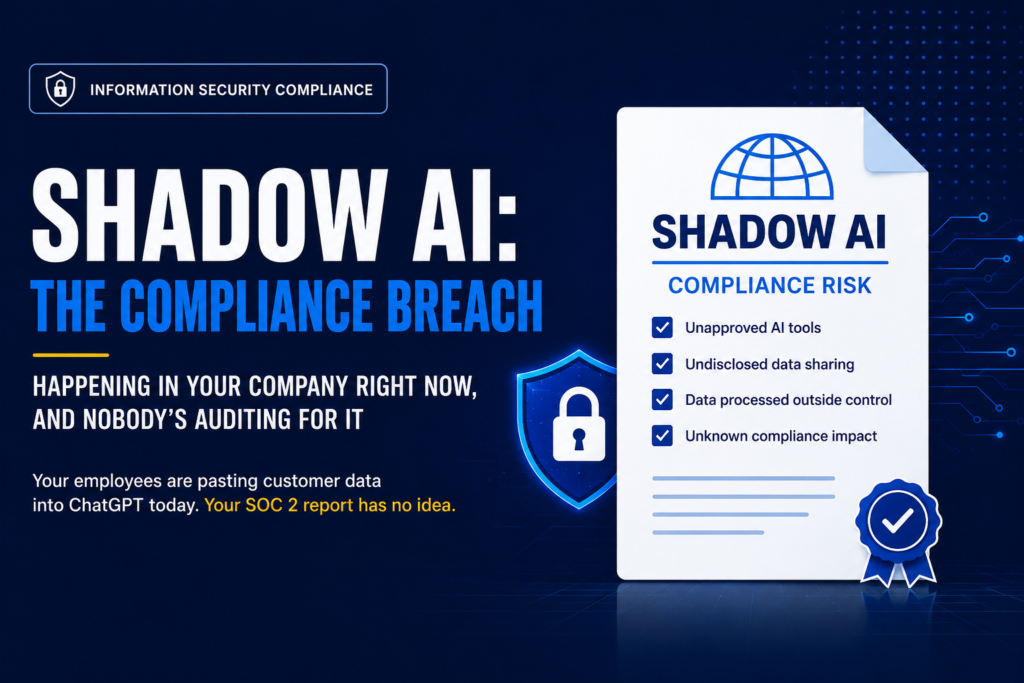
Your employees are pasting customer data into ChatGPT today. Your SOC 2 report has no idea.
Every framework in this blog series – SOC 2, ISO 27001, HIPAA, GDPR – was built around a shared assumption: that data moves through systems your organisation actually knows about, monitors, and governs. That assumption held reasonably well for years, because most compliance risk showed up in places a company could actually see – a procured application, a signed contract, a configured integration. Shadow AI breaks that assumption quietly, at scale, inside almost every company that hasn’t specifically gone looking for it.
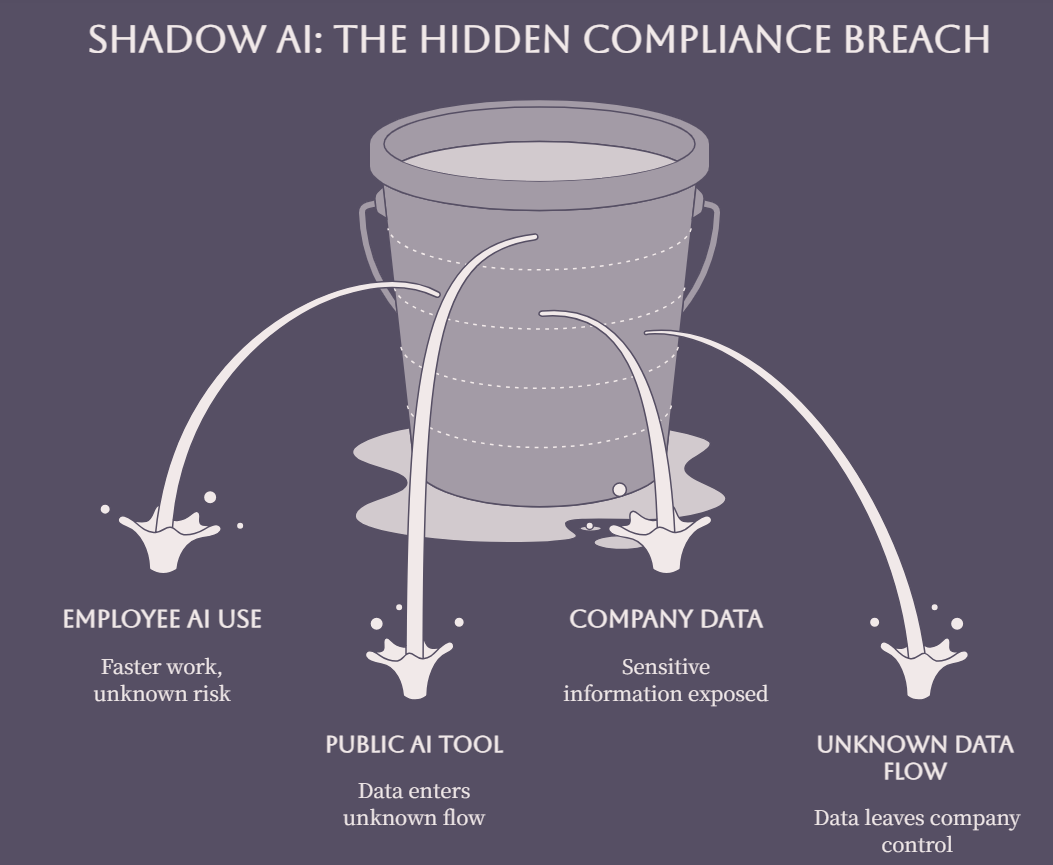
An engineer pastes a customer’s contract into ChatGPT to summarise it before a call. A support agent drops a patient’s case notes into an AI tool to draft a reply faster during a busy shift. A finance analyst uploads a spreadsheet of vendor pricing into an AI model to build a quick forecast. None of these people think they’ve done anything wrong – and in a narrow sense, they haven’t. They’re not trying to leak data, sabotage anything, or get around security on purpose. They’re trying to finish their work faster, the same way employees have always reached for whatever tool gets the job done.
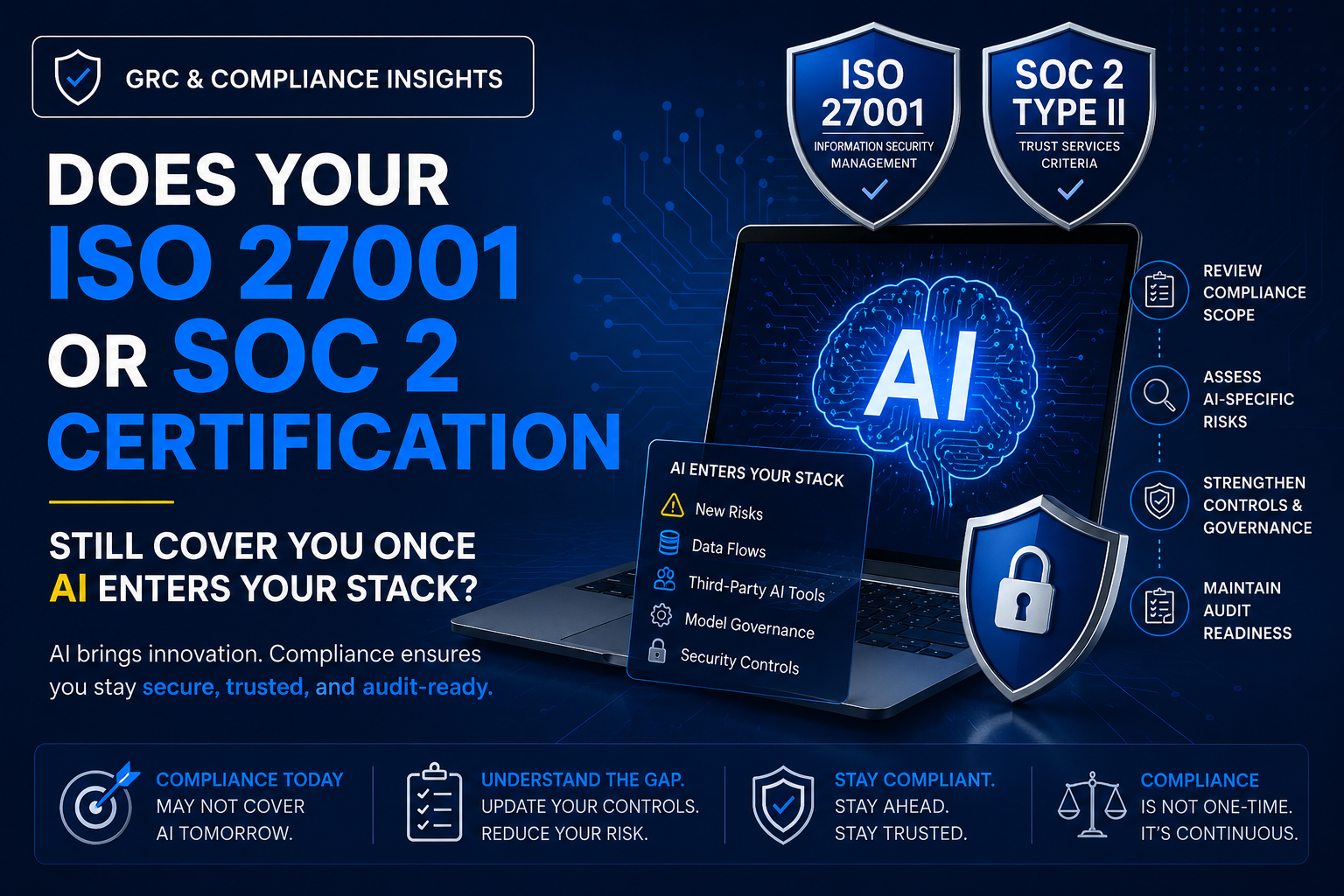
But each of these small, well-intentioned actions may have just created an undisclosed subprocessor relationship, an unauthorised international data transfer, or a Business Associate Agreement violation. And the compliance programme built specifically to catch exactly this kind of thing has no visibility into any of it, because the activity never touches a system the organisation actually monitors or audits.
“The tools moved faster than the governance did. Most companies didn’t decide to allow this – they just never decided to stop it, and by the time anyone asked, it was already the default way work got done.”
— Santosh Nandakumar, Founder, GCAI
WHY THIS ISN’T A HYPOTHETICAL RISK ANYMORE
Shadow IT – employees signing up for unapproved SaaS tools without going through procurement – has been a known compliance headache for well over a decade. Most organisations have some version of a process for catching it: reconciling billing records, checking SSO logs, running periodic access reviews. Shadow AI is the same underlying behaviour, except worse in one specific and important way – the tool doesn’t just store the data somewhere. It actively processes it, transforms it, summarises it, and generates new content from it. That processing itself is very often the exact point where a compliance obligation gets triggered, and it happens the instant the data is pasted in, not later.
| Shadow IT (the old problem) | Shadow AI (the current one) | |
|---|---|---|
| What employees do | Sign up for an unapproved SaaS tool | Paste data directly into a public AI chat interface |
| Where the data goes | A defined third-party system, at least discoverable via billing or SSO logs | Often untraceable – no procurement record, no dedicated login, sometimes no account at all |
| What triggers a compliance issue | The tool itself being unapproved | The specific data pasted in, which varies every single time, unpredictably |
| How auditors used to catch it | Reconciling procurement records against actual system usage | Same idea, but procurement records don’t capture “an employee opened a browser tab” |
That last row is where the compliance landscape is actually shifting right now. Auditors are increasingly unwilling to accept a system inventory built purely from procurement data – they’re starting to ask for it to be reconciled against identity logs, OAuth grants, and browser or endpoint discovery data, precisely because shadow AI usage never shows up in a vendor contract or an invoice. If your evidence collection still quietly assumes that “in-scope systems” means “systems we pay for,” that assumption is already out of date, and it may be costing you visibility into the single fastest-growing category of compliance risk your organisation has right now.
This isn’t a niche concern either. AI tools have become genuinely useful for everyday work – summarising documents, drafting emails, analysing spreadsheets – which is exactly why adoption has outpaced governance. The more useful a tool is, the faster it spreads informally, and the harder it becomes to track once it’s already woven into how people get their work done.
HOW SHADOW AI TRIPS EACH FRAMEWORK – SPECIFICALLY
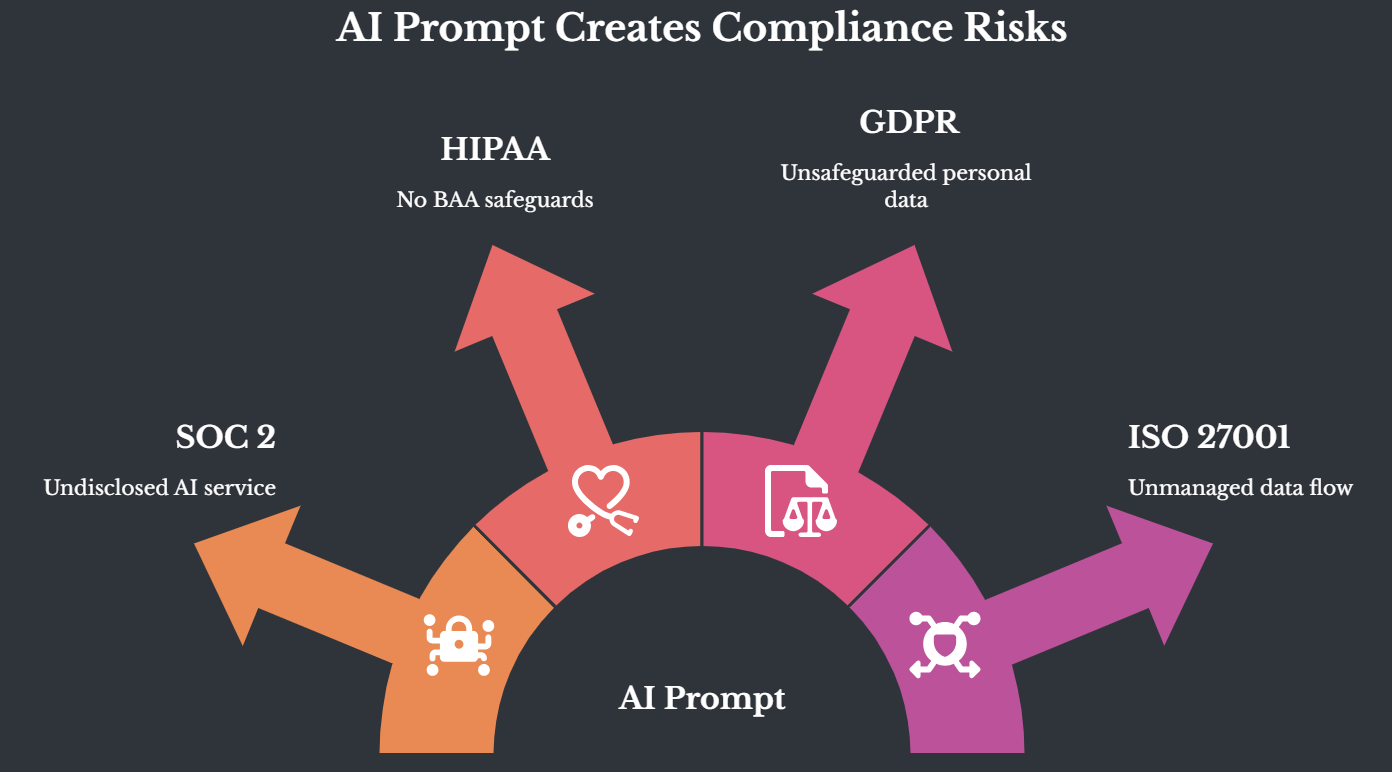
SOC 2 — A public AI tool processing customer data is functionally acting as a subprocessor your customers were never told about. That’s a direct gap against Confidentiality and Privacy trust services criteria, and beyond the technical failure, it’s an honesty problem if it surfaces mid-audit or, worse, after a customer asks a pointed question about where their data has actually been.
HIPAA — Pasting patient information into a consumer AI tool with no signed Business Associate Agreement in place is a violation the moment it happens. Not a risk, not a maybe – a completed violation, regardless of what happens to the data afterward, regardless of whether anything bad ever comes of it, and regardless of how well-intentioned the employee was.
GDPR — Most consumer AI tools process data on infrastructure outside the EU, with no assessed lawful basis for that specific use and no transfer mechanism in place to cover it. That’s an unauthorised international transfer, created by a single paste, with no Data Protection Impact Assessment ever conducted and no one on the privacy team aware it occurred.
ISO 27001 — This creates an unmanaged, unmonitored data flow to a system sitting entirely outside the ISMS boundary. It’s precisely the kind of gap a Stage 2 auditor is trained to look for once they know to specifically ask about AI tool usage during interviews and evidence review – and increasingly, they do ask.
One employee, one paste, four separate frameworks compromised in under ten seconds. That’s what makes this genuinely different from most traditional compliance risks. It doesn’t require a bad actor, a system failure, or an external attacker breaching a firewall. It requires someone trying to do their job a little faster, on an ordinary Tuesday, without giving it a second thought.
WHY POLICY ALONE DOESN’T FIX THIS
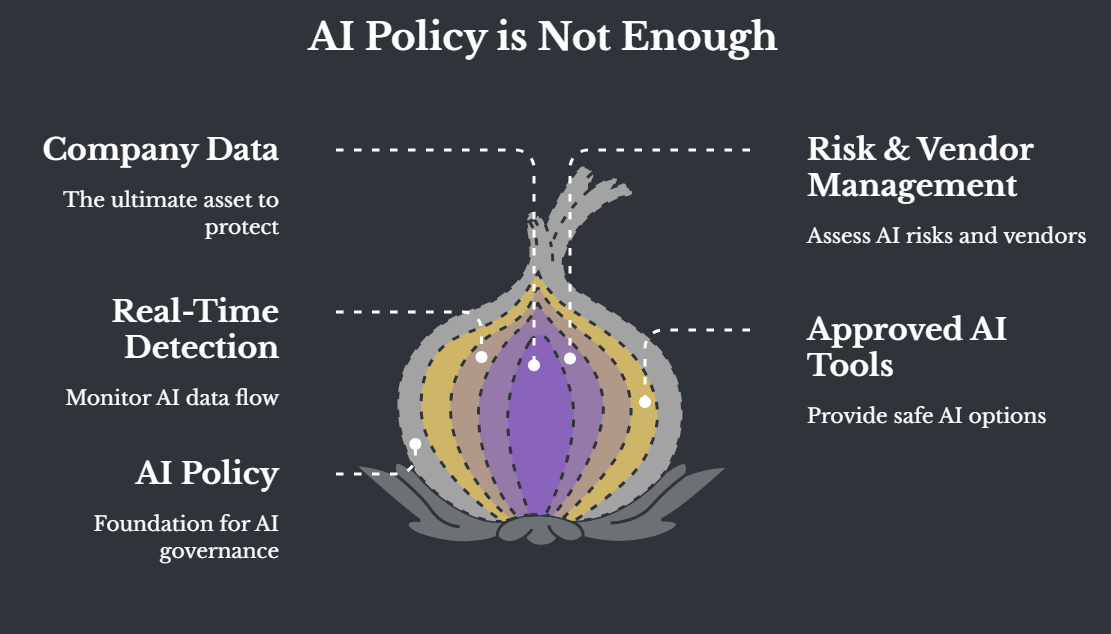
The instinctive first response to Shadow AI is almost always a written policy: “employees may not paste sensitive or confidential data into public AI tools.” That policy is necessary – no organisation should skip it – but it’s nowhere near sufficient on its own, and treating it as the complete solution is itself one of the more common compliance mistakes companies make when this issue first comes up.
A policy document doesn’t stop someone at 4pm on a Friday who just wants a ticket closed before the weekend. If the sanctioned way of doing a task isn’t at least as fast and convenient as the unsanctioned one, the policy loses every single time – quietly, without anyone consciously deciding to break a rule on purpose. People don’t experience this as non-compliance. They experience it as getting their work done the way everyone around them already does it.
The organisations that are actually managing this risk well are doing three things a policy alone doesn’t cover:
First, they provide an approved, contractually-governed AI tool, so there’s a legitimate fast option sitting right next to the unsanctioned one – meaning employees don’t have to choose between compliance and speed.
Second, they deploy detection at the browser, endpoint, or network layer that flags sensitive data leaving through unapproved AI interfaces in real time, rather than discovering it weeks later during an audit or, worse, after a customer or regulator raises it first.
Third, they treat AI tool usage as a first-class item in the risk assessment and vendor inventory from the outset, rather than as an afterthought that gets bolted on only once someone in leadership notices the problem exists.
None of these three things is complicated on its own. What’s hard is that most organisations only do one of them, if any, and assume the policy alone was the finish line rather than the starting point.
COMMON MISCONCEPTIONS WORTH KILLING
“We banned ChatGPT, so we’re covered.” Banning one tool doesn’t stop the underlying behaviour – it simply shifts it to whichever tool isn’t blocked yet, or to a personal device that network monitoring can’t see at all. The tool was never the actual problem. The ungoverned movement of data was.
“Our AI policy has been signed by everyone, so we’ve done our part.” A signed policy proves awareness, not prevention. Auditors increasingly want evidence of technical controls actually operating – logs, detection, enforcement – not just documentation showing that intent was communicated once, in an onboarding packet nobody remembers.
“This is an IT problem, not a compliance one.” It becomes squarely a compliance problem the moment regulated, confidential, or contractually protected data is involved. IT and security can help detect and technically prevent it, but the specific framework obligations it breaches – SOC 2 criteria, HIPAA rules, GDPR articles, ISO controls – are compliance’s to own and answer for.
“Enterprise AI tools with a paid subscription are automatically safe.” Only if a proper data processing agreement or BAA is actually in place, and the tool’s data retention and training settings are configured correctly for your use case. A paid plan by itself doesn’t create a compliant one — it just creates an invoice.
WHAT ORGANISATIONS SHOULD DO ABOUT SHADOW AI
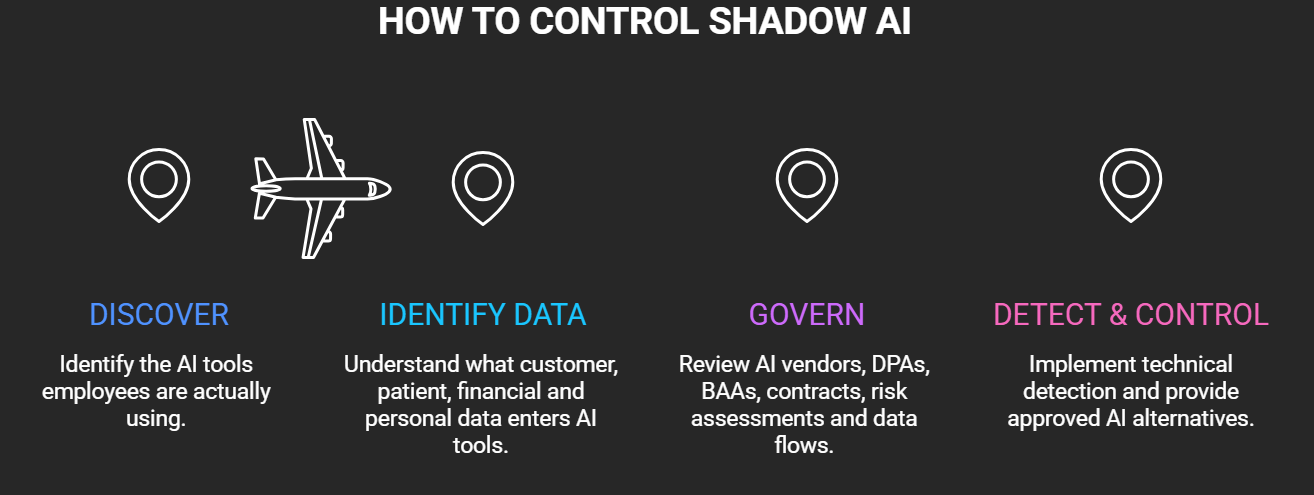
A practical Shadow AI programme starts with honest visibility, not assumptions. Worth asking, plainly:
- What AI tools are employees actually using, across any device, sanctioned or not?
- What kind of data – customer, patient, financial, or personal — is realistically being entered into those tools day to day?
- Which AI vendors now effectively have access to organisational or customer information, whether or not they were ever formally onboarded?
- Are those vendors included anywhere in your existing supplier and risk management process?
- Are AI-related data flows documented in your data flow diagrams and risk register at all?
- Do your existing DPAs, BAAs, and customer commitments still hold up given this new, messier reality?
- Can you actually detect unauthorised AI usage today, or would you only find out about it by accident, or after something has already gone wrong?
- Do employees have a genuine, practical, approved alternative — or just a rule telling them what not to do, with nothing offered in its place?
The honest answers to these questions give a far more accurate picture of your organisation’s real AI compliance exposure than an acceptable-use policy sitting quietly unread in an employee handbook.
KNOW SHADOW AI RISKS IN YOUR COMPANY IN THE BELOW VIDEO:
KEY TAKEAWAYS
- Shadow AI isn’t a future risk – it’s very likely already happening inside your organisation today, and it can touch SOC 2, HIPAA, GDPR, and ISO 27001 simultaneously through a single action.
- The compliance gap isn’t really the AI tool itself — it’s that traditional inventory and evidence-collection processes were never built to catch data leaving through a browser tab instead of a procured, contracted system.
- A policy alone won’t solve this. It needs to be paired with a genuine approved alternative, real-time technical detection, and formal inclusion in your risk assessment and vendor inventory.
- If your organisation’s last risk assessment doesn’t explicitly name AI tool usage as a scenario, it’s very likely already out of date, whether or not anyone has noticed yet.
BOTTOM LINE
Shadow AI isn’t simply an IT governance issue. It’s a security issue, a privacy issue, a regulatory issue, a contractual issue, and a compliance issue, all stacked on top of each other in a single employee action.
The organisations that manage this well won’t necessarily be the ones that try to ban AI outright — that approach rarely survives contact with how people actually work. They’ll be the ones that know where AI is genuinely being used, what data is going into it, which vendors are quietly involved, what the real exposure looks like, and which of their controls are actually operating versus which ones simply look good written down on paper.
Because the biggest Shadow AI risk was never really an employee using AI to get their work done a little faster. It’s an organisation that has no idea it’s happening at all.
For a closer look at how this plays out in real evidence-collection cycles, watch our breakdown on GCAI’s YouTube channel, where we walk through what an actual SOC 2 auditor now asks for when reconciling system inventory against identity and discovery data.
Related Reading
- What Is SOC 2? – SOC 2 Compliance: The Complete Guide to SOC 2 Certification, Audit Process & Requirements (2026) – Cyber Security Certification Body for ISO 27001 Compliance
- HIPAA Business Associate vs Covered Entity: What’s the Difference? – HIPAA Business Associate vs Covered Entity: What’s the Difference? – Cyber Security Certification Body for ISO 27001 Compliance
- Legitimate Interest vs Consent Under GDPR – Legitimate Interest vs Consent: GDPR Lawful Basis Guide (2026) – Cyber Security Certification Body for ISO 27001 Compliance
- ISO 27001 Risk Assessment: The One Decision That Determines Everything Else – ISO 27001 Risk Assessment: The One Decision That Determines Your ISMS Success – Cyber Security Certification Body for ISO 27001 Compliance
How GCAI Helps
GCAI builds AI-usage scenarios directly into your risk assessment, helps select and contractually govern an approved AI tool so employees have a fast, sanctioned option available to them, and reconciles your system inventory against actual identity and discovery data – not just procurement records – so shadow AI shows up in your evidence, not in your next incident.