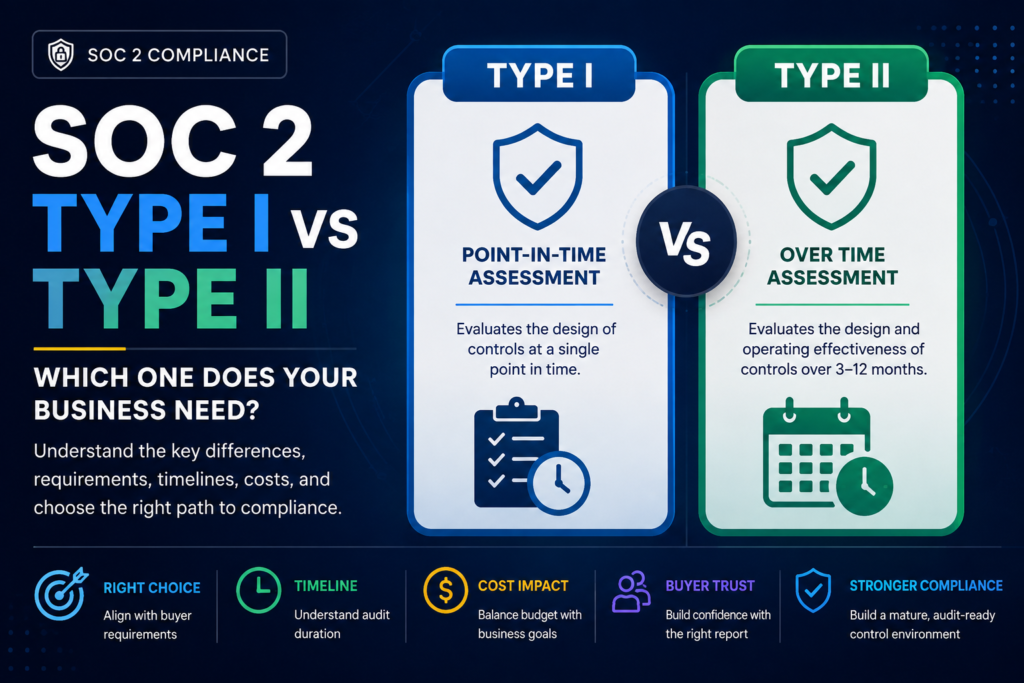
SOC 2 Type I vs Type II: Which One Does Your Business Need?
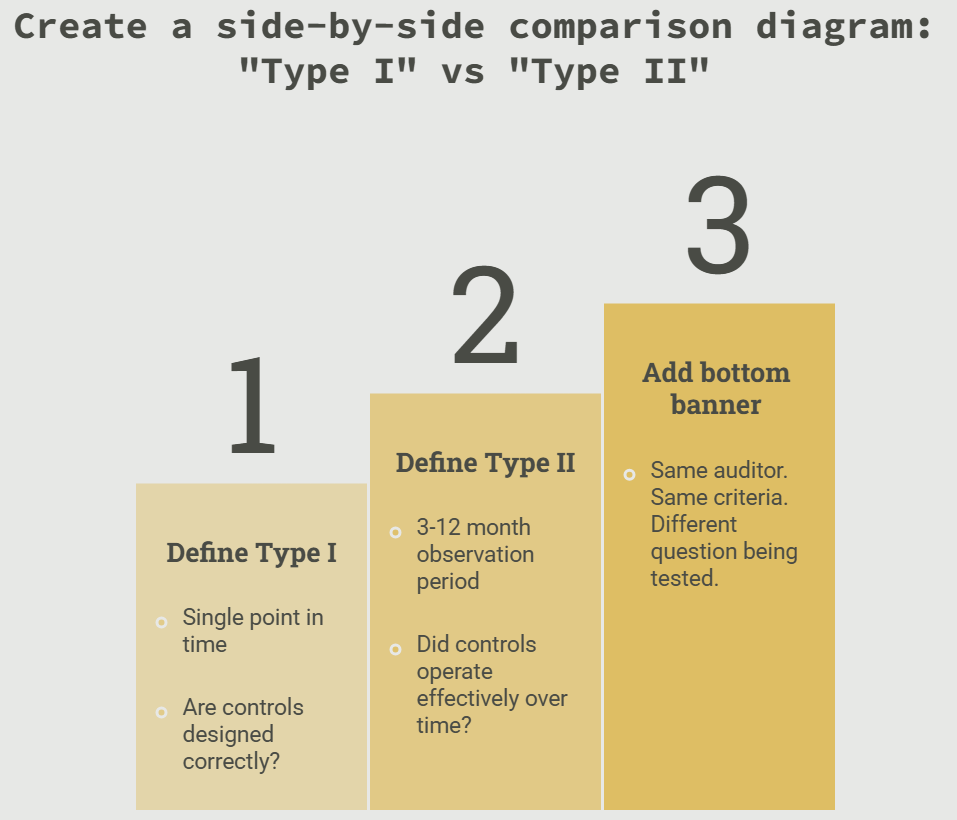
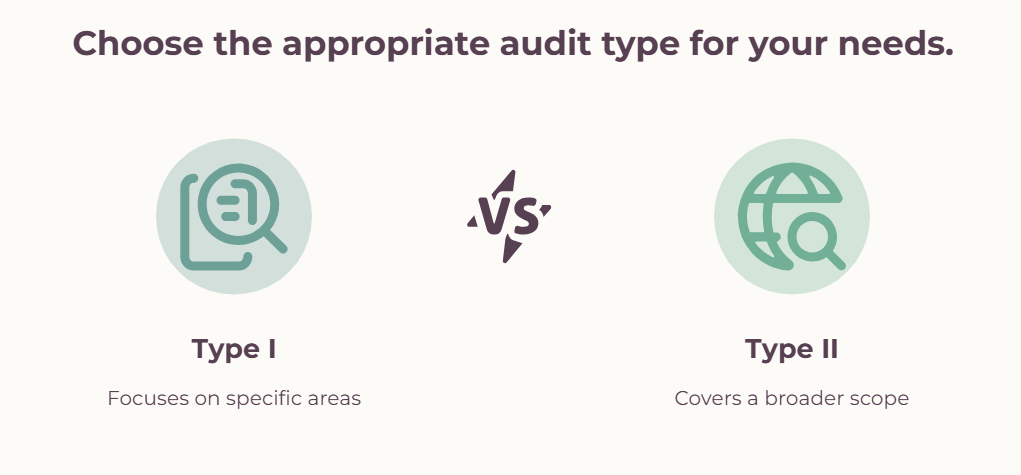
Same criteria, same auditor — the question is what stage your control environment can actually survive.
Most explanations frame this as “Type I is faster, Type II is more thorough” and stop there. That’s the wrong axis. The real decision runs on several variables at once: what your buyer’s procurement policy actually requires, whether your control environment can survive being watched for months without drifting, what it costs you in both directions, and how the choice compounds at renewal time. Get any of these wrong and you either burn a year building a report nobody asked for, or hand a buyer a Type I their own security policy won’t accept.
STEP BY STEP APPROACH TO COMPLY BY SOC 2: CLICK THE YOUTUBE LINK BELOW TO WATCH THE FULL VIDEO
WHAT EACH REPORT ACTUALLY PROVES
| Type I | Type II | |
|---|---|---|
| Question answered | Are controls designed correctly? | Did controls operate effectively over time? |
| Evidence checked | Policies and configurations, once | Logs, tickets, and records sampled across the whole window |
| Timeframe | A single point in time | 3–12 month observation period |
| Typical duration | 5 weeks to 2 months | 6 to 15 months for a first report |
| Auditor’s opinion covers | Design suitability only | Design suitability and operating effectiveness |
| What it can’t tell a buyer | Whether controls held up in practice, under no special scrutiny | — |
| Best for | Unblocking an urgent deal, fast | Enterprise procurement, renewals, mature buyers |
A Type I can pass cleanly and a Type II can still fail — because Type II isn’t re-checking that the controls are good, it’s checking whether the organisation actually does the thing it says it does, every month, with nobody watching more closely than usual. That distinction is where most of the real decision-making below actually lives.
WHO PERFORMS THE AUDIT — AND WHY IT’S THE SAME EITHER WAY
Both Type I and Type II must be performed by a licensed CPA firm — the audit firm doesn’t change based on report type, only the engagement length and evidence-sampling approach do. This matters for one practical reason: many organisations mistakenly think a Type I is a “lighter” audit performed by a less rigorous party. It isn’t. The rigor of the auditor’s methodology is the same; what changes is how much operating history there is to test against.
THE REAL DECIDING FACTOR: YOUR BUYER’S POLICY, NOT YOUR PREFERENCE
This gets framed everywhere as a company’s own choice. It usually isn’t — it’s downstream of who’s buying, and how mature their vendor risk process is.
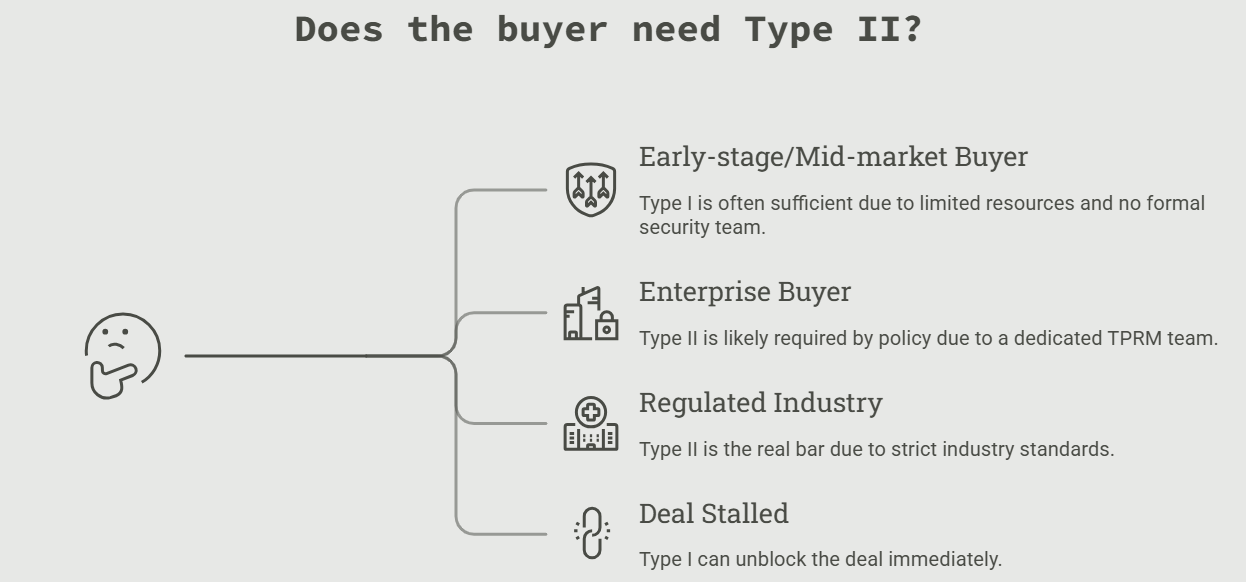
DOES YOUR BUYER ACTUALLY NEED TYPE II? → Early-stage or mid-market buyer, no formal vendor security team? A Type I is often genuinely enough for the next 12–18 months of deals. → Enterprise buyer with a named security/TPRM (third-party risk management) team? Assume a written policy requiring Type II exists — sometimes with an explicit minimum window length (commonly 6 or 12 months). → Regulated industry (finance, healthcare, government-adjacent)? Type II is the real bar. Type I is a bridge, not a destination — plan for it from the start. → Deal actively stalled at security review this quarter? That urgency alone can justify starting with Type I regardless of the long-term plan. → You don’t actually know what your buyer’s policy requires? Ask directly — sophisticated buyers will state their minimum bar without hesitation, and guessing wrong costs more than asking.
TWO SEQUENCING PATHS — AND WHY THE WRONG ONE COSTS MORE THAN THE AUDIT FEE
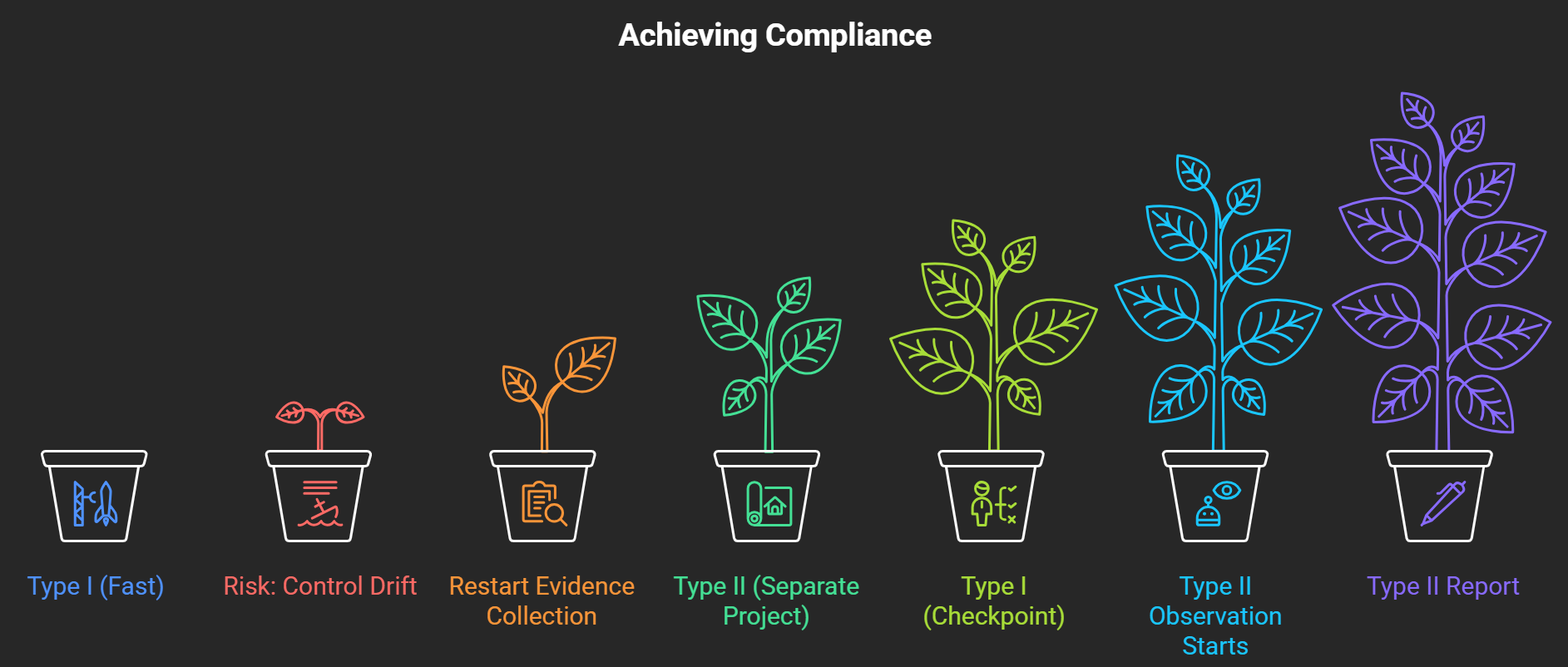
| Path A: Type I, then separate Type II later | Path B: Type I as a checkpoint, straight into Type II | |
|---|---|---|
| What happens | Get Type I fast, unblock the deal, restart evidence collection later for a fresh Type II project | Type I confirms design is sound, Type II observation starts immediately after — sometimes the same week |
| Best when | You need something now and aren’t ready to sustain evidence collection continuously yet | You have the resourcing to run controls consistently from day one |
| Real risk | Control environment drifts in the gap between projects — an access review process changes, a control owner leaves, a new tool gets added without the control being updated | None — continuity is built in, no gap for drift to happen in |
| Hidden cost | Not the audit fee itself — it’s treating compliance as a one-time event instead of an ongoing operating habit | Requires upfront resourcing commitment before deal pressure forces it |
| Total time to Type II | Often longer overall, since evidence-collection setup effectively happens twice | Faster overall, because nothing is rebuilt from zero |
The part worth sitting with: teams that rush a Type I to close a deal, then let evidence collection lapse until they “start the Type II project” later, routinely discover their control environment has quietly drifted in the interim. Nobody planned for the drift — it happens by default, because nothing was actively maintaining the discipline once the audit pressure that produced the Type I disappeared.
OBSERVATION WINDOW LENGTH IS A LEVER, NOT A FIXED RULE
| Window length | Speed to report | How sophisticated buyers read it | Strategic use |
|---|---|---|---|
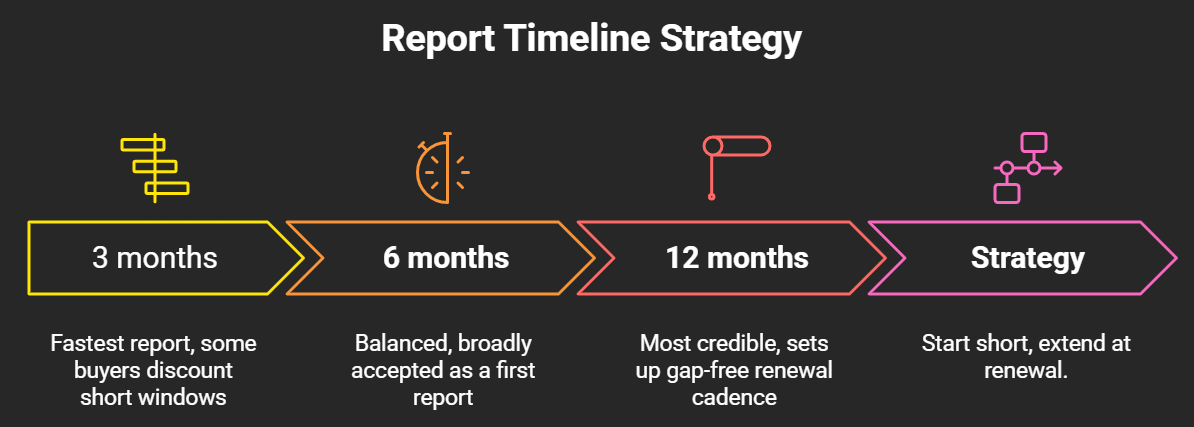
| 3 months | Fastest path to a Type II | Some mature TPRM programs explicitly discount very short windows — less operating history demonstrated | Good for a first Type II under deal pressure, not a long-term default |
| 6 months | Balanced | Broadly accepted by most enterprise buyers as a credible first report | Common choice for a first-time Type II |
| 9–12 months | Slowest first report | Reads as most credible to sophisticated buyers; some questionnaires score window length explicitly | Sets up a rolling 12-month renewal cadence with no coverage gap |
A common and underused move: start with a shorter first window deliberately — just to get any Type II report in front of buyers who require one — then extend toward 12 months on subsequent renewals, once you’re no longer racing a specific deal. Treating window length as a one-time, unchangeable decision (rather than something optimized differently the first time vs. every renewal after) is a frequent source of either unnecessary delay or an unnecessarily thin first report.
Why the coverage-gap detail matters: once you’re on a 12-month renewal cadence, the goal is for each new report’s observation period to start right where the last one’s ended. A gap between “last report expired” and “next report issued” — even a few weeks — reads as a red flag in a renewal-stage security review, even when nothing was actually wrong operationally. Buyers can’t tell the difference between “briefly between audits” and “something went wrong and they paused.”
WHAT ACTUALLY BREAKS A TYPE II THAT A TYPE I WOULD NEVER CATCH
TYPE II FAILURE PATTERNS → Control ownership gap — the owner leaves or changes roles mid-window, and nobody formally reassigns the control. A Type I would never catch this; it only checks the environment as of one audit date. → Manual evidence collection — evidence that depends on someone remembering to screenshot or export something monthly degrades within a few months, especially once the “we’re about to get audited” urgency of the Type I fades. Controls that generate evidence automatically as a byproduct of the tool itself (system-generated access-review exports, audit logs) survive Type II far better than controls needing a human to manually produce evidence on a recurring basis. → Scope creep — a new production system or vendor is added mid-window without anyone updating which controls apply to it. By the time the auditor samples evidence, there’s a system that should have had controls from month one but only got them from month seven. → Policy-practice drift — the documented policy stays the same on paper while the actual day-to-day process quietly changes (a new tool, a process shortcut under deadline pressure), so evidence stops matching the stated control.
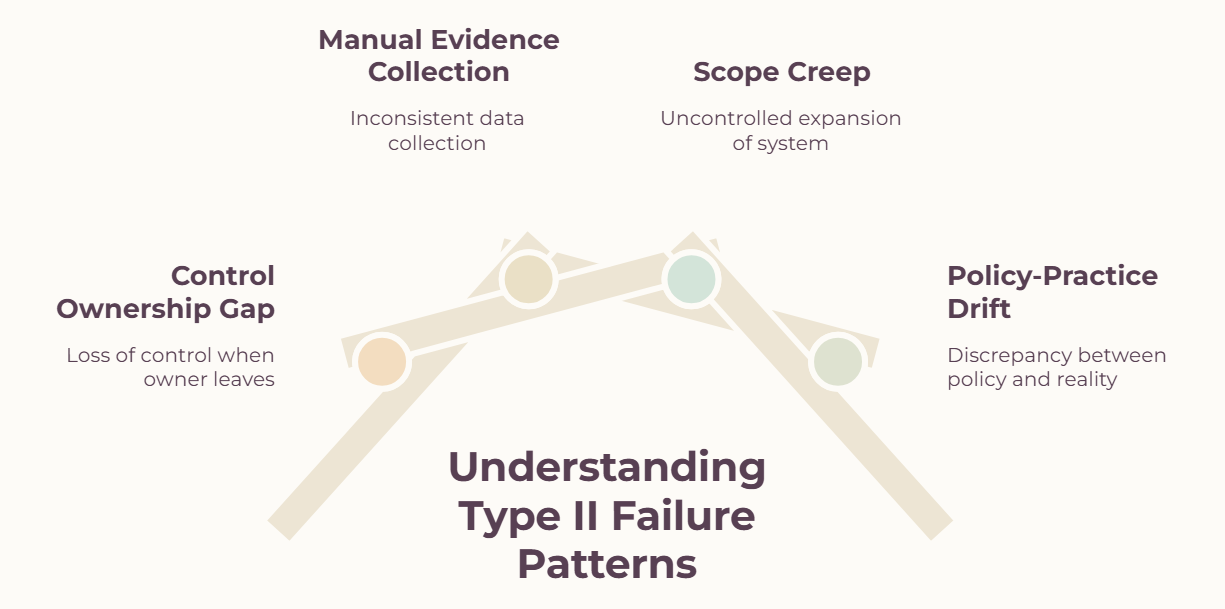
None of these are edge cases — they’re the default failure pattern for organisations that treat a Type I as “we’re compliant now” rather than “we’ve proven the design is sound; now we have to prove we can actually run it, unsupervised, for months.”
COST AND EFFORT — WHAT ACTUALLY DIFFERS
| Type I | Type II | |
|---|---|---|
| Audit fee | Lower — shorter engagement, single point-in-time testing | Higher — longer engagement, evidence sampled across the full window |
| Internal effort during the audit | Concentrated in a short pre-audit sprint | Spread continuously across the entire observation period |
| Ongoing operational cost | Minimal after the report is issued | Real — someone has to actually run and evidence the controls every month, not just at audit time |
| Tooling dependency | Lower — manual evidence collection is more survivable for a one-time check | Higher — automated evidence collection materially reduces both effort and failure risk |
The real cost difference isn’t the invoice from the audit firm — it’s that Type II requires the organisation to actually operate differently, continuously, for the length of the window, which is a cultural and process cost far larger than the fee difference between the two report types.
COMMON MISCONCEPTIONS WORTH KILLING
MISCONCEPTIONS → “A Type I is basically a Type II, just faster.” No — it tests a fundamentally different thing (design vs. operation), not a shorter version of the same test. → “Once we pass Type I, Type II is basically guaranteed.” No — a well-designed control that isn’t consistently followed will fail Type II regardless of how clean the Type I looked. → “We can go straight for a 12-month Type II window as our very first report.” Technically possible, but it means no report exists for 12+ months while it’s building, which can stall deals that need something sooner. → “Type II replaces the need for a Type I entirely.” Not procedurally — most auditors still assess design as part of the Type II engagement; the distinction is about what gets reported, not whether design gets checked at all.
THE HONEST FRAMEWORK — QUESTIONS, NOT A COIN FLIP
- What does my highest-value active or near-term buyer’s security review process actually require — not what’s nice to have, what’s written into their policy?
- Can my control environment survive being watched for 3–12 months without drifting, or is it currently held together by pre-audit urgency rather than built-in operating discipline?
- Is there a deal-specific deadline forcing a decision right now, or is this a proactive investment with more room to sequence correctly?
- Is my evidence collection automated enough to survive months of unsupervised operation, or does it depend on someone remembering to do something manually?
- Where do I want to be at renewal — starting a fresh window each time, or on a continuous 12-month cadence with no coverage gaps?
SOC 2 BY THE NUMBERS Type I typical duration: 5 weeks – 2 months Type II observation window: 3–12 months First Type II report, end to end: 6–15 months Both report types: audited by a licensed CPA firm — no difference in auditor rigor Most common cause of Type II failure: control ownership gaps and manual evidence collection, not control design
Related reading: What Is SOC 2? · The SOC 2 Audit Process · SOC 2 vs ISO 27001 How GCAI helps: GCAI scopes the Type I vs Type II decision against your actual buyer pipeline and current control maturity, sets observation window length strategically rather than by default, and builds evidence collection into your existing tools from day one — so a Type II window doesn’t quietly fail on ownership gaps or manual evidence that stops happening once the initial audit pressure fades.