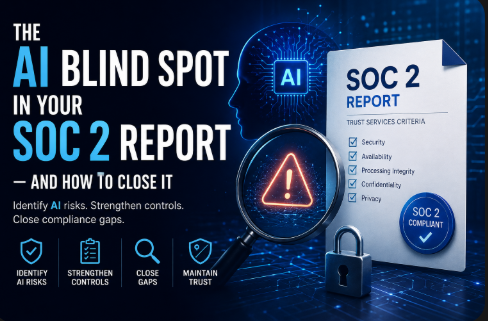
The AI Blind Spot in Your SOC 2 Report, And How to Close It
I read a lot of SOC 2 reports for a living. Somewhere in year three of doing that, I started noticing the same thing over and over: reports that were technically flawless, every control tested, every exception explained, every auditor’s opinion clean, and not a single meaningful mention of the AI tools the company was actually running day to day.
Not because anyone was hiding anything. Because nobody thought to ask.
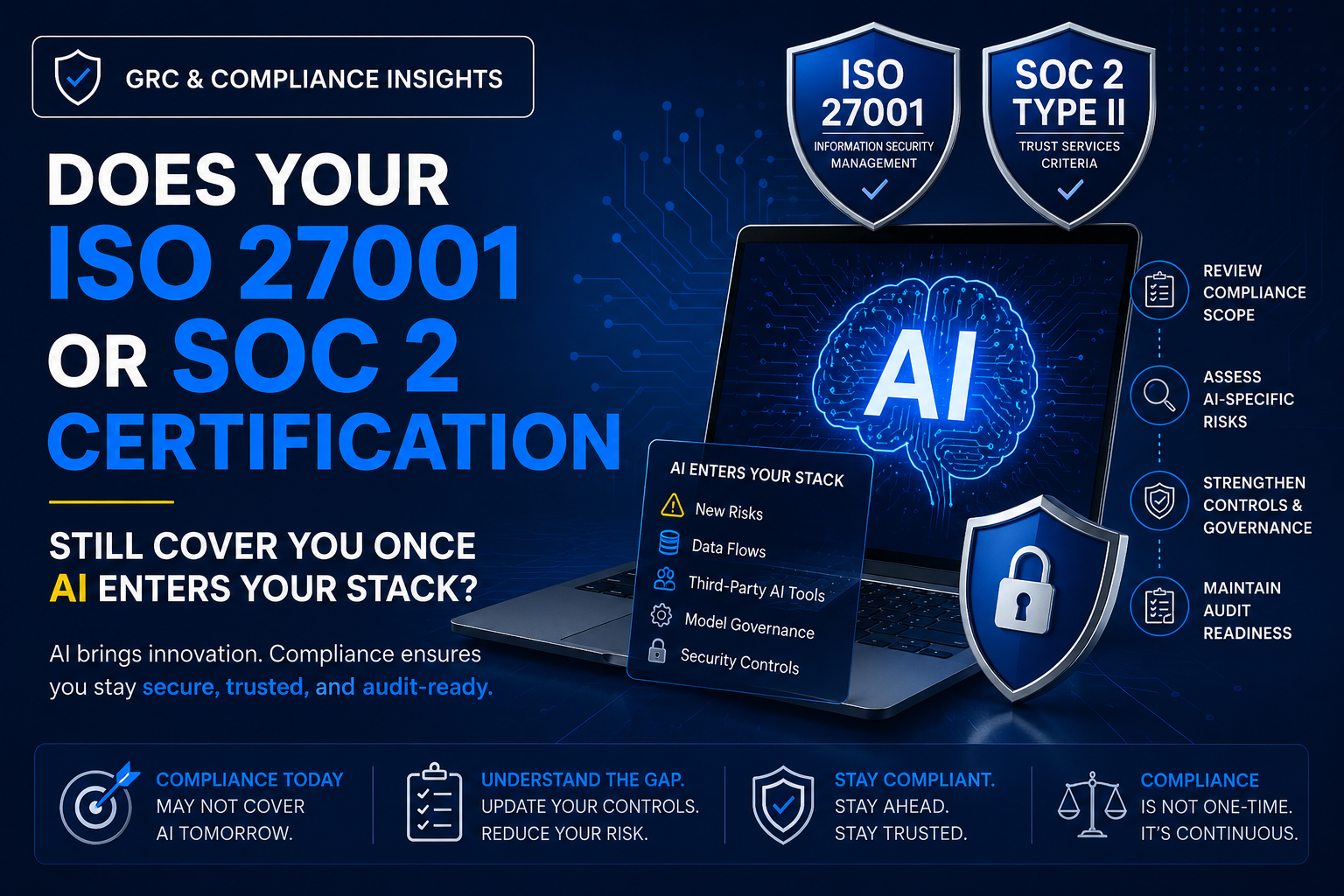
That’s the blind spot. It’s not fraud, it’s not negligence in the traditional sense, it’s a framework built for a pre AI world quietly failing to catch up with how companies actually operate now. And the gap is wide enough that enterprise buyers, the same ones who used to accept a SOC 2 report as the final word, are starting to ask follow up questions that the report itself was never built to answer.
If you’re the one fielding those follow ups right now, this is for you.
SOC & ITGC Simplified:
GCAI’s compliance desk put it bluntly: “A SOC 2 report is a snapshot of controls someone tested. If nobody tested the AI part, the report is accurate and incomplete at the same time. That’s the blind spot in one sentence.”
Why SOC 2 Has a Blind Spot at All
SOC 2 was built by the AICPA to answer a specific question, can this service organization be trusted with customer data, examined against five Trust Services Criteria: security, availability, processing integrity, confidentiality, and privacy. It’s a rigorous framework. It’s also, by design, scoped to whatever the organization and the auditor agree to examine.
That’s the mechanism behind the blind spot. SOC 2 doesn’t fail to cover AI because it’s outdated in some sweeping sense, it fails to cover AI because nobody explicitly put AI in scope. And for most companies, that’s exactly what happened, quietly, without a decision ever being made.
Here’s the timeline that got us here. Two years ago, AI adoption inside most companies was scattered, a few teams experimenting, nothing load bearing. Then generative AI tools became genuinely useful fast, customer support copilots, internal knowledge assistants, AI powered analytics, and adoption outpaced governance by a wide margin. The SOC 2 audit cycle, typically annual, simply couldn’t keep pace with how quickly AI went from experiment to infrastructure.
The result: a huge number of currently valid SOC 2 reports describe a company that existed twelve months ago, not the one operating today.
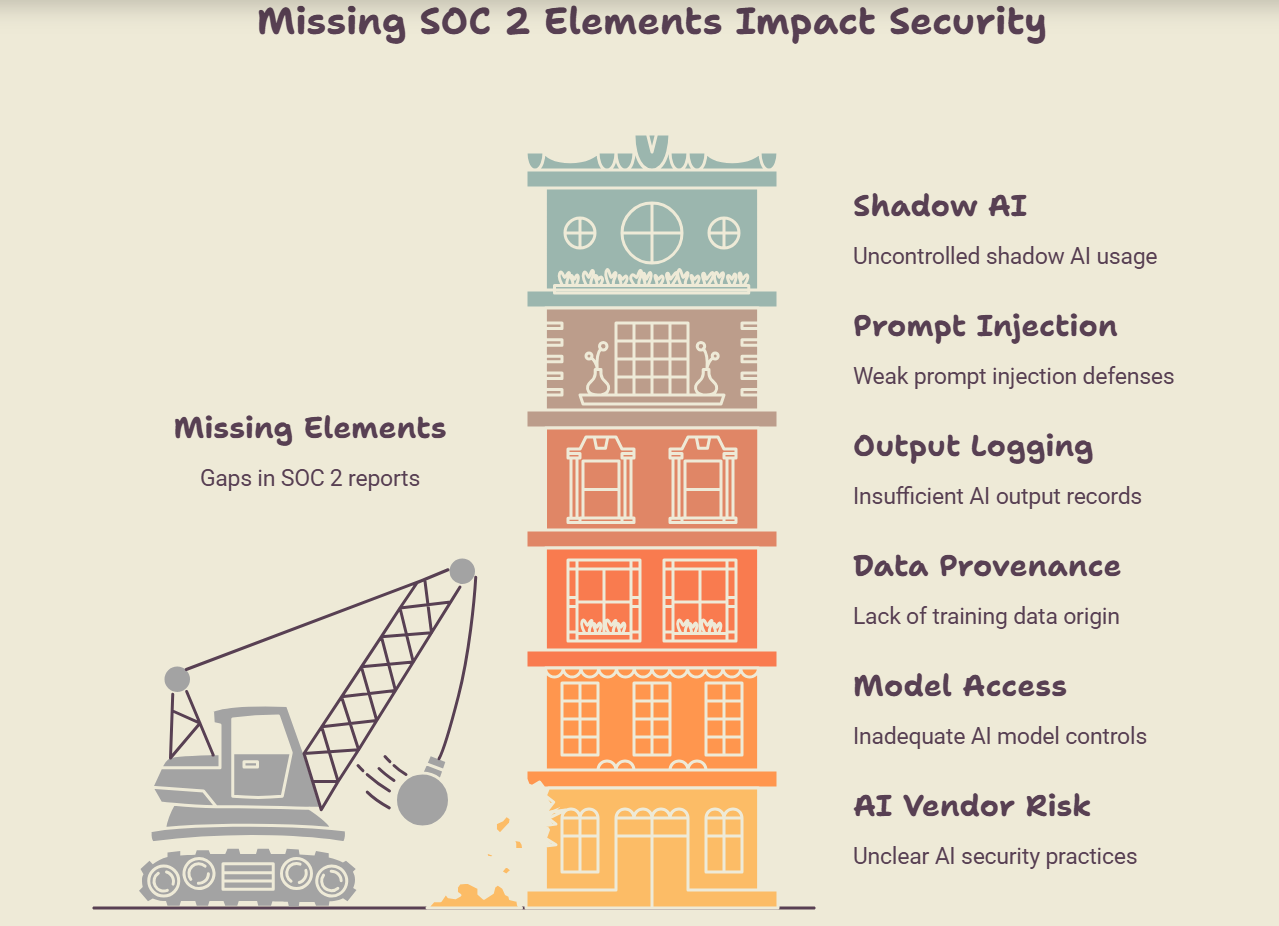
What’s Actually Missing From Most SOC 2 Reports Right Now
This is the part worth sitting with, because it’s more specific than “AI isn’t covered.” Here’s exactly what tends to fall outside a standard SOC 2 examination.
| Gap Area | Why It’s Missing | Why It Matters |
|---|---|---|
| AI vendor risk | Third party AI tools are often adopted outside formal procurement, so they never enter vendor risk assessments | If a vendor’s AI has a security failure, that risk now sits inside your environment, unreviewed |
| Model access controls | SOC 2 access control testing typically covers systems and data stores, not who can query, fine tune, or retrain a model | Unrestricted model access is a direct path to data exposure or manipulation |
| Training data provenance | Not a standard SOC 2 test area at all | If training data included data it shouldn’t have, that’s a liability sitting outside your audit’s visibility |
| AI output logging and monitoring | Traditional logging covers system events, not necessarily what an AI model generated or acted on | Without this, you can’t reconstruct what an AI system did if something goes wrong |
| Prompt injection and manipulation defenses | An entirely new risk category that didn’t exist when SOC 2’s testing procedures were written | Attackers are actively probing AI systems this way, and most SOC 2 scopes were never asked to defend against it |
| Shadow AI usage | Employees adopting AI tools informally, without security review | Creates data flows and dependencies that exist entirely outside the audited environment |
None of these are hypothetical. They’re the exact questions increasingly showing up in enterprise vendor security reviews, questions that arrive after the SOC 2 report has already been handed over, because the buyer’s security team knows the report alone doesn’t answer them.
The Issue Tree: Tracing the Blind Spot Through Your Own Report
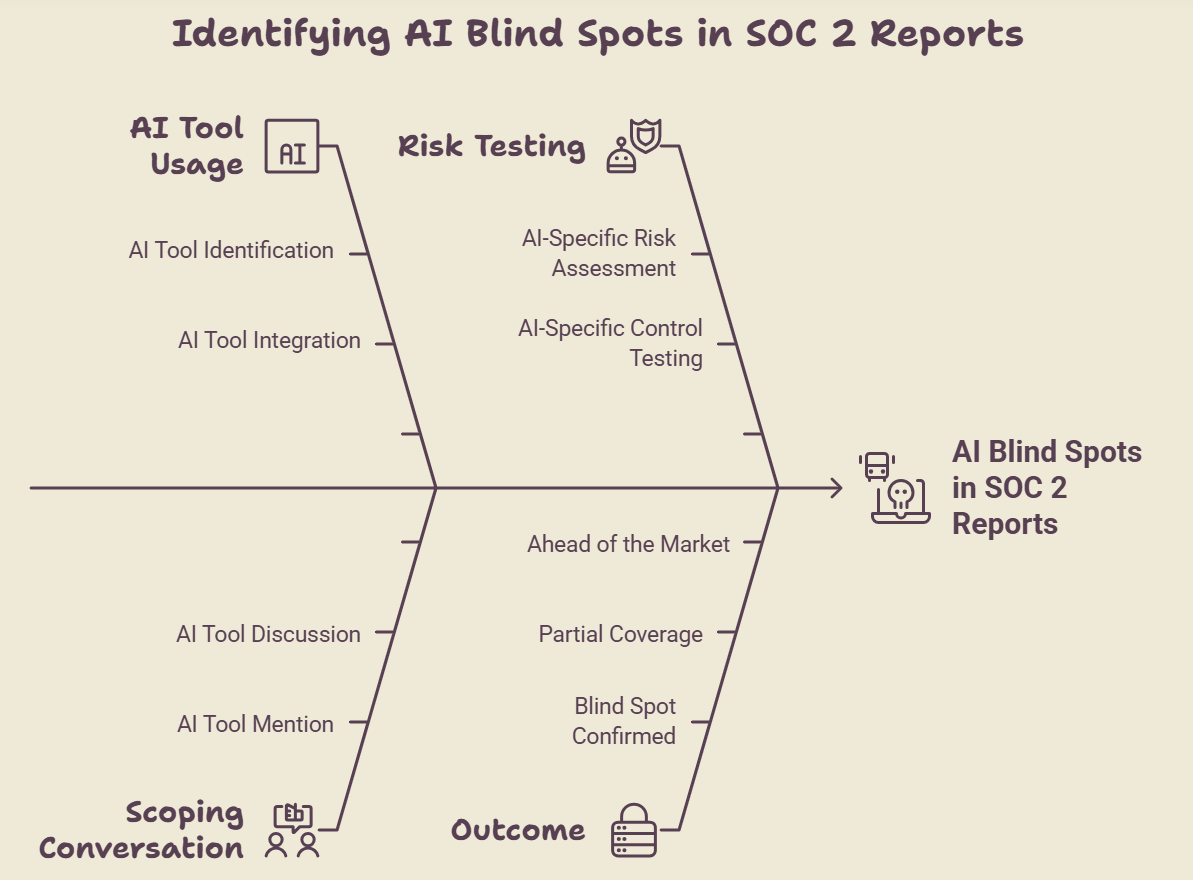
Run your own SOC 2 report through this before your next renewal conversation.
Does your organization use any AI tool, internally or customer facing?
│
├── NO → Your current SOC 2 scope is likely still accurate.
│         Revisit the moment any team adopts an AI tool, this changes
│         faster than most compliance calendars account for.
│
└── YES → Was that AI tool explicitly named or referenced anywhere in
    your most recent SOC 2 scoping conversation with your auditor?
    │
    ├── NO → This is the blind spot. The tool exists, it may touch
    │         customer data, and your report says nothing about it.
    │         │
    │         └── Does it touch customer or personal data in any way?
    │                   ├── YES → High priority gap. This is exactly what
    │                   │         enterprise buyers are starting to ask about.
    │                   └── NO → Lower urgency, but still worth logging and
    │                             monitoring, internal AI tools are a common
    │                             route to data eventually touching customers.
    │
    └── YES → Were AI specific risks actually tested, access controls,
        output monitoring, vendor risk, not just general system controls
        applied loosely to an AI tool?
        │
        ├── YES → You're genuinely ahead of the market. Document this
        │         clearly, it's a real differentiator in vendor reviews.
        │
        └── NO → Partial coverage. The tool is acknowledged, but the
                  testing wasn't built for what makes AI systems risky
                  in the first place.
If you land anywhere other than the top branch, you have a version of this blind spot. Most organizations do. This isn’t a reason to panic, it’s a reason to close the gap before a customer’s security team finds it for you.
Why This Is Surfacing Now, Not Two Years Ago
A few forces are converging at once, and it’s worth understanding why this became urgent specifically in this cycle.
SOC 2 scope is visibly widening across the board. Confidentiality criteria jumped from being included in 34% of SOC 2 reports in 2023 to 64.4% in 2024. Reports with more than 150 individual controls rose from 16% to 23% over the same period. Organizations are already expanding scope to meet buyer demand, AI is simply the next, and biggest, wave of that expansion.
Major AI providers are setting a new baseline expectation. OpenAI publicly states it maintains SOC 2 Type 2, ISO 27001, and ISO 42001 coverage for its relevant offerings. AWS positions Bedrock around encryption, logging, and governance support aligned with ISO and SOC programs. When the infrastructure layer treats this stack as a baseline requirement, everyone building on top of it inherits the same expectation from their own customers.
SOC 2 itself is shifting toward continuous compliance. Reliance on internal audit to reduce testing has dropped, likely reflecting updated AICPA guidance that gives it less weight, and the broader direction is toward continuous, evidence based monitoring rather than a once a year snapshot. A point in time report that doesn’t mention AI ages badly fast in that environment.
Buyers are getting more specific, faster than frameworks are updating. Vendor security questionnaires are starting to include direct AI questions, regardless of whether the SOC 2 report they’ve been handed addresses them.
GCAI’s compliance desk: “None of this means SOC 2 stopped working. It means the bar for what a ‘clean’ SOC 2 report actually proves has moved, and most reports haven’t moved with it.”
What a Genuinely AI Aware SOC 2 Report Looks Like
Here’s the comparison I walk clients through when they ask what “closing the gap” actually means in practice.
| Element | Standard SOC 2 Report | AI Aware SOC 2 Report |
|---|---|---|
| Scope definition | Systems and data stores explicitly named at audit kickoff | Explicitly includes AI tools, models, and AI vendor relationships in scope |
| Access control testing | Who can access systems and data | Extended to who can query, fine tune, or retrain AI models |
| Vendor risk assessment | Covers formally procured third party vendors | Includes AI tools adopted by individual teams, formally reviewed and logged |
| Logging and monitoring | System and access event logs | Includes AI output logging, enabling reconstruction of what an AI system did |
| Incident response | Defined for traditional security incidents | Extended to cover AI specific incidents, model manipulation, data leakage through prompts |
| Evidence collection cadence | Often still largely point in time | Moving toward continuous, particularly for fast changing AI systems |
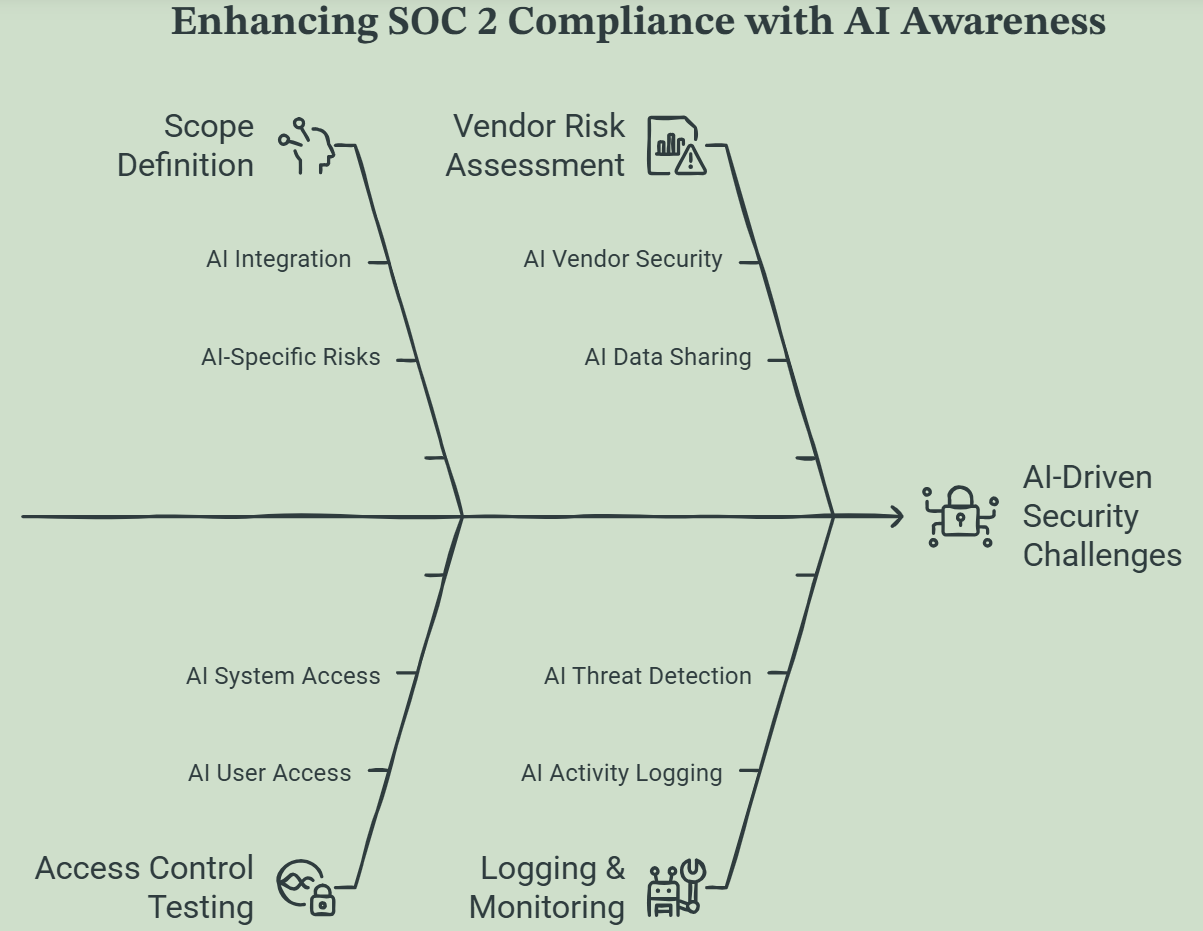
The difference isn’t a heavier report. It’s a report that actually describes the company as it exists today, rather than the company as it existed at the last scoping call.
The Real Cost of Leaving the Gap Open
There’s no regulator issuing fines for an AI blind spot in a SOC 2 report, this isn’t a compliance violation in the strict legal sense. The cost shows up somewhere else, and it’s arguably more expensive because it’s harder to see coming.
It shows up as a stalled enterprise deal, when a customer’s security team asks a direct AI question your report doesn’t answer, and the deal sits in limbo while you scramble to respond. It shows up as a competitor winning a deal specifically because their SOC 2 report already addresses AI and yours doesn’t. It shows up as a genuine incident, an AI tool nobody reviewed, handling data nobody logged, discovered only after something goes wrong.
None of these show up on a compliance dashboard. All of them show up on a revenue dashboard, eventually.
Common Misconceptions I’m Hearing Right Now
| What People Are Saying | What’s Actually True |
|---|---|
| “We’re SOC 2 certified, so we’re covered for AI too” | Only if AI was explicitly scoped and tested, most reports never addressed it |
| “Our AI vendor is SOC 2 certified, so we’re covered by extension” | Their certification covers their own controls, not your use of their tool inside your environment |
| “This only matters for AI companies” | Any company using AI tools internally, even for support or content, has some exposure |
| “We’ll deal with this at our next renewal” | Enterprise buyers are asking these questions now, not on your renewal schedule |
| “Adding AI to scope means a much bigger, more expensive audit” | It means a more accurately scoped audit, the cost is usually incremental, not exponential, when planned properly |
How to Close the Gap, Practically
Start with an honest inventory, not a policy document. Before anything else, find every AI tool actually in use across the organization, including the ones adopted informally by individual teams. This is almost always more than compliance or IT initially expects.
Bring the AI conversation into your next scoping call, explicitly. Don’t let AI tools get audited under the assumption that general system controls cover them. Ask your auditor directly: does our current scope address model access, AI vendor risk, and output monitoring, and if not, what would it take to include them.
Prioritize the AI systems that touch customer data first. Not every internal AI tool needs the same urgency. The ones processing, storing, or generating output based on customer or personal data are where enterprise buyers will ask first, and where real risk concentrates.
Extend logging and monitoring to AI outputs, not just system events. If you can’t reconstruct what an AI system did after the fact, that’s a gap an auditor and eventually a customer will notice.
Review your AI vendor contracts and their own certifications. Understand exactly what their SOC 2 or ISO certification covers, and don’t assume it extends to your specific use case.
Move toward continuous evidence collection for anything AI related. AI systems change faster than annual audit cycles were built to track, treat evidence collection accordingly.
How GCAI Helps
This is precisely the work a certification body should be doing, not selling automation software, but honestly telling you where your current report ends and your real exposure begins.
GCAI runs a targeted AI blind spot review against your existing SOC 2 report. Rather than a generic recertification, GCAI compares your current Trust Services Criteria scope against your actual live AI stack, identifying exactly which tools, vendors, and data flows exist outside what your report currently covers.
GCAI helps you bring AI into scope deliberately, before a buyer forces the issue. GCAI works directly with your team and your auditor relationship to extend access control testing, vendor risk assessment, and logging requirements to cover AI systems properly, closing the gap on your timeline rather than a customer’s.
GCAI builds one evidence base that serves SOC 2, ISO 27001, and ISO 42001 together. For clients running AI at meaningful scale, GCAI structures control mapping so the same evidence satisfies multiple frameworks, avoiding duplicated effort across separate audit cycles.
GCAI connects this work into your broader compliance picture. For organizations also navigating DPDP, GDPR, or DORA obligations involving AI, GCAI ensures this work feeds directly into those frameworks instead of becoming a disconnected, one off project.
GCAI’s compliance desk: “We’d rather help a client find this gap in a review than have their biggest customer find it in a security questionnaire. One of those conversations is a lot more comfortable than the other.”
Your SOC 2 report isn’t wrong. It’s just describing less of your company than it used to. The AI tools your teams adopted over the last year, some sanctioned, some not, are quietly operating outside the boundary of what your last audit actually tested. That gap doesn’t show up as a finding, an exception, or a failed control. It shows up as silence, a report that simply never mentions the part of your business that’s grown the fastest.
Closing it isn’t about starting over. It’s about going back to a report you already trust and asking the harder question, does this actually describe the company we’re running today. The organizations answering that question now, before a customer asks it for them, are the ones who’ll still have a clean answer when the question inevitably comes.