AI System Scope: The ISO 42001 Decision That Quietly Determines Whether Your AIMS Means Anything
Certify the wrong boundary and you can pass the audit while your riskiest AI system sits completely outside it.
Most ISO 42001 guidance treats scoping as an early administrative step – define your AI Management System (AIMS) boundary, write it down, move on to controls. That undersells it badly. Scope isn’t a formality that happens before the real work starts; it’s the decision that determines which AI systems ever get risk-assessed, which ones get human oversight requirements, and which ones simply never enter the conversation at all – legally certified, technically absent. An organisation can hold a clean ISO 42001 certificate while its highest-risk AI system was quietly scoped out from day one, and nothing in the certification process itself will flag that as a problem, because the audit tests whether the AIMS operates correctly within its declared boundary, not whether the boundary was drawn honestly.
Checkout HOW TO IMPLEMENT ISO 42001:
WHAT “SCOPE” ACTUALLY MEANS UNDER ISO 42001 – AND WHERE IT DIFFERS FROM ISO 27001
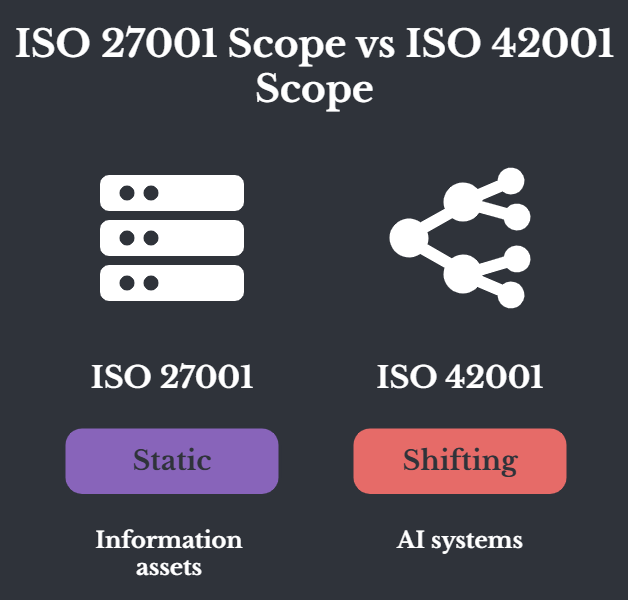
| ISO 27001 Scope | ISO 42001 Scope | |
|---|---|---|
| What’s being bounded | Information assets and systems | AI systems across their entire lifecycle — design, development, deployment, monitoring, retirement |
| Typical scoping unit | Systems, data, locations, business units | Individual AI systems or AI system categories, often cutting across business units |
| Common failure mode | Excluding a location or subsidiary that still handles sensitive data | Excluding a specific AI system, or a use case of a shared model, that’s actually high-impact |
| Why exclusions are harder to justify | Assets are relatively static and enumerable | AI systems evolve — a low-risk system today can become high-risk after a retraining or new use case, without the scope ever being revisited |
The structural difference that matters most: an information asset doesn’t change what it does on its own. An AI system does. A model deployed for internal analytics can be repurposed six months later to inform a customer-facing decision, and if scope was defined once at certification and never revisited, that repurposed system operates entirely outside the AIMS – not because anyone deliberately excluded it, but because nobody’s process caught the change.
THE SCOPING TEST – WHERE ORGANISATIONS QUIETLY UNDER-SCOPE
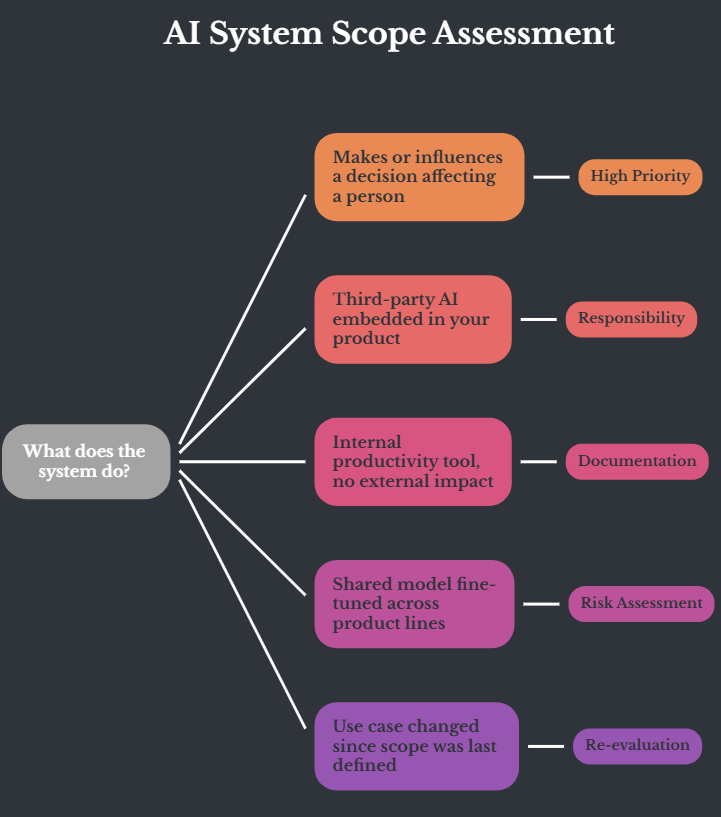
IS THIS AI SYSTEM IN SCOPE? → Does the system make or materially influence a decision affecting a person – hiring, credit, pricing, content moderation, care recommendations? → In scope, and likely warrants closer AIMS attention regardless of how the system was originally categorised internally. → Is it a third-party or vendor AI system embedded in your product, rather than one you built? → Still generally in scope for the AIMS if your organisation deploys it and bears responsibility for its outputs — “we didn’t build the model” doesn’t move accountability outside your boundary. → Is it an internal productivity tool (an LLM assistant for drafting, an internal search tool) with no external-facing decision impact? → Often lower priority, but the exclusion needs to be a documented, deliberate risk-based decision – not a default assumption that internal tools don’t count. → Is it a shared foundation model fine-tuned differently across several product lines, only some of which are high-risk? → The riskiest fine-tuned use case should drive scope treatment for the shared model, not the average use case across all of them. → Has this system’s actual use case changed since scope was last defined? → If yes, and nobody re-evaluated scope as part of that change, there’s likely a live gap between what’s certified and what’s actually running.
The pattern behind most under-scoping isn’t malicious – it’s organisational. AI initiatives frequently start in a single team (data science, a product pod) that isn’t the same team running the ISO 42001 programme, and by the time a system reaches production, it may never have crossed the desk of whoever owns AIMS scope. Scoping failures are usually a communication gap dressed up as a technical boundary.
WHY “WE DIDN’T BUILD THE MODEL” ISN’T THE TEST
A specific and common misjudgment: organisations assume that if they’re using a third-party foundation model or an off-the-shelf AI vendor tool rather than training their own, ISO 42001 scope doesn’t really apply to that system, since “the AI management” is happening somewhere else. ISO 42001 doesn’t work that way – the AIMS is scoped around the organisation’s role in the AI system’s lifecycle, not around who trained the underlying model.
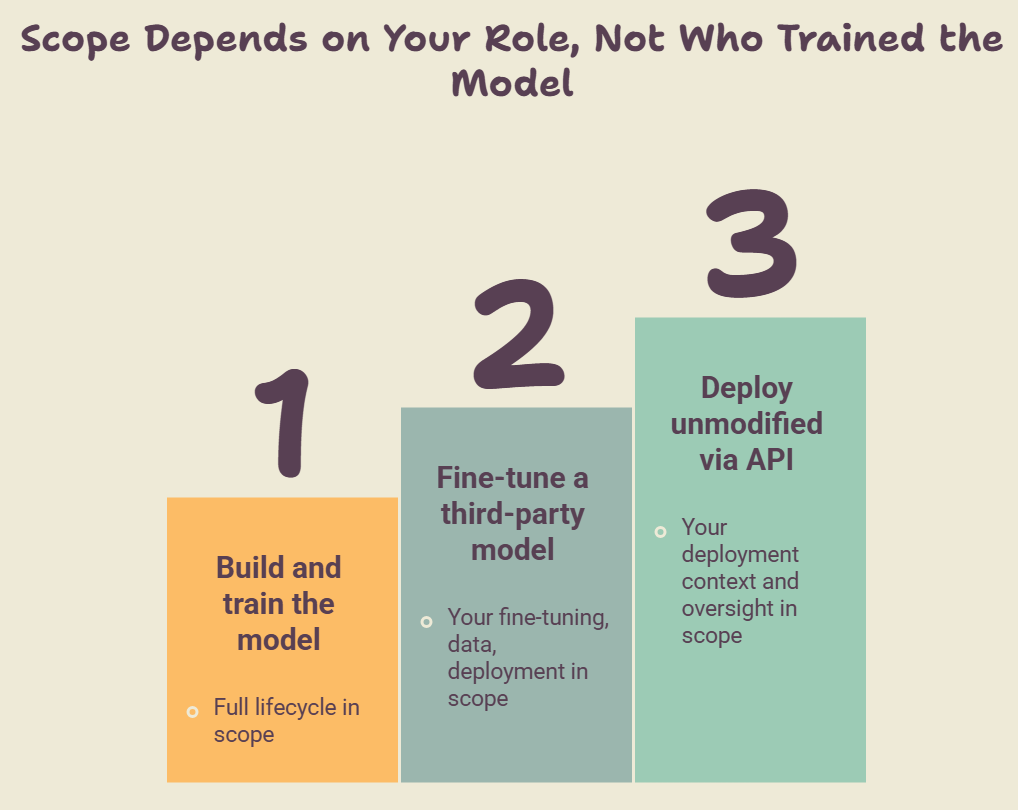
| Your role | What’s actually in scope |
|---|---|
| You build and train the model | Full lifecycle – data governance, training practices, testing, deployment, monitoring |
| You fine-tune a third-party foundation model | Your fine-tuning process, your data used, your deployment and monitoring – not the base model’s original training |
| You deploy a third-party model with no modification (API integration) | Your deployment context, your use case, your oversight of its outputs – vendor due diligence becomes a core AIMS control, not a bypass of one |
The deciding factor isn’t “did we build it” – it’s “do we deploy it, and do we bear responsibility for what it does once deployed.” An organisation integrating a third-party content-moderation API into its platform is fully in scope for how that system is used, monitored, and overseen, even though the model itself was trained entirely outside the organisation.
RISK CLASSIFICATION INSIDE THE AIMS – WHY A FLAT SCOPE PRODUCES A WEAK CERTIFICATE
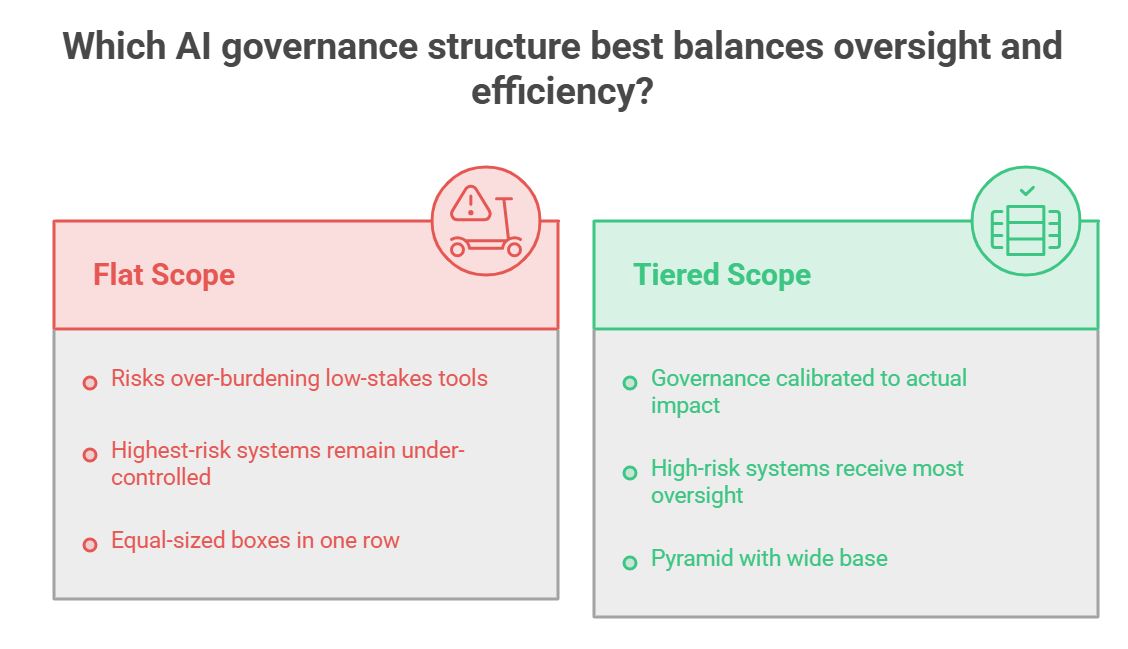
Scoping a system “in” isn’t the end of the decision – how it’s classified inside the AIMS determines how much oversight it actually gets. A common shortcut: treating every in-scope AI system with the same level of governance, rather than tiering by actual risk and impact. This produces one of two bad outcomes – either the governance is calibrated to the lowest-risk system and the highest-risk one is under-controlled, or it’s calibrated to the highest-risk system and every low-stakes internal tool now carries an unsustainable documentation burden that quietly erodes over time because nobody can keep it up.
A defensible AIMS instead tiers systems by actual impact – commonly by asking what happens if this system fails or behaves unexpectedly: does it affect a person’s legal rights or access to opportunity, does it affect safety, does it primarily affect internal efficiency with a human able to catch and correct errors downstream. The tiering doesn’t need to mirror the EU AI Act’s four categories exactly, but building it with awareness of that structure means the same risk classification work serves both ISO 42001 conformity and external regulatory obligations, instead of duplicating the analysis twice.
WHAT AUDITORS ACTUALLY TEST ON SCOPE – AND WHY IT’S NARROWER THAN PEOPLE EXPECT
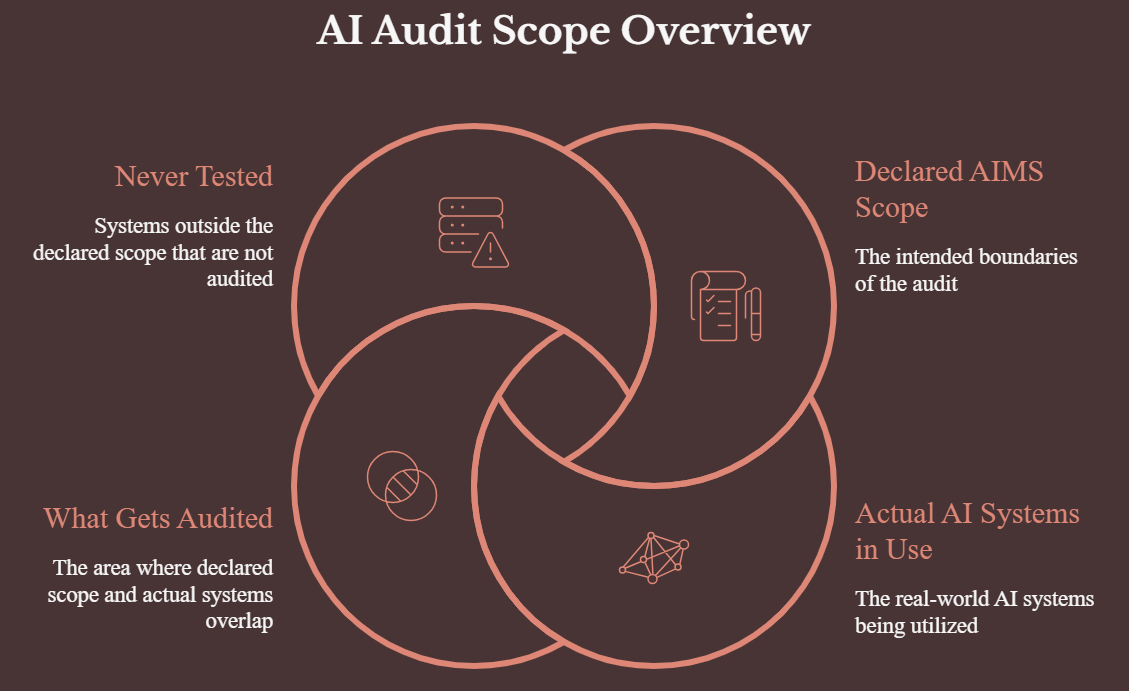
A common misconception is that an ISO 42001 audit will independently verify whether your scope is complete – that the auditor will go looking for AI systems you didn’t declare. That’s not how conformity audits work, for ISO 42001 any more than for ISO 27001. The audit tests whether the AIMS operates correctly within the scope the organisation itself defined and documented. If a high-risk system was never declared, the audit has no natural mechanism to surface it, because there’s no requirement being tested against a system that was never named.
This is precisely why scope is the highest-leverage decision in the entire certification, not a formality to get past quickly. A narrow, convenient scope can produce a certificate that’s technically valid and materially misleading about the organisation’s actual AI risk posture – and the gap between “certified” and “actually governed” only becomes visible when the excluded system causes a real-world problem, at which point “we were ISO 42001 certified” offers no protection for the system that was never inside the boundary in the first place.
COMMON MISCONCEPTIONS WORTH KILLING
MISCONCEPTIONS → “Internal tools don’t need to be in scope.” They can be excluded, but only through a documented, risk-based decision – not a default assumption that internal-facing means low-stakes. → “We use a vendor’s AI, so it’s the vendor’s certification problem, not ours.” The AIMS is scoped around your deployment and use, not the vendor’s training process – vendor due diligence is a control inside your scope, not an exemption from it. → “Once scope is defined at certification, it’s fixed until recertification.” Scope needs active review as systems evolve – a model repurposed for a new use case can move from out-of-scope-appropriate to in-scope-required without anyone updating the documentation. → “A broader scope always looks more rigorous to auditors.” A scope that’s broader than the organisation can actually govern well produces weaker evidence of operating effectiveness than a narrower, honestly-defined scope that’s genuinely well managed. → “The audit will catch systems we forgot to include.” It won’t – conformity audits test operation within declared scope, not completeness of the declaration itself.
THE HONEST FRAMEWORK – QUESTIONS THAT ACTUALLY DETERMINE SCOPE
- Have we inventoried every AI system in active use across the organisation, including ones that originated outside the team that owns the AIMS?
- For each system, have we asked what happens if it fails or behaves unexpectedly — not just what it was designed to do?
- Have we excluded any system on the assumption that “internal” or “vendor-built” automatically means lower risk, without a documented risk-based justification?
- Do we have a process that re-triggers a scope review when an existing system’s use case changes, rather than only reviewing scope at recertification?
- If our highest-risk AI system were removed from scope tomorrow, would our certificate still be technically accurate – and would that accuracy actually mean anything to the people affected by that system?
ISO 42001 BY THE NUMBERS Structure mirrors: ISO 27001’s management-system clause structure, with an AI-specific Annex Audit tests: operation within declared scope, not completeness of the declaration itself Scope review trigger: should occur on system change, not only at recertification Third-party AI systems: in scope based on your deployment role, not who trained the model
Related reading:
https://gcaicert.com/iso-42001-artificial-intelligence-management-system/
ISO 42001: The Complete Guide · AI Impact Assessments: What They Actually Require · ISO 42001 vs EU AI Act: Where the Obligations Overlap How GCAI helps: GCAI builds the AI system inventory across teams that don’t normally talk to your compliance function, applies risk-based tiering aligned with both ISO 42001 and the EU AI Act’s risk categories, and sets up scope-review triggers tied to actual system changes — so the certificate reflects what’s really running, not just what was declared on day one.