
Legitimate Interest vs Consent: The Lawful Basis Decision That Determines Everything Else Under GDPR
Picking the wrong lawful basis doesn’t just risk a fine — it can make the processing itself illegal from day one, no matter how good your security is.
Most GDPR content treats “get consent” as the default safe move and treats legitimate interest as the loophole you reach for when consent is inconvenient. Both instincts are wrong, and the mistake compounds: the lawful basis you pick isn’t a formality you can swap later if regulators push back — it shapes what rights the data subject has, what you have to document upfront, and whether the processing was ever legal in the first place. Get this wrong and no amount of good security posture fixes it, because the violation isn’t in how the data was protected — it’s in why you were allowed to process it at all.
Ministry of Security – YouTube
For the full legal breakdown of GDPR Articles 1 to 13, covering scope, definitions, and the lawfulness principles this whole framework builds on, check out our company page, Ministry of Security. We’ve broken each article down in plain language so you’re not parsing legal text alone.
WHAT EACH LAWFUL BASIS ACTUALLY REQUIRES
| Consent | Legitimate Interest | |
|---|---|---|
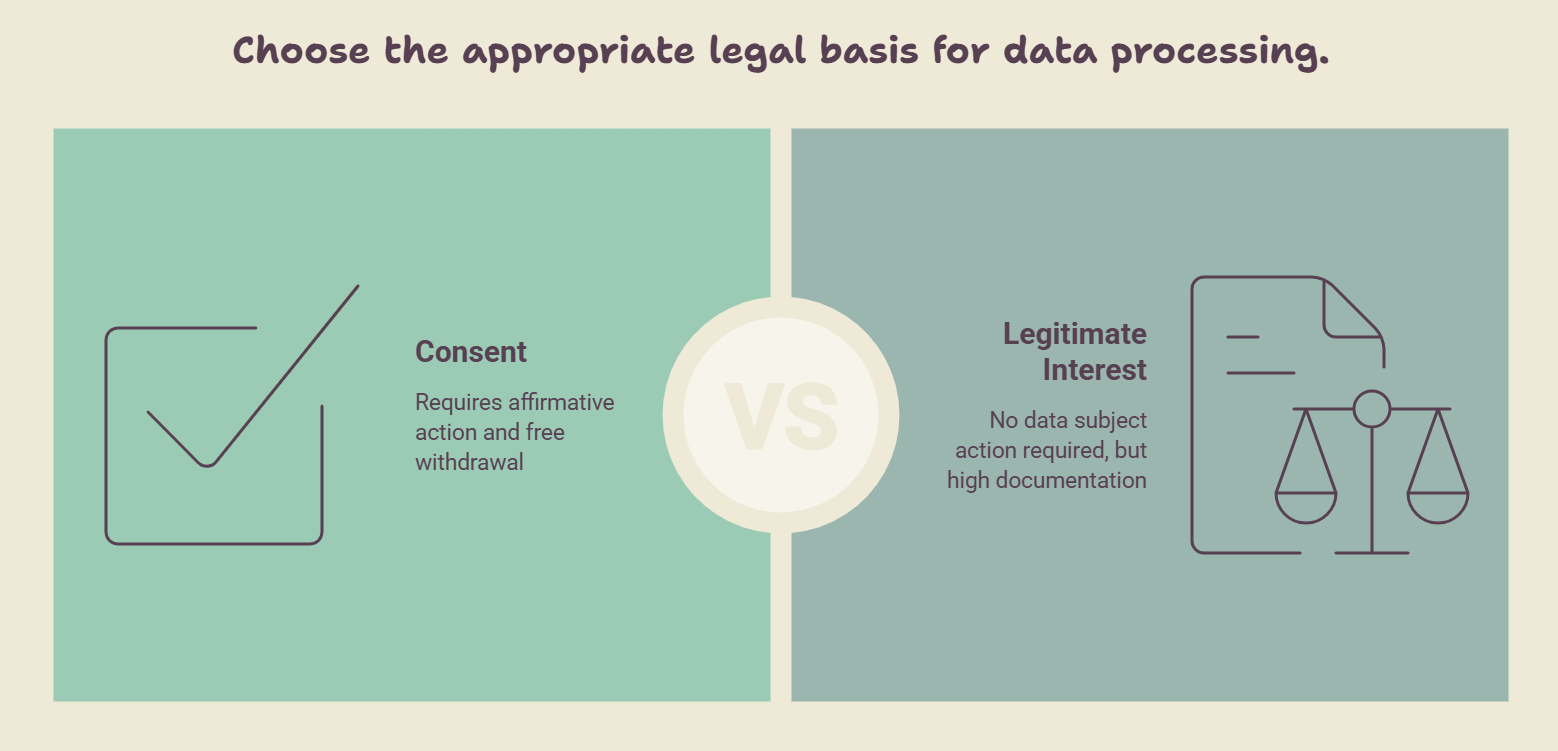
| What it requires | Freely given, specific, informed, unambiguous affirmative action from the data subject | A documented three-part test — no data subject action required |
| Can be bundled into T&Cs? | No — must be separate, granular, and as easy to withdraw as to give | N/A — no consent mechanism exists |
| Right to withdraw | Yes, at any time, as easily as it was given | N/A — but data subject retains the right to object |
| Upfront documentation burden | Low — a consent record (what, when, how) | High — a Legitimate Interests Assessment (LIA) must exist before processing starts |
| Who bears the “was this valid” risk | The consent mechanism itself — was it really freely given, granular, unbundled | The organisation’s own balancing judgment — was the interest actually legitimate and proportionate |
| Best suited for | Marketing communications, non-essential cookies, anything genuinely optional for the user | Fraud prevention, network security, direct marketing to existing customers, internal admin purposes |
The detail that trips people up: legitimate interest isn’t the “no paperwork” option — it’s the opposite. Consent’s documentation burden is low precisely because the data subject did the work of actively agreeing. Legitimate interest shifts that burden entirely onto the organisation, which now has to prove — in writing, before processing starts, not after a complaint — that its judgment call was sound.
THE THREE-PART TEST THAT LEGITIMATE INTEREST ACTUALLY REQUIRES
LEGITIMATE INTERESTS ASSESSMENT (LIA) → Purpose test — is there a real, specific, legitimate interest being pursued? Not “it would help the business” in the abstract, but a concrete, articulable reason. → Necessity test — is this processing actually necessary to achieve that interest, or would a less intrusive method work just as well? If a less invasive option exists and wasn’t seriously considered, the test fails here. → Balancing test — do the organisation’s interests override the data subject’s rights and freedoms, given their reasonable expectations? This is the step most LIAs skip or rush, and it’s the one regulators scrutinise hardest.
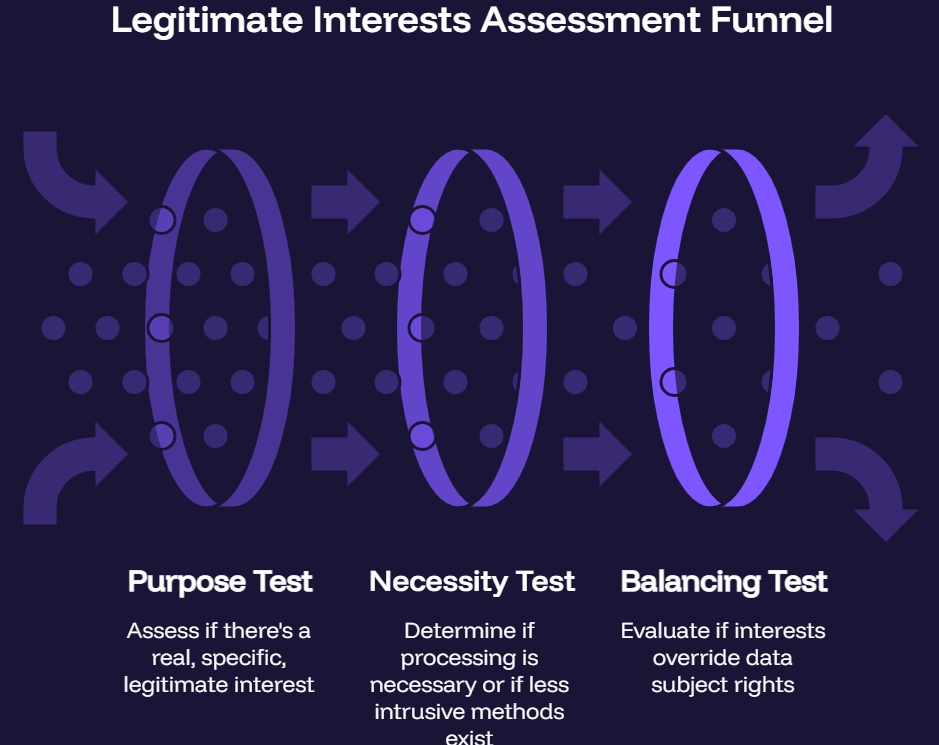
Skipping any one of the three doesn’t just weaken the LIA — it invalidates the basis entirely. An LIA that only addresses “why we want the data” (purpose) without seriously engaging “would the person reasonably expect this” (balancing) isn’t a partial pass. It’s not a legitimate interest basis at all, which means the processing was unlawful from the moment it started, regardless of how the data was subsequently handled.
WHY “REASONABLE EXPECTATION” IS THE HINGE OF THE BALANCING TEST — AND WHY IT’S NOT ABOUT WHAT’S TECHNICALLY POSSIBLE
The balancing test doesn’t ask whether the processing is harmful in some objective sense. It asks whether the data subject would reasonably expect it, given the context of the relationship. This is a genuinely different question than most organisations think they’re answering.
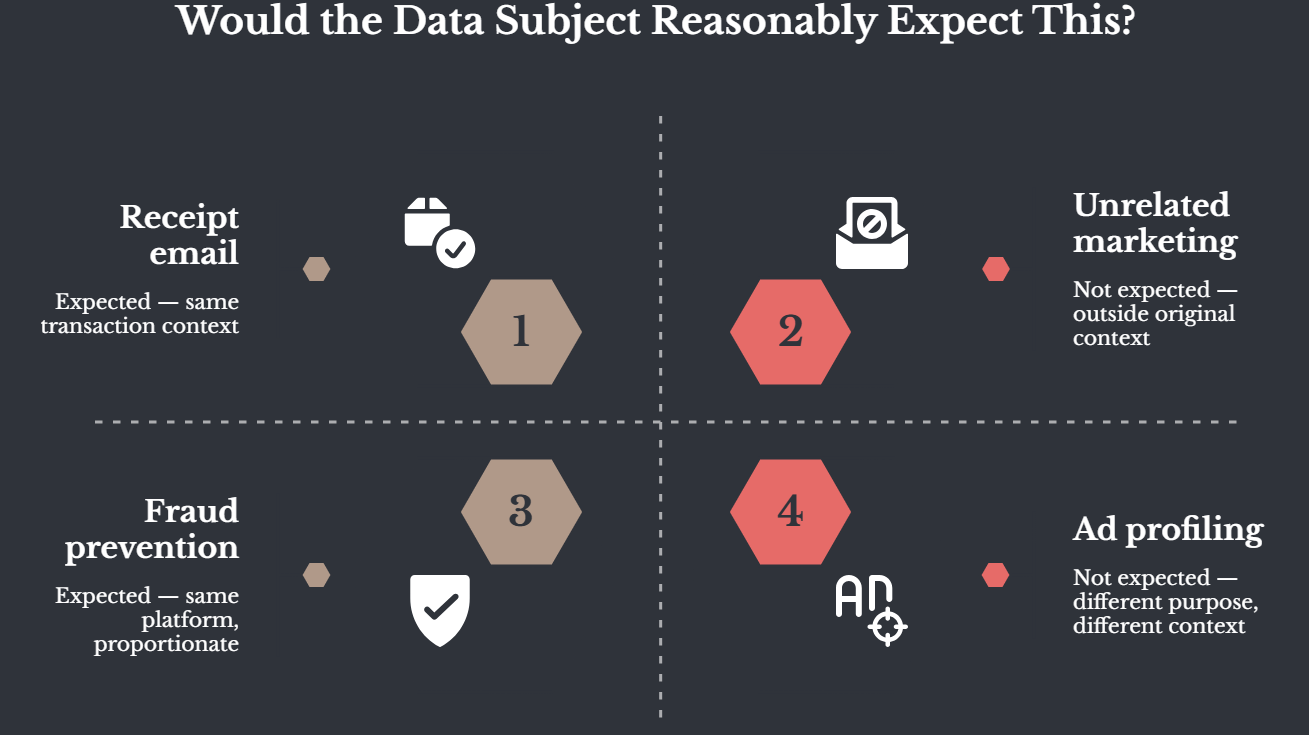
| Scenario | Reasonable expectation? | Why |
|---|---|---|
| Using a customer’s email to send a receipt | Yes | Directly tied to the transaction just completed |
| Using that same email for marketing about unrelated products | No, without separate basis | Outside the context the data was originally collected in |
| Using browsing behaviour to prevent fraud on the same platform | Yes | Security purpose, same context, proportionate |
| Using that same browsing behaviour to build a cross-site ad profile | No | Different purpose, different context, not what the person reasonably expected when they browsed |
The pattern: legitimate interest tends to hold up when the new processing stays inside the context the data subject already understood themselves to be in. It tends to fail — even with a technically well-argued purpose and necessity case — when the processing steps outside that context, because “reasonable expectation” is measured from the data subject’s vantage point, not the organisation’s internal business logic.
THE RIGHT TO OBJECT: THE STRUCTURAL DIFFERENCE MOST PEOPLE MISS
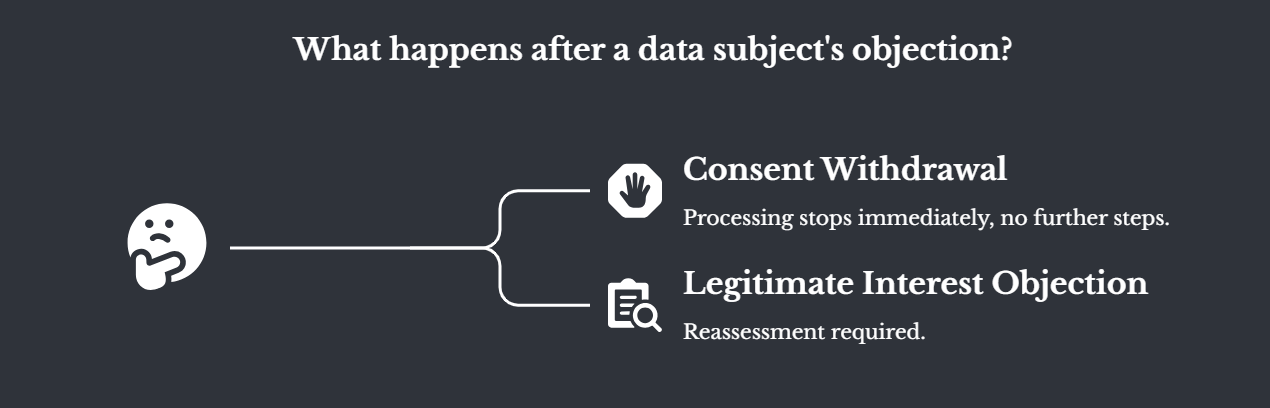
Consent and legitimate interest don’t just differ in how they’re obtained — they differ in what happens after. Consent can be withdrawn, which stops the processing outright, no further conversation needed. Legitimate interest instead carries a right to object — the data subject can object at any time, and the organisation then has to reassess whether its legitimate interest still overrides theirs, this time under active challenge rather than a pre-emptive internal assessment.
For direct marketing specifically, GDPR removes the organisation’s discretion entirely: an objection to direct marketing must be honoured absolutely, with no balancing test permitted at that stage. This is a common and costly misunderstanding — some organisations treat every objection as something they get to evaluate and potentially override with a strong-enough legitimate interest. For marketing, that’s not how it works; the objection wins automatically, full stop, no counter-argument available.
For other legitimate interest processing outside direct marketing, the organisation can maintain the processing only if it can demonstrate compelling legitimate grounds that override the individual’s interests — a genuinely higher bar than the original LIA, because it now has to survive a specific, individual challenge rather than a general assessment.
WHY SWITCHING BASES MID-STREAM IS OFTEN NOT ALLOWED
A common instinct when a lawful basis gets challenged — a regulator asks questions, a data subject complains — is to fall back to a different basis: “if consent wasn’t valid, we’ll just say it was legitimate interest instead.” Regulatory guidance treats this specifically as a compliance failure in its own right, not a safe fallback.
The reasoning: the lawful basis has to be identified and documented before processing begins, as part of transparency obligations to the data subject. Retroactively picking a different basis after the fact means the data subject was never properly informed of the actual basis being relied on at the time — which is itself a separate violation of the transparency requirements, layered on top of whatever the original problem was. This is why the upfront LIA documentation matters so much: it’s not just audit paper-trail hygiene, it’s the thing that prevents an organisation from being caught with no valid basis at all if consent is later found defective.
WHERE ORGANISATIONS GET THE MIX WRONG IN PRACTICE
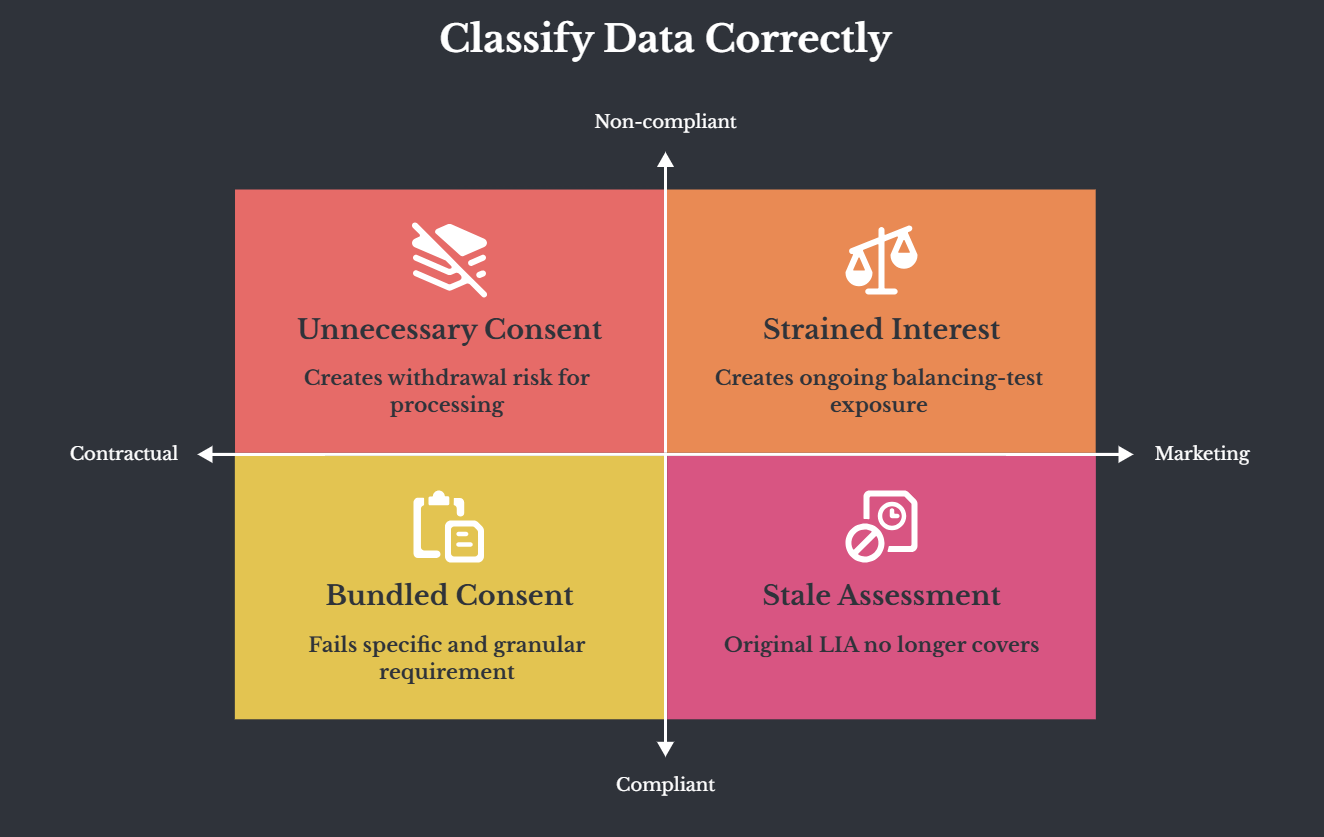
COMMON MISCLASSIFICATION PATTERNS → Using consent for something that’s actually necessary for the contract (e.g., asking for “consent” to process a delivery address for an order already placed) — this creates an unnecessary withdrawal risk for processing that shouldn’t require consent at all, since contractual necessity is its own separate, more stable basis. → Using legitimate interest for genuinely optional marketing that would be better served by clean, revocable consent — this creates ongoing balancing-test exposure for something that could have been simpler and more defensible as consent. → Bundling consent into broad terms and conditions acceptance — this fails the “specific and granular” requirement regardless of how clearly it’s worded, because a single blanket acceptance can’t represent informed agreement to multiple distinct processing purposes. → Writing an LIA once at product launch and never revisiting it as the product or data use evolves — an LIA is a snapshot of a specific processing purpose at a specific time; if the purpose expands, the original LIA no longer covers what’s actually happening. → Treating “everyone else in the industry does this” as evidence of legitimate interest — the balancing test is about this specific data subject’s reasonable expectations in this specific relationship, not industry norms, which have no independent legal weight in the assessment.
THE HONEST FRAMEWORK — QUESTIONS THAT ACTUALLY DETERMINE THE RIGHT BASIS
- Is this processing genuinely optional for the data subject, or something they’d reasonably expect as part of the relationship they already have with us?
- If we’re leaning toward legitimate interest, have we actually written a three-part LIA — purpose, necessity, balancing — or do we just have an internal justification for purpose alone?
- Would the data subject be surprised to learn we were doing this, given the context in which we originally collected their data?
- If this is direct marketing, are we prepared to honour an objection unconditionally, with zero discretion to override it?
- Have we documented the lawful basis before processing starts, so we’re not tempted to retroactively pick a different one if this one gets challenged?
- If our LIA is more than a year or two old, does it still reflect what the processing actually does today?
GDPR BY THE NUMBERS Lawful bases available: 6 (consent, contract, legal obligation, vital interests, public task, legitimate interests) LIA required before processing starts: Yes, for legitimate interest — not optional documentation Right to object to direct marketing: Absolute — no balancing test permitted Fines for unlawful processing: up to €20 million or 4% of global annual turnover, whichever is higher Basis-switching after the fact: Generally treated as its own separate violation, not a valid fallback
Related reading: GDPR: The Complete Guide · Data Subject Rights: What You Actually Owe Them · Data Protection Impact Assessments Explained How GCAI helps: GCAI runs the lawful-basis test against your actual data flows purpose by purpose — not a blanket assumption — writes defensible LIAs before processing starts, and flags where consent and legitimate interest are quietly mismatched to what the processing actually needs.