Covered Entity vs. Business Associate: The Classification That Decides Your Entire
HIPAA Burden The wrong self-classification here doesn’t just create paperwork gaps — it changes who’s liable when something goes wrong.
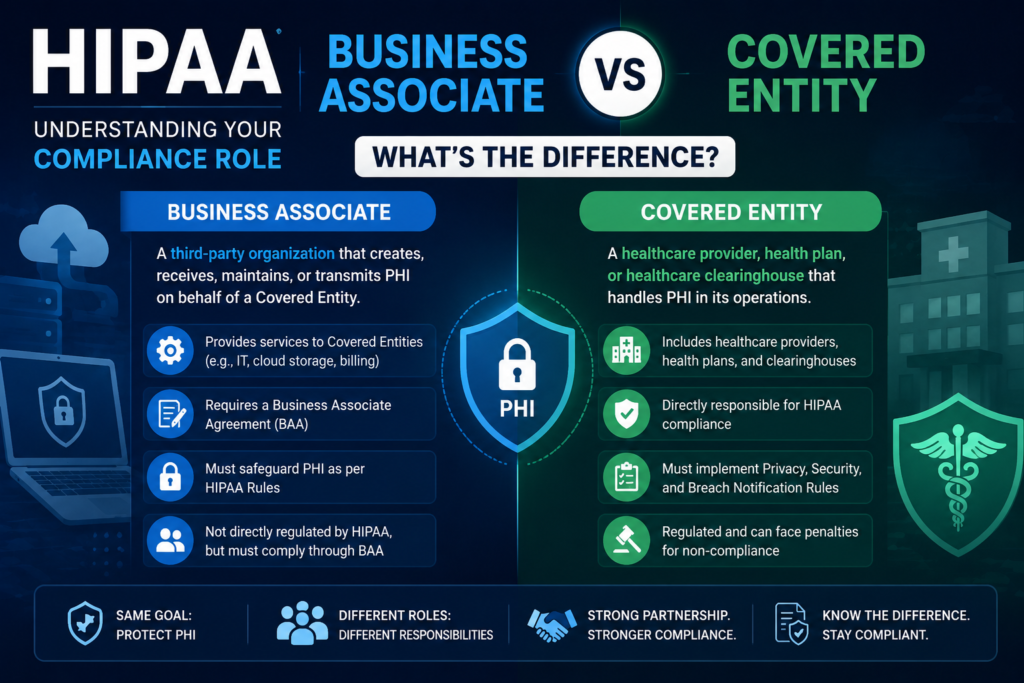
Most HIPAA content treats “covered entity” and “business associate” as a footnote definition to get through before the real content starts. That’s backwards. Which one you are — or worse, misclassifying which one you are — determines your entire compliance obligation set, your BAA requirements, your breach notification duties, your Security Rule scope, and critically, your direct liability exposure to HHS enforcement. Companies get this wrong constantly, usually in one specific direction: assuming they’re “not really” a business associate because they don’t think of themselves as a healthcare company.
Watch the video below – to learn the key differences between a HIPAA Business Associate and Covered Entity:
WHAT EACH CLASSIFICATION ACTUALLY MEANS
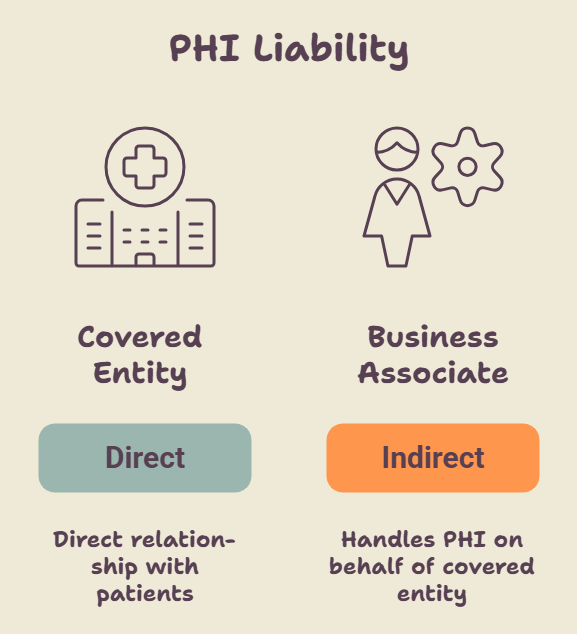
| Covered Entity | Business Associate | |
|---|---|---|
| Who it is | Health plans, healthcare providers, healthcare clearinghouses | Any vendor that creates, receives, maintains, or transmits PHI on a covered entity’s behalf |
| Direct obligation to patients | Yes — the primary relationship | No direct relationship — obligation flows through the covered entity |
| Requires a BAA | Signs BAAs with business associates | Must sign a BAA before touching PHI |
| Subject to Privacy Rule | Fully | Only the parts relevant to PHI it handles |
| Subject to Security Rule | Fully, for all ePHI it holds | Fully, for any ePHI it creates, receives, maintains, or transmits |
| Direct HHS enforcement liability | Yes, since HIPAA’s original enactment | Yes — since the HITECH Act (2009), BAs are directly liable, not just contractually |
| Common examples | Hospitals, clinics, insurers, therapists, pharmacies | Cloud hosting providers, billing software, EHR platforms, analytics tools, IT support, transcription services, scheduling software |
The detail most people miss: the HITECH Act made business associates directly liable to HHS enforcement, not just contractually liable to the covered entity. Before 2009, a BA’s failure was primarily the covered entity’s legal problem, dealt with contractually — a breach of contract, sorted through the BAA itself. Since HITECH, HHS can investigate and fine the business associate directly, independent of whatever the covered entity does or doesn’t pursue. “We’re just a vendor” stopped being a liability shield over a decade ago, and a lot of vendor risk assessments — on both sides of the relationship — still operate as if it hasn’t.
THE CLASSIFICATION TEST — WHERE COMPANIES GET IT WRONG
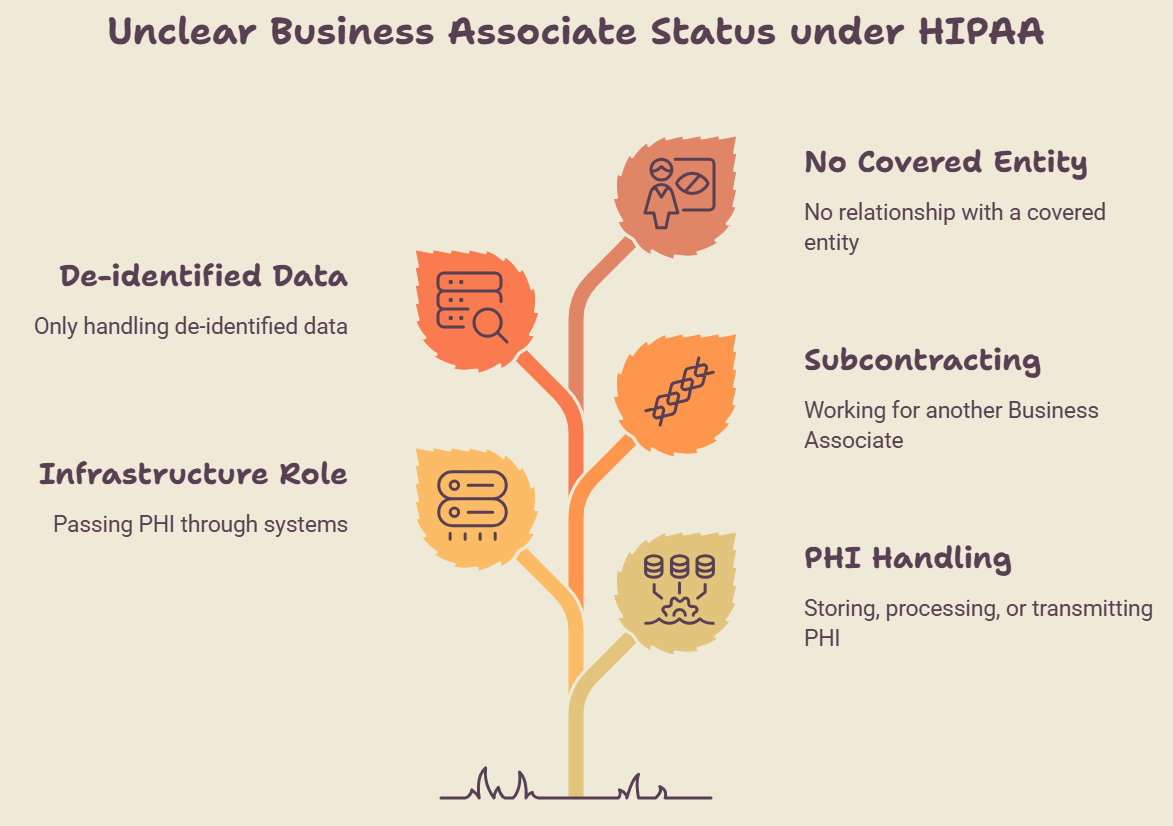
ARE YOU A BUSINESS ASSOCIATE? → Does your product ever store, process, or transmit PHI on behalf of a covered entity, even if PHI isn’t the primary data type you handle? → You’re a business associate. → Do you provide infrastructure (hosting, cloud storage, backup) that a covered entity’s PHI passes through, even if you never look at the content? → Still a business associate — “conduit” exceptions are narrower than most people assume. → Are you a subcontractor to another business associate, one layer removed from the covered entity? → Still a business associate. HITECH extended liability down the subcontractor chain — there’s no “we’re too far removed” exemption. → Does your product touch scheduling, billing codes, insurance claims, or care-coordination data rather than clinical records directly? → Still likely PHI — the definition covers any individually identifiable health information, not just diagnoses and treatment notes. → Do you only handle de-identified data, stripped per HIPAA’s Safe Harbor or Expert Determination method? → Not PHI, not a business associate for that data — but the de-identification has to actually meet the standard, not just have obvious identifiers loosely removed. → Are you a health and wellness app that isn’t working with a covered entity at all — no clinic, no insurer, no provider relationship? → Often not a business associate, and not directly covered by HIPAA at all, which is its own separate problem: consumer health apps outside a covered entity relationship frequently sit in a regulatory gap that HIPAA was never designed to cover, and state consumer privacy law fills in unevenly.
The most common misclassification isn’t malicious — it’s a startup building a tool that touches health data adjacently (scheduling software, a wellness app integrating with a provider’s system, an analytics platform ingesting claims data) and not realizing “on behalf of a covered entity” catches far more business models than “healthcare company” implies.
WHY THE “CONDUIT EXCEPTION” GETS MISUNDERSTOOD SO OFTEN
HHS guidance carves out a narrow conduit exception — entities that merely transmit PHI without accessing it in any meaningful way, historically framed around things like postal services and internet service providers. The exception exists because those entities have only transient, incidental access to data in transit, not because they’re “just infrastructure” in a general sense.
The mistake: companies assume any technical/infrastructure role qualifies. It doesn’t. The deciding factor HHS actually applies is whether access to PHI is transient versus persistent — a courier who never opens the envelope is a conduit; a cloud hosting provider storing PHI on disk, even encrypted, even if nobody on staff ever queries the data, is generally not a conduit, because the access is persistent by nature of storage, not transient by nature of transit. This single distinction is where a large share of misclassified SaaS and infrastructure companies go wrong — “we don’t look at the data” is not the test; “does the data persist in a system we control” usually is.
WHY THE BAA IS THE HINGE POINT, NOT A FORMALITY
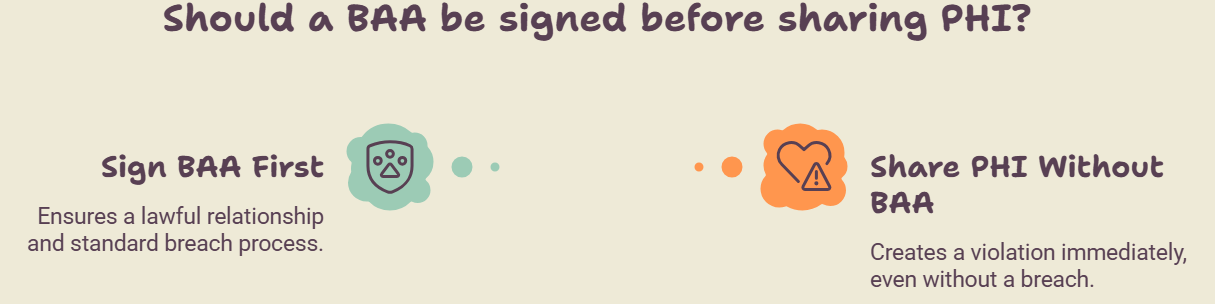
A Business Associate Agreement is often treated as boilerplate to sign quickly so a deal can close. It’s actually the document that legally activates a business associate’s HIPAA obligations — and its absence is itself a violation, independent of whether anything else goes wrong.
| Scenario | What Actually Happens |
|---|---|
| BAA signed, PHI later breached | Standard breach response and notification process under existing HIPAA rules |
| PHI shared with a vendor, no BAA in place | A violation exists the moment PHI is shared — regardless of whether a breach ever occurs downstream |
| BAA signed but vendor’s actual practices don’t match its terms | Vendor is liable for its own conduct, but the covered entity also carries exposure for inadequate vendor oversight |
| BAA exists but was never updated as the vendor’s product scope grew | Effectively the same exposure as no BAA, for whatever new PHI flows fall outside the original agreement’s description |
| Vendor terminates the relationship but BAA has no clear data-return/destroy clause | PHI’s disposition becomes ambiguous — a common source of disputes and, occasionally, breach exposure, well after the commercial relationship has ended |
The part that surprises people: you can be fully compliant on paper — encrypted, access-controlled, audited — and still be in violation, simply because PHI was shared before a BAA was executed. The BAA isn’t evidence of compliance; it’s a precondition for the relationship being lawful in the first place. Good security practices don’t retroactively fix a missing BAA, in the same way a well-built house doesn’t retroactively fix the fact it was built without a permit.
WHAT A BAA ACTUALLY HAS TO COVER
BAA CORE REQUIREMENTS → Permitted uses and disclosures — exactly what the business associate is allowed to do with PHI, not a blanket “as needed” → Safeguard obligations — the BA must implement the Security Rule’s administrative, physical, and technical safeguards for any ePHI it handles → Breach notification terms — how fast the BA must notify the covered entity after discovering a breach (often tighter than HIPAA’s own 60-day outer limit, since the covered entity needs time to notify patients within their own deadline) → Subcontractor flow-down — the BA must get its own BAAs from any subcontractor it shares PHI with, extending the same terms down the chain → Termination provisions — what happens to PHI when the relationship ends: return, destroy, or in some cases continued safeguarding if return/destruction isn’t feasible → Reporting obligations beyond breaches — many BAAs also require reporting security incidents that don’t rise to a reportable breach, since the covered entity often wants visibility into near-misses, not just confirmed breaches → Audit and inspection rights — the covered entity’s right to verify the BA’s actual practices, not just rely on the BA’s self-reported compliance
A BAA missing the subcontractor flow-down clause is a common gap — it creates an unprotected link the moment the business associate outsources any part of its own PHI handling (a subprocessor, a cloud provider, a support vendor), and that gap is exactly where breach investigations tend to find the actual point of failure.
LIABILITY DOESN’T STOP AT THE FIRST LAYER
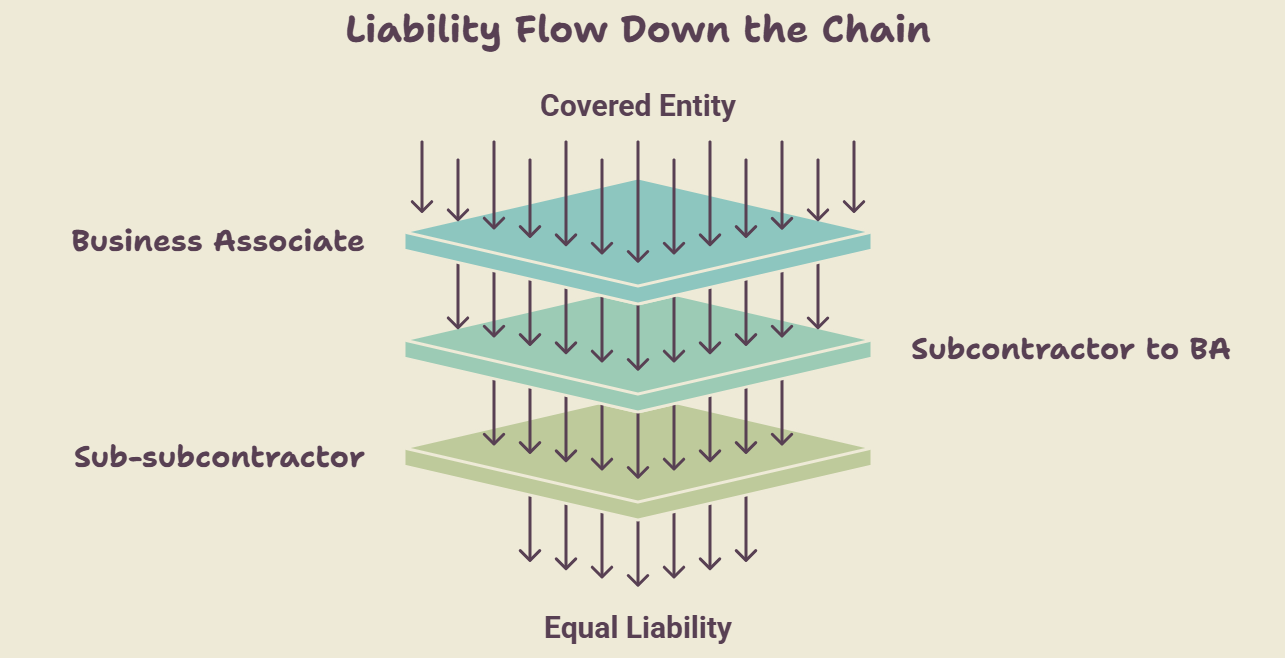
| Layer | Example | Direct HHS Liability? | Typical BAA Relationship |
|---|---|---|---|
| Covered Entity | Hospital | Yes | Holds BAAs with all direct business associates |
| Business Associate | EHR software vendor | Yes (since HITECH) | Has a BAA with the hospital; must obtain BAAs from its own subcontractors |
| Subcontractor to BA | Cloud host the EHR vendor uses | Yes — liability flows down the chain | Has a BAA with the EHR vendor, not directly with the hospital |
| Sub-subcontractor | A backup/DR vendor the cloud host uses | Yes, if it touches PHI, regardless of distance from the original covered entity | Has a BAA with the cloud host |
This is the detail most vendor risk programs still get wrong: HIPAA liability doesn’t dilute with distance from the patient. A four-layers-removed subcontractor handling PHI is exactly as directly liable to HHS enforcement as the hospital is, for its own conduct. “We’re just infrastructure for infrastructure” isn’t a real exemption — it’s a chain of BAAs that all need to exist and all need to actually reflect what’s happening operationally. In practice, this chain is also where compliance most often quietly breaks: the covered entity verifies its direct BA has a BAA, but rarely verifies that BA’s subcontractors actually have their own BAAs in place, correctly worded, currently accurate — the assumption of downstream compliance is exactly the assumption breach investigators are trained to test.
HYBRID ENTITIES AND ORGANIZED HEALTH CARE ARRANGEMENTS — THE EDGE CASES THAT TRIP UP LARGER ORGANIZATIONS
Not every organization is cleanly one or the other. Two structural edge cases are worth naming because they change the analysis:
- Hybrid entities — a single legal entity that runs both covered and non-covered functions (a university that has both a student health clinic and non-healthcare academic departments, or a large employer that both provides a covered health plan and runs unrelated business lines). HIPAA allows the entity to formally designate which components are the “health care component,” walling off HIPAA obligations to that part specifically — but only if the designation is done deliberately and correctly. Get the internal walling wrong, and PHI flowing between the health care component and the rest of the organization without proper controls is itself a violation, even within a single legal entity.
- Organized Health Care Arrangements (OHCAs) — multiple legally separate covered entities that clinically integrate (a hospital and the independent physician groups that practice there) and are allowed to share PHI for certain joint activities without a BAA between them, because HIPAA treats the arrangement as a defined joint operation rather than a vendor relationship. This is frequently misunderstood in the other direction — people assume a BAA is always required between any two entities touching PHI, and miss that OHCAs are a specific, narrow exception, not a general rule.
COMMON MISCONCEPTIONS WORTH KILLING
MISCONCEPTIONS → “We’re not a healthcare company, so HIPAA doesn’t apply to us.” Irrelevant — what matters is whether you touch PHI on behalf of a covered entity, not your industry label. → “We never look at the actual health data, we just host it.” Hosting infrastructure that PHI passes through generally still makes you a business associate — the conduit exception turns on transient vs. persistent access, not on whether staff actively view the data. → “Our subcontractor signed their own BAA with us, so we’re covered.” Only if the terms actually flow down correctly and your subcontractor’s real practices match what the BAA says — a signed document with mismatched practice is a liability gap, not a shield. → “HIPAA certification proves we’re compliant.” There’s no such thing as HIPAA certification — no accredited body issues one. Anyone marketing “HIPAA certified” is describing an internal assessment, not a recognized credential. → “Our BAA from two years ago still covers us.” Only if your product scope hasn’t changed. A BAA describes specific permitted uses — a vendor whose product has since expanded into new PHI flows is operating outside what the original BAA actually authorizes. → “We’re too small/early-stage for HHS to care.” Enforcement doesn’t scale strictly with company size — smaller BAs and even individual practitioners have faced real HHS penalties; obscurity isn’t a compliance strategy, and breach notification duties trigger regardless of company size.
THE HONEST FRAMEWORK — QUESTIONS THAT ACTUALLY DETERMINE YOUR STATUS
- Does PHI (identifiable health data) touch our systems at any point, even transiently, on behalf of a covered entity or another business associate?
- If our access to that data is persistent rather than truly transient, are we relying incorrectly on a conduit exception that doesn’t actually apply to us?
- If we’re a business associate, does every BAA we’ve signed actually match how we operate today, or has our product evolved past what the BAA describes?
- Do our own subcontractors have BAAs in place with terms that flow down correctly, or are we assuming their compliance without verifying it?
- If a breach happened right now, could we meet our BAA’s notification deadline to the covered entity — not HIPAA’s outer limit, but the tighter one the BAA likely specifies?
- Have we actually de-identified any data we’re treating as “not PHI,” using a method that meets HIPAA’s standard, or did we just remove some obvious identifiers?
- If we’re a hybrid entity or part of a clinically integrated arrangement, has the health care component actually been formally and correctly designated?
HIPAA BY THE NUMBERS Direct BA liability under HHS enforcement: since 2009 (HITECH Act) Breach notification outer limit: 60 days from discovery (often tighter in the BAA itself) Penalty range: hundreds to over $1M per violation category, per year, scaled by negligence BAA required: before any PHI is shared — absence is itself a violation, independent of a breach Conduit exception test: transient access, not “we don’t look at the data”
Related reading: HIPAA Compliance: The Complete Guide · Business Associate Agreements: What Goes Wrong · HIPAA Breach Notification Timelines How GCAI helps: GCAI runs the classification test against your actual data flows — not your industry label — maps every BAA against how you operate today, verifies subcontractor flow-down so liability gaps don’t sit undiscovered, and handles hybrid-entity or OHCA designation correctly for larger, multi-function organizations.