ISO 42001 Explained: Building Trustworthy AI, One Standard at a Time
What it is, why it matters, and how to get certified – explained simply.
This guide covers everything you need to know about ISO 42001 – the world’s first international standard for AI management systems. It is written for business leaders, AI product teams, compliance leads, and anyone who needs to understand the standard without a technical background. Each section follows an issue-based structure: the topic is broken down into the specific questions that matter most, with the answers laid out clearly.
- So, What Is ISO 42001, Really?
| ISO 42001 (ISO/IEC 42001:2023) is the international standard for Artificial Intelligence Management Systems (AIMS). Published jointly by ISO and IEC in December 2023, it is the first standard in the world that an organisation can be independently certified against for how it governs AI.
It defines how organisations should establish, implement, maintain, and continually improve a structured approach to managing the risks and opportunities that come with developing, providing, or using AI systems. |
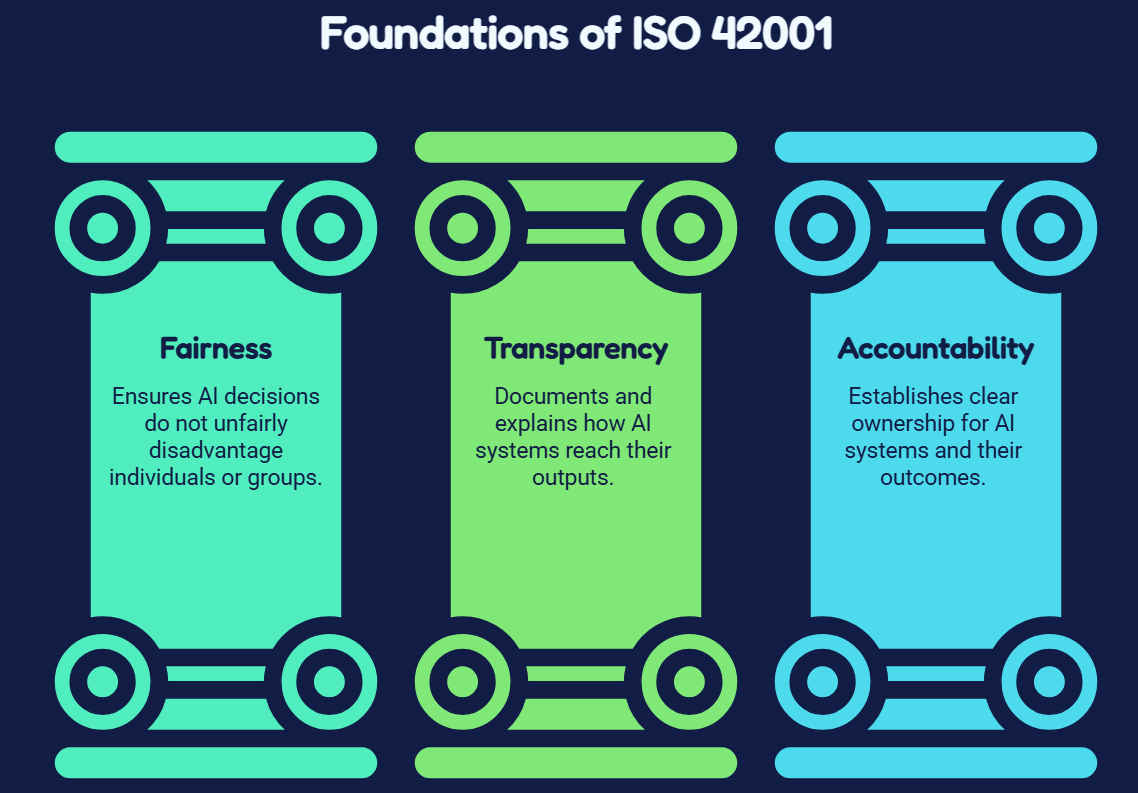
THE THREE PRINCIPLES ISO 42001 IS BUILT ON
|
Risk and impact assessment under ISO 42001 weighs every AI system against these three qualities, alongside its potential effect on the people and groups it touches. Controls are selected based on what a specific AI system could realistically get wrong – not applied as a blanket checklist.
GET DETAILED KNOWLEDGE ON HOW TO IMPLEMENT ISO 42001 IN THE BELOW VIDEO:
- How ISO 42001 Is Structured: Key Components
ISO 42001 is built on several core components that form the foundation of an AIMS. These components are what an organisation is actually assessed against during certification:
- AI Management System (AIMS): the overall framework of policies, processes, and people that governs how an organisation develops, provides, or uses AI. Like other ISO management systems, it is designed to scale to an organisation’s size and risk profile rather than being applied as a one-size-fits-all checklist.
- AI Risk and Impact Assessment: organisations assess both the operational risk an AI system poses to the business and its potential impact on individuals, groups, and society. This dual focus – technical risk plus human impact – is what sets ISO 42001 apart from standards built purely around information security.
- Annex A Controls: 38 AI-specific controls organised into nine control objectives (A.2 to A.10), covering areas such as AI policy, data, system lifecycle, and third-party relationships. Organisations select and implement the controls relevant to their own AI systems.
- Statement of Applicability (SoA): the document recording which Annex A controls apply, which don’t, and why. It is the foundational reference document auditors return to throughout certification.
- Continuous Improvement (PDCA Cycle): ISO 42001 follows the Plan-Do-Check-Act cycle, requiring organisations to monitor how their AI systems perform against stated objectives and adjust governance as the technology, the use case, or the regulatory landscape changes.
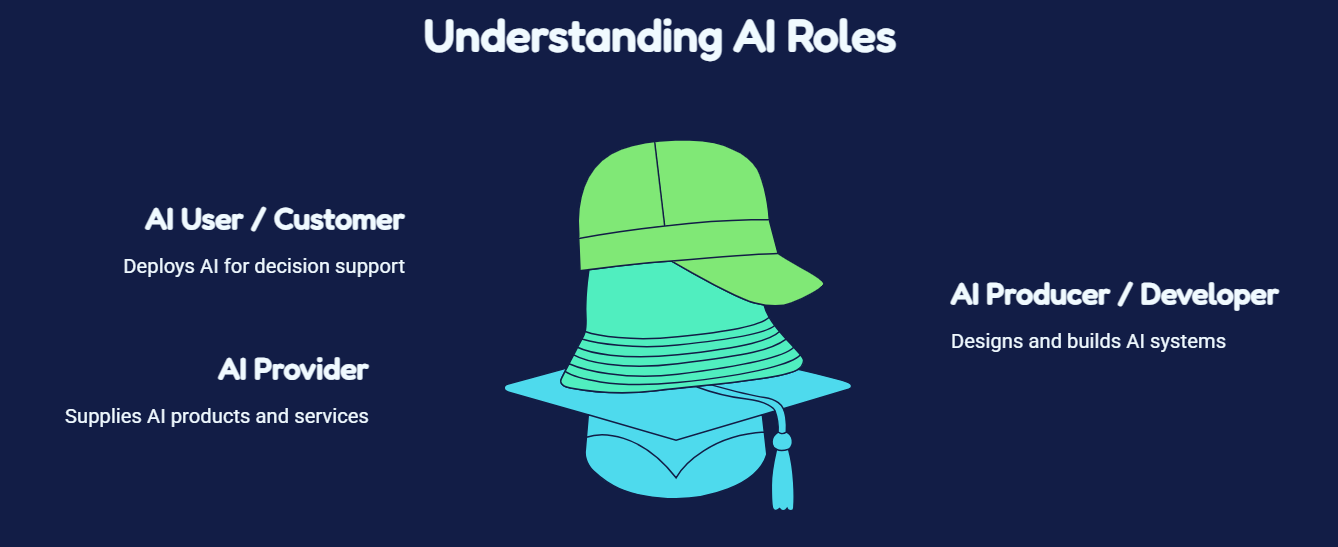
| Before scoping an AIMS, an organisation first identifies which role it plays in relation to its AI systems – this determines which Annex A controls are likely to apply and how the certification audit is approached. | WHICH AI ROLE ARE YOU?
|
- The Purpose of ISO 42001
ISO 42001 exists to give organisations a structured, auditable way to develop and use AI responsibly – balancing the pace of innovation with the governance needed to manage its risks. It does this through an AI Management System (AIMS): a documented, continually maintained framework covering the people, processes, and technology responsible for how AI is built, deployed, and monitored.
The standard serves three core purposes:
- Managing AI risk systematically. ISO 42001 requires organisations to identify the AI systems in use, assess the risks and potential impacts of each, and implement proportionate controls – replacing informal assumptions about what an AI system might get wrong with a documented, reviewable process.
- Building stakeholder trust. By demonstrating fairness, transparency, and accountability through independently audited controls – rather than self-assessment – organisations can show customers, partners, and regulators that their AI is governed responsibly.
- Supporting regulatory alignment. ISO 42001 maps closely to the direction of the EU AI Act and other emerging AI regulations. Organisations that implement an AIMS build much of the documentation and oversight these regulations expect, rather than starting from zero when a new law takes effect.
Beyond these three objectives, ISO 42001 builds responsible AI use into how an organisation operates day to day – through defined ownership of every AI system, staff awareness of AI risk, and an ongoing cycle of monitoring and improvement, rather than treating AI governance as a one-time project owned by a single team.
- How ISO 42001 Is Enforced
ISO 42001 is a voluntary international standard, not a government regulation. There is no single authority that mandates or polices its implementation. Instead, the framework operates through three layers of oversight:
- ISO and IEC. These bodies develop and publish the standard in collaboration with technical experts and industry representatives worldwide. They define the requirements – they don’t issue certificates or conduct audits.
- Accredited certification bodies. Certification is awarded by independent bodies accredited to assess management systems against ISO/IEC 42001. These bodies carry out the two-stage initial certification audit and the annual surveillance audits required to maintain the certificate, and are themselves overseen by national accreditation authorities.
- Internal AI governance teams. Alongside external audits, ISO 42001 requires organisations to run their own internal audits on a regular schedule. Internal teams assess whether the AIMS is operating as designed, identify nonconformities, and generate corrective actions – the function that keeps an AIMS current between external audits.
The result is layered accountability: ISO and IEC set the standard, accredited bodies verify conformance, and internal teams maintain it continuously.
- Industries That Benefit from ISO 42001
ISO 42001 is sector-agnostic by design – any organisation that develops, provides, or uses AI has a use for it. That said, some industries face elevated risk exposure or regulatory pressure that makes certification particularly valuable.
Financial services and fintech. Banks, insurers, and lenders increasingly use AI for credit scoring, fraud detection, and personalisation. ISO 42001 gives these firms a framework to manage AI-driven decisions that directly affect customers’ financial outcomes.
Healthcare and life sciences. AI used in diagnostics, clinical decision support, and patient triage carries direct consequences for patient safety. ISO 42001 supports healthcare organisations in demonstrating that these systems are governed with the rigour patients and regulators expect.
Technology and SaaS providers. Companies that build or embed AI into their products increasingly need to show enterprise buyers their AI is governed responsibly – certification is becoming a vendor qualification requirement in procurement, much as ISO 27001 already is for security.
Government and public sector. Public bodies using AI for service delivery, benefits assessment, or public safety face particular scrutiny over fairness and transparency. ISO 42001 offers a structured way to manage that responsibility.
E-commerce and retail. Recommendation engines, personalisation, and fraud detection all introduce data governance and bias risks. ISO 42001 helps retailers manage these risks as AI plays a larger role in the customer experience.
Legal and professional services. Firms using AI for research, drafting, or risk analysis need to demonstrate that AI-assisted work meets the same standards of accuracy and accountability as work done by people.
The common thread across all of these is not industry type – it is whether an AI system materially influences a decision, an outcome, or the trust a person places in an organisation. That is the relevant threshold, and ISO 42001 is built around it.
- The ISO 42001 Certification Process
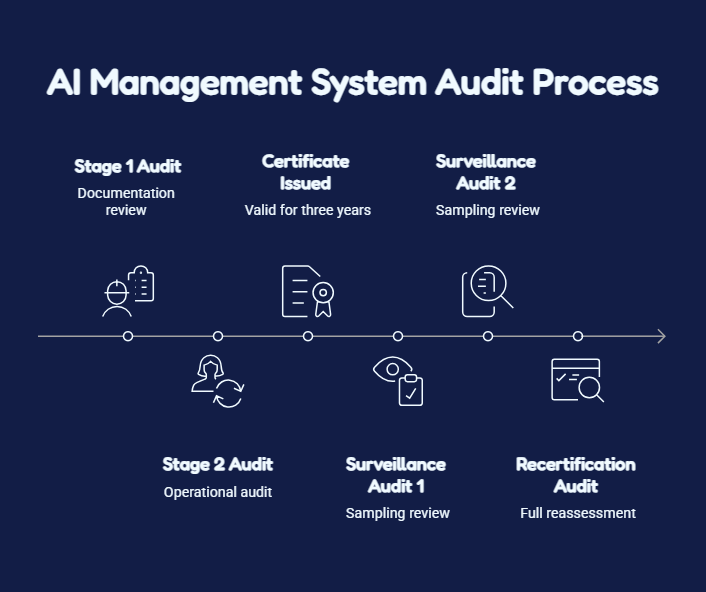
Certification follows a two-stage audit in year one, then two annual surveillance audits before a full recertification audit begins the next three-year cycle:
| Year | Audit | What it covers | Typical duration |
|---|---|---|---|
| Year 1 | Stage 1 Audit | Documentation review: scope, AI policy, risk methodology, SoA | 1-2 days |
| Year 1 | Stage 2 Audit | Operational audit verifying controls are implemented and effective | 2-9 days |
| Year 1 | Certificate issued | Valid for a three-year cycle | – |
| Year 2 | Surveillance Audit 1 | Sampling review of AIMS effectiveness and corrective actions | 1-3 days |
| Year 3 | Surveillance Audit 2 | Sampling review of AIMS effectiveness and corrective actions | 1-3 days |
| Year 4 | Recertification Audit | Full reassessment; new three-year cycle begins | Similar to Stage 1 + 2 |
| Most organisations take three to twelve months to prepare for Stage 1, depending on size and how mature their existing AI governance already is. Any major nonconformity raised at Stage 2 typically needs to be resolved within 90 days before the certificate is issued. | ISO 42001 BY THE NUMBERS
|
- Frequently Asked Questions
What is the Statement of Applicability (SoA)? The SoA is the document that records which of the 38 Annex A controls are implemented, which are excluded, and the justification for each decision. It is one of the foundational AIMS documents and typically the first thing an auditor asks for at Stage 1.
Does an organisation need to implement all 38 Annex A controls? No. Organisations select the controls relevant to their AI systems and risk profile, and document the justification for any that are excluded. The selection should be driven by the risk and impact assessment, not convenience. Excluded controls without a documented reason are a common audit finding.
What is the difference between ISO 42001 and ISO 27001? ISO 27001 governs information security; ISO 42001 governs how AI systems are developed, provided, and used. They share the same high-level structure, so organisations already certified to ISO 27001 typically find ISO 42001 faster to implement, but ISO 42001 adds AI-specific requirements – fairness, explainability, and AI impact assessment – that ISO 27001 doesn’t cover.
How does ISO 42001 relate to the EU AI Act? The EU AI Act is a legal requirement for organisations operating in the EU; ISO 42001 is a voluntary standard. The two are designed to complement each other – the Act sets out what must be achieved, while ISO 42001 provides the operating framework, documentation, and audit trail to evidence it. Certification alone doesn’t guarantee Act compliance, but it covers a significant share of what the Act expects from a governance perspective.
How does ISO 42001 relate to GDPR and India’s DPDP Act? AI systems that process personal data sit at the intersection of AI governance and data protection law. ISO 42001’s controls around data quality, data provenance, and AI system impact assessment support the same objectives as GDPR and the DPDP Act, so organisations implementing an AIMS typically satisfy a meaningful portion of their data protection obligations through the same evidence base.
Can a small business or startup get ISO 42001 certified? Yes. The standard is built to scale, and many AI-native startups pursue certification specifically to win enterprise contracts that require it. The key for smaller organisations is keeping the AIMS scope tight and realistic – covering the core AI product first – rather than attempting to certify every system in the first cycle.
What is the most common reason organisations delay or fail certification? Scoping too broadly on the first attempt, AI policies that don’t reflect how the organisation actually develops or uses its AI systems, and treating certification as a one-off project rather than an ongoing management practice. Missing or undocumented impact assessments are also a frequent Stage 2 finding.
What happens if a nonconformity is found during the audit? Minor nonconformities allow the certificate to be issued alongside a corrective action plan. Major nonconformities must be resolved – usually within 90 days – before certification is granted, and may require a follow-up audit before Stage 2 is concluded.
How long does ISO 42001 certification take, and what does it cost? Most organisations take three to twelve months to prepare, depending on size and existing maturity. Audit fees vary widely with organisational size and AI complexity, and implementation costs – documentation, training, internal audit – typically run two to three times the audit fee itself.
ISO 42001 is still new, but it is quickly becoming the reference point for what responsible AI governance looks like in practice. Organisations that build an AIMS now – rather than waiting for regulation to force the issue – are the ones best placed to use AI with confidence, and to demonstrate it to everyone watching.
How does GCAI support organisations through the certification process? GCAI provides certified AI Management System Lead Auditors who support organisations from initial gap analysis through to certificate issuance, including readiness assessment, AIMS documentation review, Stage 1 and Stage 2 audit management, and corrective action guidance. A DIY readiness assessment option is also available for organisations that want to evaluate their current AI governance posture before committing to full certification.