What Is ISO 22301?
The international standard every organisation managing risk and resilience needs to understand.
ISO 22301 is the international standard for Business Continuity Management Systems (BCMS). Published by the International Organization for Standardization (ISO), it provides a systematic framework for organisations to plan, establish, implement, operate, monitor, review, maintain, and continually improve their ability to protect against, prepare for, respond to, and recover from disruptive incidents when they arise.
Unlike a simple policy document or checklist, ISO 22301 defines a full management system. Certification requires demonstrating ongoing compliance through independent third-party audits, not a one time assessment.
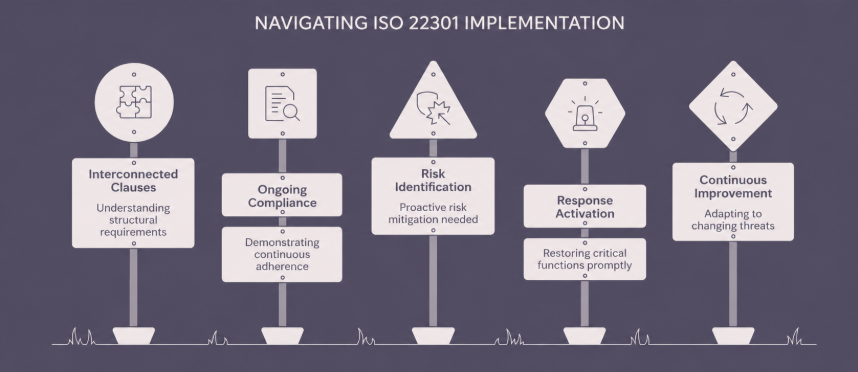
ISO 22301 is built around a set of interconnected clauses not a single rule and almost all of its practical requirements sit in Clauses 4 through 10. Understanding the structure is essential before attempting to implement or certify.
THE THREE CORE PILLARS OF ISO 22301
- Prevention and preparedness – identifying risks before they materialise, and embedding continuity controls into daily operations.
- Response and recovery – activating documented plans to restore critical functions within defined timeframes when disruption occurs.
- Continuous improvement – reviewing performance, conducting audits, and updating the BCMS in response to changing threats and organisational context.
ISO 22301 applies to any organisation regardless of size, sector, or geography that wants to demonstrate a credible ability to withstand and recover from disruption. Certification is often required by regulators, enterprise customers, and procurement frameworks in critical sectors such as finance, healthcare, and public infrastructure.
Related reading: Business Impact Analysis & Risk Assessment · BCP vs BCMS · ISO 22301 Clause Breakdown · Who Needs ISO 22301?
How GCAI helps: GCAI conducts an ISO 22301 gap assessment against all mandatory clauses (4–10), maps your existing continuity controls, and identifies what needs to be built, documented, or updated before certification.
Business Impact Analysis & Risk Assessment
The foundation of any credible business continuity management system.
Most business continuity programmes fail not because organisations lack plans, but because those plans are not grounded in a rigorous analysis of what actually matters. ISO 22301 addresses this through two closely linked requirements: Business Impact Analysis (BIA) and Risk Assessment.
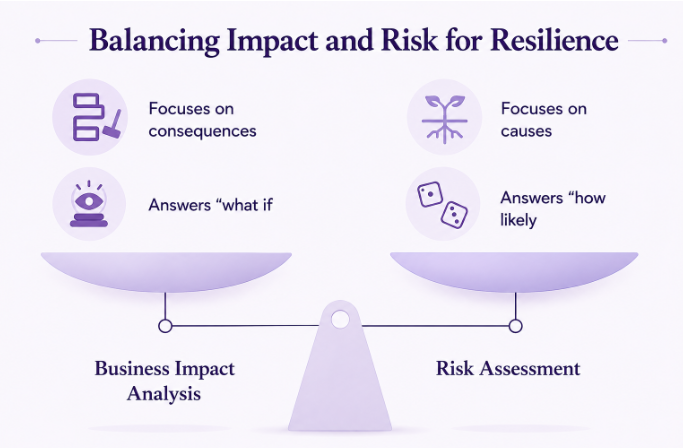
The BIA asks a deceptively simple question: if a function stopped working today, how long could the organisation tolerate that before the consequences become unacceptable? The answers drive every downstream decision recovery time objectives, resource prioritisation, supplier dependencies, and crisis communications.
WHAT THE BIA MUST ESTABLISH
- Critical activities – the specific processes, functions, and services that must continue or be recovered first during a disruption.
- Maximum Tolerable Period of Disruption (MTPD) – the point beyond which the impact of non-availability becomes unacceptable to the organisation.
- Recovery Time Objective (RTO) – the target time within which a critical activity must be restored after disruption.
- Minimum Business Continuity Objective (MBCO) – the minimum level of service required during recovery, not necessarily full capacity.
- Dependencies – internal resources, external suppliers, utilities, and technology systems that critical activities rely on.
Risk Assessment under ISO 22301 is narrower in scope than enterprise-wide risk management. The focus is specifically on threats that could disrupt business continuity not general organisational risks. Common threat categories include cyberattacks, power outages, supply chain failures, extreme weather events, and pandemics.
BIA VS RISK ASSESSMENT: KEY DISTINCTION
| What it answers | |
| Business Impact Analysis | What happens to us if a function is disrupted, and how long can we tolerate it? |
| Risk Assessment | What threats could cause that disruption, and how likely and severe are they? |
ISO 22301 Clause 8.2 requires both the BIA and risk assessment to be performed at planned intervals, not just at initial implementation. Auditors will expect evidence of regular reviews and documented updates whenever the organisation’s context, operations, or threat environment changes.
Related reading: What Is ISO 22301? · Business Continuity Strategies · ISO 22301 Clause Breakdown · Incident Response Under ISO 22301
(How GCAI helps: GCAI facilitates structured BIA workshops with process owners, documents MTPDs and RTOs per function, and produces a risk register mapped to ISO 22301 Clause 8.2 requirements ready for auditor review.)
Business Continuity Plan vs Business Continuity Management System
Same goal, very different scope and conflating the two is one of the most common mistakes in continuity planning.
A Business Continuity Plan (BCP) is a document. A Business Continuity Management System (BCMS) is the management framework that creates, tests, maintains, and improves that document. ISO 22301 certifies the BCMS, not the plan itself.
Organisations that treat ISO 22301 as a documentation exercise producing a BCP and stopping there consistently struggle at audit. Certification auditors are not checking whether you have a plan. They are checking whether you have a functioning system that governs how continuity is planned, exercised, reviewed, and improved over time.
BCP VS BCMS AT A GLANCE
| Business Continuity Plan (BCP) | Business Continuity Management System (BCMS) | |
| What it is | A documented set of procedures for responding to and recovering from disruption | The governance framework, processes, and controls that manage the entire continuity lifecycle |
| Scope | Specific incidents, functions, or recovery actions | Organisation-wide, end-to-end from BIA through to audit and improvement |
| ISO 22301 role | One output of the BCMS (required under Clause 8.4) | The subject of ISO 22301 certification |
| Audited? | Yes, as evidence within the BCMS | Yes, the BCMS itself is what’s certified |
| Owned by | Business continuity team or designated coordinator | Senior leadership, with delegated accountability |
The BCMS encompasses far more than response procedures. It includes your BIA methodology, risk assessment process, training and awareness programme, exercise and testing schedule, management review cadence, and corrective action tracking. The BCP is one artefact within that system important, but not sufficient on its own.
WHAT THE BCMS MUST INCLUDE BEYOND THE BCP
- Documented BCMS scope and policy, approved at senior leadership level.
- Business Impact Analysis and Risk Assessment processes and outputs.
- Defined roles, responsibilities, and competence requirements for continuity personnel.
- Communication plans for internal teams, external stakeholders, and regulators during an incident.
- Exercise and testing schedule, including tabletop exercises and live simulations.
- Internal audit programme and management review process.
- Corrective action process to close gaps identified through audits, exercises, and incidents.
Related reading: What Is ISO 22301? · Business Impact Analysis & Risk Assessment · Who Needs ISO 22301? · ISO 22301 vs ISO 27001
How GCAI helps: GCAI builds and documents your full BCMS framework not just the BCP ensuring every clause 4–10 requirement is addressed with evidence that will satisfy a Stage 1 and Stage 2 certification audit.
Who Needs ISO 22301 Certification?
Unlike some frameworks, ISO 22301 is not sector-specific but certain industries face stronger pressure to certify.
ISO 22301 can apply to any organisation that wants to demonstrate a systematic ability to prepare for, respond to, and recover from disruptive incidents. Certification is voluntary in most jurisdictions, but commercial and regulatory expectations have made it functionally mandatory in a growing number of sectors.
Financial services and banking. The EU Digital Operational Resilience Act (DORA), which came into force in January 2025, mandates robust incident response and business continuity planning for financial entities across Europe. ISO 22301 certification is explicitly recognised as aligning with DORA requirements, making it a strategic asset for firms in this space.
Critical national infrastructure. Energy, water, telecommunications, and transport operators face increasing regulatory expectations around operational resilience. Many procurement frameworks and government contracts require evidence of certified business continuity capability.
Healthcare and life sciences. Hospitals, pharmaceutical manufacturers, and medical device companies operating under regulatory frameworks such as NHS England’s Business Continuity Policy or FDA requirements benefit significantly from the structured BCMS approach ISO 22301 provides.
Technology and SaaS providers. Enterprise customers particularly those in regulated industries increasingly require ISO 22301 certification as a condition of supplier approval. A certified BCMS demonstrates that your platform or service has documented recovery capabilities, not just a vague promise of uptime.
DO YOU NEED ISO 22301?
- Are you a supplier to regulated sectors – finance, healthcare, energy, or government? -> Customers and procurement frameworks may require it.
- Have you been asked by an enterprise customer to demonstrate formal business continuity capability? -> ISO 22301 certification is the accepted standard of proof.
- Does your organisation rely on complex supply chains or critical technology infrastructure? -> The BCMS framework is built for exactly this risk profile.
- Are you subject to DORA, NIS2, or other resilience regulations? -> ISO 22301 aligns directly with these frameworks and reduces your compliance burden.
Organisations that delay continuity investment until after a significant incident consistently report that the cost of unplanned disruption – lost revenue, reputational damage, and regulatory penalties far exceeds the cost of implementing a BCMS.
Related reading: What Is ISO 22301? · BCP vs BCMS · ISO 22301 vs ISO 27001 · ISO 22301 Clause Breakdown
How GCAI helps: GCAI scopes ISO 22301 around your specific operations, regulatory environment, and customer requirements, so you implement only what applies, and nothing that doesn’t.
ISO 22301 vs ISO 27001: Which Do You Need?
Two ISO standards, two different problems and most organisations in critical sectors need both.
ISO 22301 and ISO 27001 are the two most commonly paired ISO management system standards, and they are also the most frequently confused. Understanding what each one covers — and where they overlap is essential before committing to either certification programme.
ISO 27001 is an information security management system (ISMS) standard. Its focus is on protecting the confidentiality, integrity, and availability of information assets from threats such as cyberattacks, data breaches, and unauthorised access. Annex A of ISO 27001 includes a control for business continuity, but it is narrow: it requires only that information security continuity is considered, not that a full BCMS is built.
ISO 22301 is a business continuity management system standard. Its focus is on the organisation’s ability to continue delivering products and services during and after any type of disruption not just cyber incidents. This includes natural disasters, supply chain failures, power outages, pandemics, and facility loss.
ISO 22301 VS ISO 27001: SIDE BY SIDE
| ISO 22301 | ISO 27001 | |
| What it covers | Business continuity — keeping operations running during any disruption | Information security — protecting data and systems from threats |
| Primary concern | Operational resilience and recovery time | Confidentiality, integrity, and availability of information |
| Certification body | Accredited third-party auditors (UKAS, DAkkS, etc.) | Accredited third-party auditors (UKAS, DAkkS, etc.) |
| BCP required? | Yes — a core BCMS output under Clause 8.4 | Partial — Annex A.17 requires continuity for information security only |
| Mandatory? | No, but required by regulators and customers in many sectors | No, but widely required by enterprise customers and regulators |
| Typical driver | Operational resilience, DORA, government contracts | Cyber risk, customer trust, enterprise procurement requirements |
WHEN YOU NEED BOTH ?
- You operate in a regulated sector — financial services, healthcare, critical infrastructure — where both cyber resilience and operational continuity are assessed separately.
- Enterprise customers require evidence of certified information security AND business continuity capability as part of supplier due diligence.
- Your organisation has experienced both a cyber incident and an operational disruption — and recognised the gap between the two recovery tracks.
The practical good news: ISO 22301 and ISO 27001 share a common framework structure (Annex SL / ISO Harmonised Approach). Organisations that have already implemented one standard have a significant head start on the other, particularly for Clauses 4–7 and 9–10.
Related reading: What Is ISO 22301? · Who Needs ISO 22301? · ISO 22301 Clause Breakdown · ISO 22301 FAQ
How GCAI helps: GCAI builds integrated BCMS and ISMS programmes that share documentation, audit evidence, and management review outputs — reducing the overhead of running two certification programmes side by side.
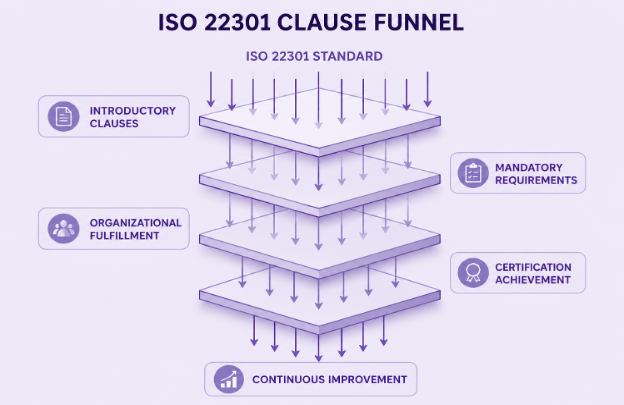
ISO 22301 Clause Breakdown
A structured walkthrough of every mandatory requirement, from context-setting to continuous improvement.
ISO 22301:2019 is structured across ten clauses. Clauses 1 to 3 are introductory and informational. Clauses 4 to 10 contain the mandatory requirements that organisations must fulfil to achieve and maintain certification. Here is what each clause requires in practice.
CLAUSE 4: CONTEXT OF THE ORGANISATION
- Identify internal and external issues relevant to the organisation’s purpose and that affect its ability to deliver intended BCMS outcomes.
- Determine the needs and expectations of interested parties — customers, regulators, employees, suppliers — who are relevant to the BCMS.
- Define the scope of the BCMS, including which sites, functions, products, and services fall within its boundaries.
CLAUSE 5: LEADERSHIP
- Top management must demonstrate visible commitment to the BCMS — not delegate it entirely to a coordinator.
- A documented business continuity policy must be approved at senior level, communicated across the organisation, and reviewed regularly.
- Roles, responsibilities, and authorities must be assigned and documented for all personnel with BCMS responsibilities.
CLAUSE 6: PLANNING
- Identify risks and opportunities that could affect the BCMS’s ability to achieve its objectives.
- Establish measurable business continuity objectives and plans to achieve them.
- Document how changes to the BCMS will be planned and controlled.
CLAUSE 7: SUPPORT
- Provide the resources — people, technology, budget — necessary to establish and maintain the BCMS.
- Ensure that personnel performing continuity-related roles are competent and trained.
- Establish awareness programmes so all relevant staff understand the BCMS and their role within it.
- Control documented information: maintain required records, ensure documents are accessible, and manage version control.
CLAUSE 8: OPERATION (THE OPERATIONAL CORE)
Clause 8 is the substantive heart of ISO 22301. It translates planning and policy into working processes that auditors will examine in detail.
- Clause 8.2: Business Impact Analysis and Risk Assessment — establish and maintain BIA and risk assessment processes, with documented outputs reviewed at planned intervals.
- Clause 8.3: Business continuity strategies — identify and select strategies for prevention, response, and recovery based on BIA and risk assessment outputs.
- Clause 8.4: Business continuity plans and procedures — document response procedures, communication plans, roles, and recovery actions for critical activities.
- Clause 8.5: Exercise programme — test business continuity plans and procedures through scheduled exercises, document outcomes, and address identified gaps.
- Clause 8.6: Evaluation of business continuity documentation and capabilities — review and update plans following exercises, incidents, and significant organisational changes.
CLAUSES 9–10: PERFORMANCE AND IMPROVEMENT
- Clause 9: Monitor and measure BCMS performance, conduct internal audits at planned intervals, and hold management reviews to assess the system’s effectiveness.
- Clause 10: Identify nonconformities, implement corrective actions, and drive continual improvement in the BCMS over time.
Related reading: What Is ISO 22301? · BCP vs BCMS · Business Impact Analysis & Risk Assessment · ISO 22301 FAQ
How GCAI helps: GCAI maps your current state against every Clause 4–10 requirement, identifies gaps, and builds the documentation and evidence library you need to pass Stage 1 and Stage 2 certification audits.
ISO 22301 FAQ
Straightforward answers to the questions organisations ask most when starting their certification journey.
IS ISO 22301 MANDATORY?
ISO 22301 is not a legal requirement in most jurisdictions. Certification is voluntary. However, it is increasingly required by enterprise customers as a condition of supplier approval, by procurement frameworks for critical infrastructure contracts, and by regulators in sectors subject to DORA, NIS2, and similar operational resilience requirements. For organisations in those sectors, voluntary and mandatory are becoming difficult to distinguish in practice.
HOW LONG DOES ISO 22301 CERTIFICATION TAKE?
Most organisations complete ISO 22301 certification within six to twelve months from gap assessment to certification decision. The timeline depends on the size and complexity of the organisation, the maturity of existing continuity processes, how much documentation needs to be built from scratch, and the availability of internal stakeholders for BIA workshops, training, and exercises. Organisations that have already implemented ISO 27001 or another Annex SL standard typically move faster.
WHAT IS THE DIFFERENCE BETWEEN STAGE 1 AND STAGE 2 AUDITS?
| Audit Stage | What the auditor reviews |
| Stage 1 (Documentation Review) | Confirms that the BCMS is designed to meet ISO 22301 requirements. Auditor reviews the BCMS scope, policy, BIA outputs, risk register, objectives, and documented procedures. Typically conducted off-site or as a desk review. |
| Stage 2 (Implementation Audit) | Confirms that the BCMS is operating effectively in practice. Auditor interviews staff, reviews records, examines exercise outputs, and validates that documented processes are actually being followed. Conducted on-site. |
DOES ISO 22301 OVERLAP WITH ISO 27001?
Yes — significantly, in two areas. First, both standards share the Annex SL / ISO Harmonised Approach structure, so Clauses 4 through 7 and 9 through 10 follow the same pattern. Organisations already certified to ISO 27001 can reuse much of their context analysis, stakeholder mapping, leadership documentation, and internal audit programme. Second, ISO 27001 Annex A includes a business continuity control (A.17), but it covers only the continuity of information security processes, not full operational continuity. ISO 22301 goes significantly further.
HOW OFTEN MUST THE BCMS BE REVIEWED?
ISO 22301 does not prescribe a specific review frequency — it requires reviews to be conducted at planned intervals. In practice, most organisations conduct formal management reviews annually, with more frequent reviews following significant incidents, major organisational changes, or failed exercises. The BIA and risk assessment must also be reviewed at planned intervals and whenever context changes materially.
WHAT HAPPENS IF WE FAIL AN AUDIT?
A certification audit can result in three outcomes: certification (no significant nonconformities), conditional certification (minor nonconformities that must be corrected within an agreed timeframe), or non-certification (major nonconformities that require re-audit). Organisations that work with an experienced implementation partner before the certification audit typically avoid major nonconformities by addressing gaps during implementation rather than discovering them at audit.
Related reading: What Is ISO 22301? · Who Needs ISO 22301? · ISO 22301 Clause Breakdown · ISO 22301 vs ISO 27001
How GCAI helps: GCAI prepares your organisation for certification from day one — scoping the BCMS, building required documentation, facilitating BIA workshops, running mock exercises, and conducting a pre-audit readiness review before your Stage 1 audit date.