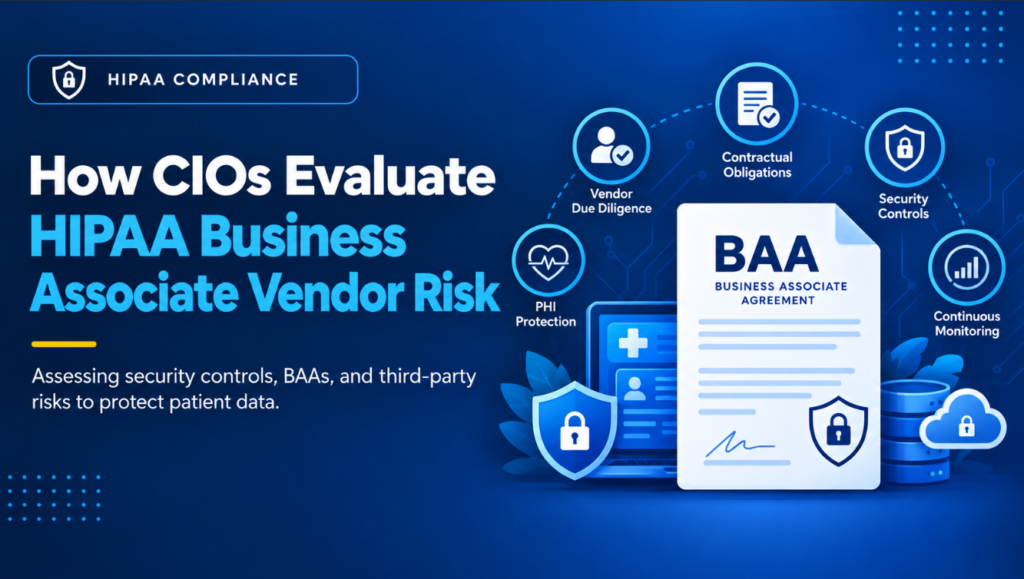
How CIOs Evaluate HIPAA Business Associate Vendor Risk
Why Business Associate Risk Is a CIO Priority
Healthcare organizations increasingly depend on external vendors to manage sensitive information, streamline operations, improve patient experiences, and support digital transformation. From electronic health record (EHR) platforms and cloud hosting providers to billing companies, analytics firms, and healthcare technology startups, third-party vendors have become integral to modern healthcare infrastructure.
However, every new vendor that handles protected health information introduces potential security, privacy, operational, and regulatory risks.
For Chief Information Officers (CIOs), selecting a technology vendor is no longer simply a question of functionality, pricing, or implementation speed. It is also a decision about how effectively the organization can protect patient information while maintaining regulatory compliance and operational resilience.
This responsibility becomes particularly important under the Health Insurance Portability and Accountability Act (HIPAA), the United States legislation that establishes requirements for protecting protected health information (PHI).
When a third-party organization performs certain functions or services involving PHI on behalf of a healthcare provider, health plan, or another regulated organization, it may qualify as a business associate. Examples include cloud service providers, claims processors, medical transcription companies, billing services, and certain software providers.
A business associate relationship introduces responsibilities that extend beyond the immediate healthcare organization. Vendors may store, process, transmit, or access sensitive patient information, creating additional points where security controls could fail.
Consequently, CIOs must evaluate whether prospective vendors have the technical safeguards, administrative processes, contractual commitments, and operational maturity necessary to manage these risks.
The challenge is not merely identifying whether a vendor claims to be HIPAA compliant. It is determining whether the vendor can demonstrate that its security practices are appropriate for the nature of the information it handles and the services it provides.
Effective vendor risk management requires evidence, accountability, and continuous oversight rather than reliance on compliance statements alone.
This article explores how CIOs evaluate HIPAA business associate vendor risk, which security controls matter most, how organizations conduct vendor assessments, and how technology leaders can establish a sustainable third-party risk management framework.
Understanding HIPAA Business Associates and Their Responsibilities
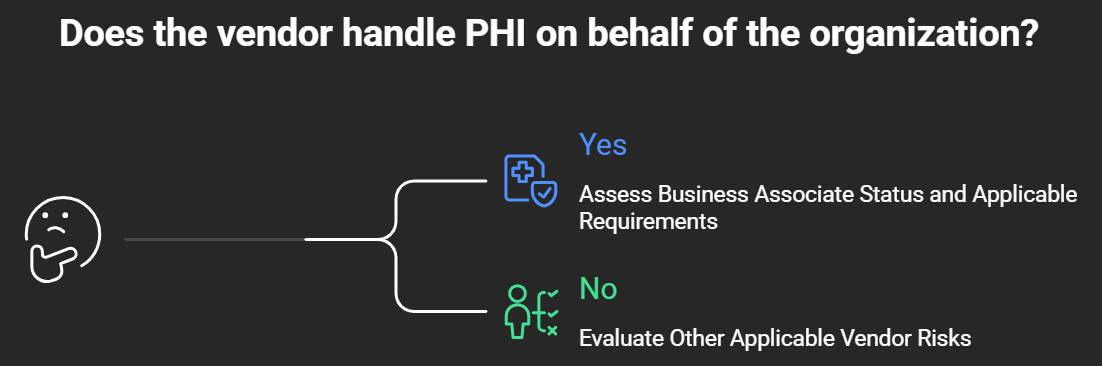
Before evaluating vendor risk, CIOs must determine whether a prospective vendor qualifies as a business associate under HIPAA.
The HIPAA Privacy Rule generally defines a business associate as a person or organization that performs certain functions or activities involving PHI on behalf of a covered entity, or provides services to a covered entity that involve the use or disclosure of PHI.
Covered entities generally include healthcare providers conducting certain electronic transactions, health plans, and healthcare clearinghouses.
Business associates can include organizations providing:
- Cloud infrastructure and hosting services involving electronic protected health information.
- Medical billing, claims processing, and payment administration.
- Electronic health record hosting and support.
- Medical transcription and documentation services.
- Healthcare analytics and data processing.
- Patient engagement platforms that handle PHI.
- IT support services involving access to systems containing PHI.
- Certain consulting, legal, accounting, and administrative services involving PHI.
The classification depends on the actual services performed and the nature of the relationship, rather than the vendor’s marketing description or industry category.
For example, a cloud provider that maintains electronic protected health information on behalf of a healthcare organization may qualify as a business associate even if it cannot view the information in readable form.
Similarly, a software provider that processes patient information for a hospital may have business associate obligations, depending on the service and contractual arrangement.
However, not every technology vendor automatically qualifies as a business associate. The determination depends on the applicable HIPAA definitions, exceptions, and circumstances of the relationship.
What Is a Business Associate Agreement?
A Business Associate Agreement (BAA) is a written contract or arrangement establishing the permitted uses and disclosures of PHI and defining the business associate’s relevant obligations.
Under HIPAA, covered entities generally must obtain satisfactory assurances through a compliant BAA before permitting a business associate to handle PHI on their behalf.
The agreement establishes important requirements concerning information protection, permitted data use, incident reporting, and the responsibilities of the parties.
A BAA generally addresses:
- Permitted and required uses and disclosures of PHI.
- Restrictions on unauthorized uses and disclosures.
- Appropriate safeguards for electronic protected health information.
- Reporting of security incidents and applicable breaches.
- Cooperation with relevant compliance obligations.
- Requirements for subcontractors that handle PHI.
- Applicable provisions concerning access, amendment, and accounting obligations where relevant.
- Return or destruction of PHI when the relationship ends, where feasible and as required by the agreement and applicable rules.
A BAA is an essential component of the vendor relationship, but it does not independently establish that the vendor’s security controls are effective.
CIOs must therefore evaluate the agreement alongside technical evidence, operational procedures, and documented risk assessments.
The U.S. Department of Health and Human Services provides additional information on business associate relationships and contractual requirements in its official guidance.
Reference: https://www.hhs.gov/hipaa/for-professionals/privacy/guidance/business-associates/index.html
The CIO’s Role in Third-Party HIPAA Risk Management
CIOs occupy a strategic position between technology operations, information security, business objectives, regulatory expectations, and organizational leadership.
Their responsibility is not necessarily to conduct every technical assessment personally. Instead, they must ensure that an appropriate governance process exists for identifying, evaluating, accepting, and monitoring vendor risk.
A strong vendor risk management process brings together multiple functions, including IT, cybersecurity, legal, compliance, procurement, privacy, and business operations.
Each function contributes a different perspective.
The cybersecurity team evaluates technical safeguards and vulnerabilities. Legal teams review contractual obligations and liability provisions. Compliance professionals assess applicable regulatory requirements. Procurement evaluates commercial terms and vendor reliability. Business leaders determine the operational importance of the service.
The CIO helps integrate these perspectives into a decision that balances business value with acceptable risk.
Establishing the Business Context
The first step is understanding what the vendor will do and how its services affect the organization.
A vendor providing a scheduling application with limited access to patient information presents a different risk profile from a cloud platform hosting a hospital’s entire electronic health record environment.
CIOs should establish:
- The purpose of the vendor relationship.
- The categories and sensitivity of information involved.
- The volume of PHI the vendor may process.
- The systems and applications the vendor can access.
- Whether the vendor requires privileged or remote access.
- The business processes that depend on the service.
- The consequences of service disruption or data compromise.
- The vendor’s subcontractors and external dependencies.
These details help determine the appropriate depth of the assessment.
Risk-Based Decision-Making
Not every vendor requires the same level of scrutiny.
A risk-based approach directs the greatest attention toward vendors whose failure could result in significant exposure of patient information, substantial operational disruption, or serious regulatory consequences.
For instance, a vendor hosting critical clinical systems should generally undergo more extensive due diligence than a supplier that has no access to PHI and does not provide a service that materially affects protected systems.
This approach helps organizations allocate assessment resources efficiently without overlooking high-impact dependencies.
The objective is to establish a clear relationship between the vendor’s business function, its access to sensitive information, and the level of oversight it requires.
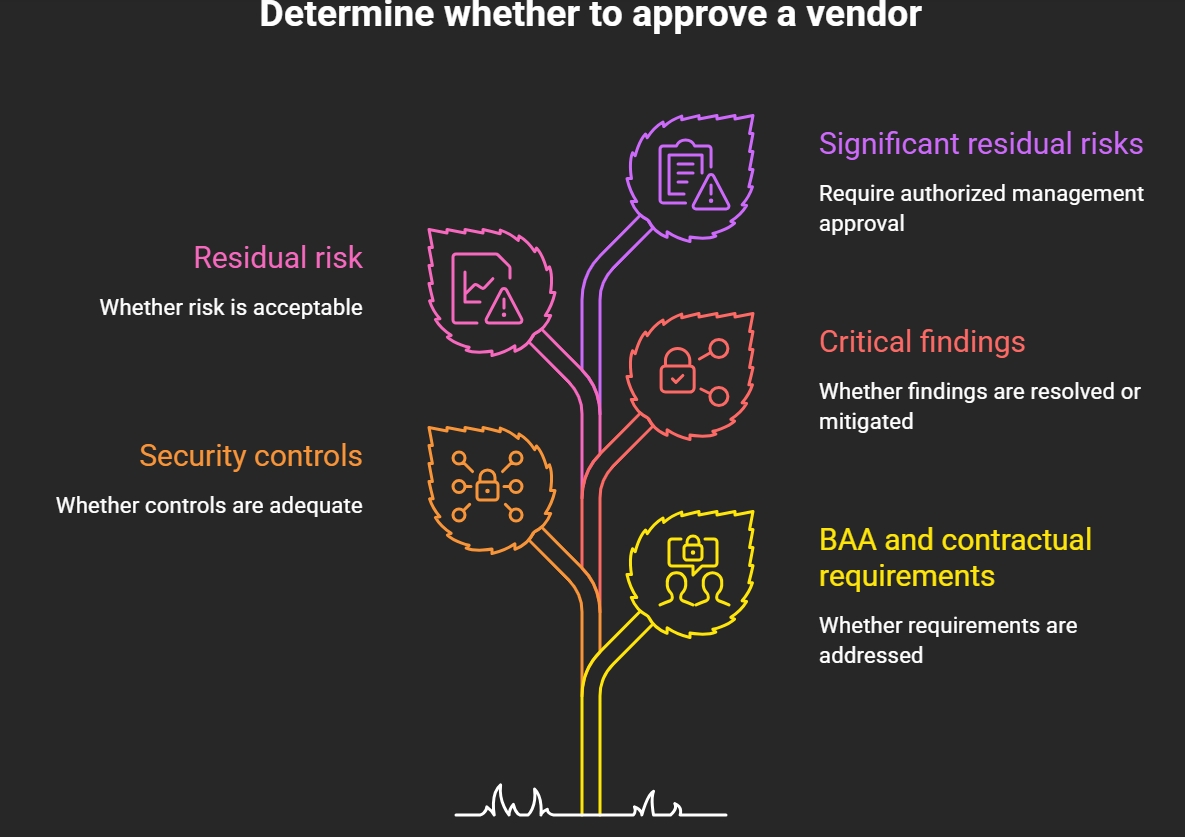
CIOs should also establish decision-making authority. High-risk vendors may require approval from senior leadership or a designated risk committee, particularly when significant residual risks remain unresolved.
Evaluating Vendor Security Controls and Technical Safeguards
Technical safeguards are a central component of HIPAA business associate risk assessments.
CIOs must determine whether vendors have appropriate mechanisms to protect electronic protected health information against unauthorized access, alteration, disclosure, loss, and disruption.
The HIPAA Security Rule establishes requirements for administrative, physical, and technical safeguards. It does not prescribe one universal technology stack for every organization. Instead, regulated organizations must implement reasonable and appropriate protections based on their circumstances and applicable requirements.
A vendor assessment should therefore examine both the existence of security controls and their effectiveness in the environment where PHI is handled.
Identity and Access Management
Unauthorized access is a major source of healthcare data exposure.
CIOs should evaluate how vendors authenticate users, authorize access, manage privileged accounts, and remove access when employees or contractors leave.
Important questions include:
- Does the vendor enforce appropriate authentication controls?
- Is multifactor authentication used for relevant administrative and remote-access systems?
- Are privileged accounts restricted to authorized personnel?
- Does the vendor follow least-privilege principles?
- Are user access rights reviewed periodically?
- Is access promptly revoked when it is no longer required?
- Are access events logged and monitored?
The assessment should focus on controls relevant to the vendor’s actual architecture and level of access.
For example, a vendor with administrative access to a production EHR environment presents a different access risk from a vendor whose employees can only access a restricted support portal.
Data Encryption and Protection
Encryption can reduce the risk associated with unauthorized disclosure of sensitive information.
CIOs should understand how the vendor protects PHI while it is transmitted across networks and when it is stored on systems, databases, backups, and portable devices.
Assessment considerations include encryption methods, key management, access restrictions, backup protection, and the handling of information exported from production environments.
Organizations should also understand whether the vendor uses PHI in development, testing, analytics, or artificial intelligence workflows.
Where patient information is used outside its original operational purpose, CIOs should evaluate the authorization, privacy, security, and contractual implications.
Encryption should not be treated as a complete substitute for access controls, monitoring, or other safeguards. A system may still be exposed if an authorized account is compromised or encryption keys are improperly managed.
Logging, Monitoring, and Threat Detection
Security monitoring helps organizations identify suspicious activity before it develops into a larger incident.
CIOs should determine whether vendors record relevant authentication events, privileged actions, data access, configuration changes, and security alerts.
They should also assess how logs are protected, how suspicious events are investigated, and whether the vendor can provide relevant evidence during a security incident.
A vendor that collects logs but does not review alerts or investigate suspicious activity may have a significant operational weakness.
Vulnerability and Patch Management
Unpatched software, insecure configurations, and outdated systems can expose PHI to exploitation.
CIOs should assess how vendors identify vulnerabilities, prioritize remediation, deploy security patches, and manage exceptions when immediate remediation is not possible.
The assessment should consider vulnerability scanning, penetration testing, remediation timelines, change management, and the handling of unsupported technologies.
Evidence should demonstrate how the vendor manages security weaknesses in practice rather than merely confirming that a vulnerability management policy exists.
Backup and Recovery
Healthcare systems must remain available when patients and clinical teams need them.
CIOs should evaluate the vendor’s backup strategy, recovery procedures, resilience architecture, and ability to restore affected services following a cyberattack, system failure, or other disruption.
Relevant evidence may include recovery test results, backup restoration records, disaster recovery exercises, and documented recovery objectives.
The central question is whether the vendor can protect the confidentiality, integrity, and availability of electronic protected health information while supporting the organization’s operational requirements.
Reference: https://www.hhs.gov/hipaa/for-professionals/security/laws-regulations/index.html
Conducting Vendor Due Diligence: Evidence Beyond Compliance Claims
Vendor due diligence is the process of gathering and evaluating evidence to determine whether a supplier can meet the organization’s security, privacy, contractual, and operational expectations.
For CIOs, this stage is particularly important because vendor claims do not always provide sufficient evidence of actual control effectiveness.
Statements such as “HIPAA compliant,” “enterprise-grade security,” or “healthcare-ready infrastructure” should be treated as starting points for investigation rather than final proof.
A credible assessment combines documentary evidence, technical validation, interviews, and an understanding of the vendor’s operating environment.
Security Questionnaires and Control Assessments
Organizations commonly begin with a structured security questionnaire.
The questionnaire should reflect the vendor’s services, data access, technology architecture, and risk classification.
Questions may cover information security governance, access control, incident response, employee training, encryption, vulnerability management, subcontractor oversight, business continuity, and data retention.
However, a questionnaire is useful only when the responses are sufficiently detailed and supported by evidence.
For example, if a vendor claims to conduct regular penetration testing, the assessment should determine whether the testing covers the relevant systems, whether significant findings remain unresolved, and whether remediation has been validated.
CIOs should distinguish between a documented policy and evidence that the policy operates effectively.
Reviewing Independent Assurance Reports
Independent assurance reports can help establish whether a vendor’s controls have been assessed by qualified external professionals.
Depending on the vendor’s services and the organization’s requirements, useful evidence may include:
- SOC 2 examination reports.
- ISO/IEC 27001 certification and relevant scope documentation.
- Independent penetration-testing summaries.
- Vulnerability assessment results.
- Security policy documentation.
- Business continuity and disaster recovery test evidence.
- Relevant privacy and security audit findings.
These documents serve different purposes.
SOC 2 reports examine controls against specified trust services criteria and the scope of the particular examination. ISO/IEC 27001 certification relates to an information security management system within a defined scope.
Neither document automatically proves HIPAA compliance.
CIOs must confirm that the evidence covers the relevant service, systems, locations, and organizational entities. They should also review the assessment period, exceptions, limitations, and any significant findings.
Evaluating the Vendor’s Security Culture
Technology controls depend on the people and processes responsible for operating them.
CIOs should evaluate employee security awareness, access provisioning, personnel screening where appropriate, incident escalation, management accountability, and the vendor’s ability to enforce established policies.
The assessment should also consider how the vendor responds to difficult questions.
A mature vendor should be able to explain its security responsibilities, identify the boundaries of its controls, disclose relevant limitations, and describe how identified weaknesses are managed.
An organization that provides incomplete answers, repeatedly delays evidence, or cannot explain who owns critical security responsibilities may require additional scrutiny.
Red Flags That Require Further Investigation
Several warning signs should trigger additional review:
- Refusal to sign an appropriate BAA when one is required.
- Inability to identify where PHI is stored or processed.
- No documented risk analysis or risk management process.
- Unclear incident reporting responsibilities.
- Significant unresolved security findings.
- Inadequate access controls for sensitive systems.
- No meaningful visibility into subcontractors.
- Unclear data deletion and return procedures.
- Inability to demonstrate backup restoration or recovery testing.
- Material discrepancies between contractual commitments and actual operating practices.
A single concern does not automatically make every vendor unsuitable. However, unresolved weaknesses must be evaluated according to their likelihood, potential impact, and available mitigation measures.
The final decision should be based on documented evidence and the organization’s risk tolerance, not the vendor’s reputation alone.
Business Associate Agreements, Contracts, and Legal Accountability
A vendor may demonstrate strong technical capabilities while presenting contractual risks that are equally important to the organization.
CIOs should work closely with legal and compliance teams to ensure that contractual arrangements reflect the vendor’s responsibilities and the organization’s requirements.
The BAA is particularly important because it establishes the permitted handling of PHI and the obligations associated with the business associate relationship.
Defining Permitted Data Use
The agreement should clearly establish what the vendor may do with PHI, the purposes for which the information may be used, and any applicable restrictions on disclosure.
CIOs should be cautious about broad contractual language that appears to permit secondary data use without adequate consideration of HIPAA requirements and the intended service.
This becomes particularly important when vendors use data for analytics, product improvement, machine learning, or artificial intelligence.
The organization should understand whether the proposed use is permitted, whether appropriate agreements and safeguards are in place, and whether additional legal or privacy review is necessary.
Incident Reporting and Breach Notification
Incident reporting obligations should be clearly defined.
Under the HIPAA Breach Notification Rule, business associates have applicable responsibilities to notify covered entities of breaches of unsecured PHI. A BAA should establish relevant reporting obligations and practical communication procedures.
CIOs should examine how quickly a vendor must report suspected or confirmed incidents under the contract, who must receive the notification, what information must be provided, and how subsequent updates will be handled.
Contractual deadlines should support the organization’s ability to investigate incidents, meet applicable legal obligations, and coordinate its response.
It is important to distinguish between the contractual reporting deadline and the legal deadline that applies to a particular party under the applicable circumstances.
For example, HIPAA generally requires a business associate to notify the covered entity of a breach of unsecured PHI without unreasonable delay and no later than 60 days after discovery. A BAA may establish a shorter reporting period.
CIOs should ensure that incident response procedures and contractual commitments work together rather than create conflicting expectations.
Subcontractor Management
Business associate risk can extend through multiple levels of the supply chain.
A vendor may rely on cloud infrastructure providers, analytics platforms, support contractors, or other subcontractors that handle PHI.
Under HIPAA, business associates generally must obtain appropriate written assurances from subcontractors that create, receive, maintain, or transmit PHI on their behalf.
CIOs should determine which subcontractors are involved, what information they can access, and how the primary vendor monitors their security and compliance obligations.
The organization should also assess whether significant changes in subcontractors require notification, approval, or additional review under the contract.
Termination and Data Disposal
The end of a vendor relationship introduces its own risks.
Contracts should address the return or destruction of PHI when required and feasible, subject to applicable legal and contractual obligations.
CIOs should establish how the vendor will revoke access, transfer necessary records, remove data from relevant systems, and manage residual copies in backups or other storage environments.
Where complete deletion is not immediately feasible, the parties should understand the applicable requirements and how retained information will continue to be protected.
A well-structured contract should make responsibilities clear throughout the relationship, including its termination.
Reference: https://www.hhs.gov/hipaa/for-professionals/privacy/guidance/business-associates/index.html
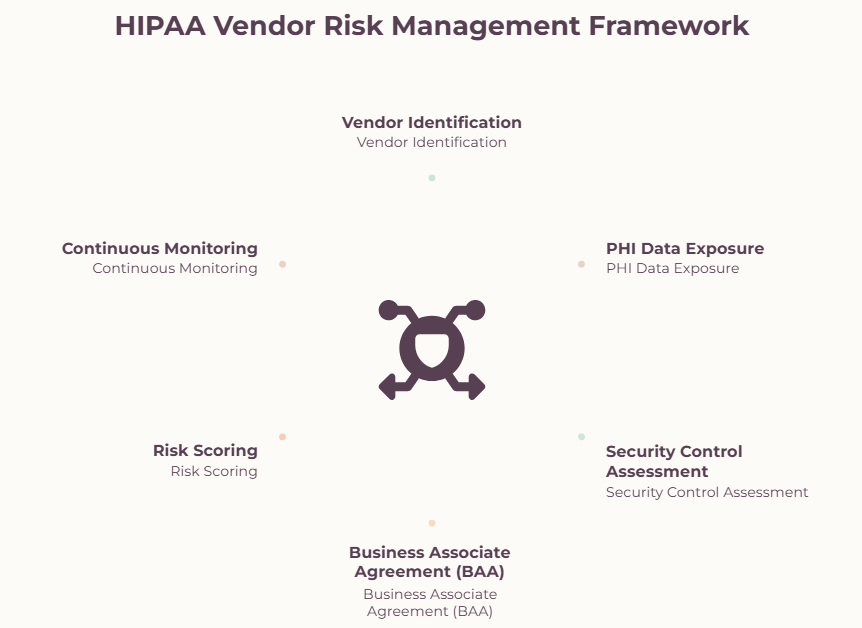
Building a Practical HIPAA Vendor Risk Scoring Framework
A structured risk scoring framework helps CIOs compare vendors consistently and prioritize the issues that require management attention.
Without a defined methodology, assessments can become subjective. One vendor may receive extensive scrutiny because of its industry reputation, while another with similar access to sensitive information may receive limited review.
A risk scoring model introduces a common basis for evaluating vendors and documenting decisions.
Step 1: Assess Inherent Risk
Inherent risk represents the risk associated with a vendor relationship before considering the effect of specific safeguards.
CIOs can evaluate several factors:
Data sensitivity: Does the vendor access highly sensitive patient information, such as detailed medical records or treatment information?
Data volume: How much PHI does the vendor process or maintain?
Access privileges: Does the vendor have administrative access, remote access, or the ability to make changes to production systems?
Business criticality: Would an interruption affect patient care, billing, clinical operations, or other essential services?
External dependencies: Does the vendor depend on multiple subcontractors or service providers?
Operational exposure: Does the vendor operate across multiple environments, geographic locations, or interconnected systems?
Each factor can be assigned a score based on a documented scale.
For example, an organization might use a scale from 1 to 5, where 1 represents low exposure and 5 represents very high exposure.
Step 2: Evaluate Control Effectiveness
The second stage examines the effectiveness of the vendor’s safeguards.
Relevant control categories may include:
- Identity and access management.
- Encryption and data protection.
- Vulnerability and patch management.
- Security monitoring and incident response.
- Backup and disaster recovery.
- Security governance and employee training.
- Subcontractor oversight.
- Privacy and contractual compliance.
Each category should be evaluated using defined criteria and supporting evidence.
A vendor with extensive documentation but unresolved critical findings should not automatically receive a high control score.
Similarly, an organization with limited formal documentation may require additional review even if it reports having implemented several technical safeguards.
Step 3: Determine Residual Risk
Residual risk is the risk that remains after considering existing safeguards and mitigation measures.
For example, a cloud vendor may present high inherent risk because it hosts a large volume of PHI and supports essential clinical applications. Strong access controls, effective monitoring, tested recovery procedures, and reliable incident response may reduce some of that risk.
However, the final assessment must also consider unresolved vulnerabilities, control limitations, and the consequences of a potential failure.
A simple illustrative framework is shown below.
| Risk Category | Example Assessment Factor | Illustrative Score |
|---|---|---|
| Data exposure | Volume and sensitivity of PHI | 5 |
| System access | Privileged access to production systems | 5 |
| Business impact | Disruption of critical clinical services | 4 |
| Security controls | Evidence of effective safeguards | 2 |
| Incident readiness | Tested response and escalation procedures | 2 |
These scores are illustrative and should not be interpreted as an assessment of an actual vendor.
Organizations may use weighted scoring, qualitative risk matrices, or other suitable methodologies. The important requirement is to document the methodology, apply it consistently, and ensure that the resulting risk rating reflects the actual circumstances.
Step 4: Establish Risk-Based Decisions
The assessment should lead to a clear decision.
A vendor may be approved when its controls meet the organization’s requirements and residual risk is acceptable.
Conditional approval may be appropriate when identified weaknesses can be addressed through specific corrective actions within agreed timelines.
A high-risk vendor may require executive approval, additional safeguards, restrictions on access, or a revised implementation plan.
If a material weakness cannot be adequately mitigated, the organization may need to delay onboarding or select another provider.
The decision should record the assessment results, supporting evidence, identified exceptions, accountable owners, remediation commitments, and approval authority.
A risk score is not the final objective. The objective is a defensible decision supported by evidence and an accountable plan for managing risk.
Continuous Monitoring and Ongoing Vendor Risk Management
Vendor risk management should not end when the contract is signed.
Security conditions, vendor operations, technology architectures, subcontractor relationships, and threat environments change over time.
A vendor that met the organization’s requirements during onboarding may introduce new risks after changing its hosting provider, acquiring another company, deploying a new platform, or experiencing a significant security incident.
For this reason, CIOs should establish continuous monitoring and periodic reassessment processes.
Establishing a Monitoring Schedule
The frequency of reassessment should reflect the vendor’s risk profile and the organization’s circumstances.
High-risk vendors may require more frequent reviews and closer monitoring than vendors with limited access to PHI.
Monitoring activities can include:
- Periodic reviews of security assurance reports.
- Tracking of outstanding remediation actions.
- Review of material security incidents.
- Monitoring of relevant vulnerability disclosures.
- Confirmation of ongoing contractual and BAA obligations.
- Review of significant subcontractor changes.
- Assessment of business continuity and recovery evidence.
- Verification of access rights and privileged accounts.
- Periodic reassessment of vendor criticality.
Organizations should define specific triggers for additional reviews rather than relying exclusively on a fixed annual schedule.
Monitoring Changes in Vendor Risk
Certain events should prompt a reassessment of the vendor relationship.
Examples include a confirmed security incident, a significant change in the services provided, expansion of PHI access, migration to a new technology platform, changes in ownership, or the introduction of a new subcontractor that materially affects risk.
These events may change the assumptions underlying the original assessment.
For instance, a vendor originally approved to provide limited technical support may later request direct access to a production database. That change could increase both data exposure and operational risk.
The original approval should not automatically extend to the expanded access arrangement without appropriate review.
Measuring Vendor Risk Performance
CIOs can use key risk indicators and performance measures to understand whether vendors are meeting established expectations.
Useful measures may include:
- Percentage of high-risk vendors with current assessments.
- Number of overdue critical remediation actions.
- Time taken to notify the organization of relevant incidents.
- Percentage of required security documents received and reviewed.
- Completion rate for scheduled vendor reassessments.
- Percentage of critical vendors with tested recovery arrangements.
- Number of unresolved contractual or security exceptions.
- Time taken to revoke access when a vendor relationship ends.
Metrics should support meaningful decisions rather than become reporting exercises.
For example, a high assessment completion rate may look positive, but it does not necessarily mean that the organization’s vendors have effective controls. CIOs must also consider the severity of outstanding findings and the speed at which material weaknesses are addressed.
Maintaining Audit-Ready Documentation
Documentation supports accountability and helps organizations demonstrate how risk decisions were made.
Records should capture the assessment methodology, evidence reviewed, identified risks, remediation plans, approvals, and subsequent monitoring activities.
HIPAA’s Security Rule includes documentation requirements, including requirements concerning the retention and availability of specified compliance documentation.
A structured recordkeeping process helps CIOs coordinate reviews, support audits, and maintain visibility into the organization’s third-party risk exposure.
Reference: https://www.hhs.gov/hipaa/for-professionals/security/guidance/guidance-risk-analysis/index.html
Common Challenges CIOs Face When Evaluating HIPAA Vendor Risk
Even organizations with established cybersecurity programs can encounter challenges when assessing third-party risk.
These challenges frequently arise from incomplete information, inconsistent assessment practices, limited resources, and the complexity of modern technology environments.
Treating HIPAA Compliance as a Certification
One common misconception is that HIPAA compliance can be established through a single universal certification.
HIPAA does not provide a general government-issued certification that automatically establishes compliance for every business associate.
Consequently, CIOs should not treat a vendor’s use of a compliance badge or marketing statement as sufficient evidence.
The assessment must consider the vendor’s actual responsibilities, applicable HIPAA requirements, implemented safeguards, contractual arrangements, and operating practices.
Independent assurance reports and external assessments may support the evaluation, but they must be interpreted according to their scope and limitations.
Relying on Incomplete Vendor Questionnaires
Questionnaires can become ineffective when they contain generic questions, rely entirely on yes-or-no responses, or fail to request supporting evidence.
A more effective approach combines structured questionnaires with targeted evidence requests, interviews, technical reviews, and risk-based follow-up.
CIOs should also ensure that questionnaire responses are reviewed by individuals with the expertise necessary to evaluate them.
Overlooking Fourth-Party Risk
A vendor’s security depends partly on the organizations and services it relies on.
For example, a healthcare software provider may depend on a cloud infrastructure provider, an identity management service, and an external support organization.
These relationships can introduce additional vulnerabilities, operational dependencies, and contractual complexities.
CIOs should establish visibility into relevant subcontractors and evaluate whether the primary vendor maintains appropriate oversight of its supply chain.
The level of scrutiny should reflect the services performed and the applicable contractual and regulatory obligations.
Balancing Security with Business Speed
Business teams often need to onboard vendors quickly to support new products, improve operations, or meet project deadlines.
However, bypassing security assessments can create long-term exposure that outweighs the immediate benefit of faster deployment.
Organizations can address this challenge by establishing standardized assessment workflows, defining risk-based review paths, maintaining approved vendor requirements, and involving security teams early in procurement.
A clearly defined process helps teams understand which information is required and how quickly decisions can be made.
Where expedited approval is necessary, the organization should document the rationale, apply appropriate safeguards, and establish a time-bound plan for resolving outstanding issues.
Managing Legacy Systems and Technical Limitations
Some healthcare organizations depend on older systems that cannot easily support modern security controls.
A vendor may also operate legacy technologies that cannot be upgraded immediately.
CIOs should evaluate these limitations according to the sensitivity of the information involved, the potential consequences of exploitation, and the availability of compensating safeguards.
Potential measures include restricting network connectivity, limiting privileged access, increasing monitoring, isolating vulnerable components, and establishing a documented remediation plan.
Compensating safeguards should not be used to justify indefinite inaction. They should be supported by risk analysis and reviewed as circumstances change.
Addressing Artificial Intelligence and Emerging Technologies
AI-enabled healthcare services introduce additional questions about data use, access, retention, and accountability.
CIOs should understand whether a vendor sends PHI to external AI services, uses patient information to train models, retains prompts or outputs, or allows personnel to access submitted data.
They should also assess how the vendor manages model providers, data processing locations, access permissions, and security incidents.
An AI tool should not be assumed to be suitable for PHI merely because it is marketed for healthcare use.
Before deployment, organizations should establish whether the service can operate within the intended privacy, security, contractual, and regulatory requirements.
The broader principle remains unchanged: new technology must be evaluated according to the information it handles, the access it requires, and the risks it introduces.
A Practical Roadmap for Improving HIPAA Vendor Risk Management
CIOs seeking to strengthen their vendor risk management programs can begin with a structured roadmap that connects governance, assessment, remediation, and continuous monitoring.
The following approach can help organizations move from fragmented vendor reviews toward a repeatable, risk-based process.
Phase 1: Establish a Complete Vendor Inventory
Begin by identifying third parties that may access, create, receive, maintain, or transmit PHI on the organization’s behalf.
Collect information about each vendor’s services, business owner, data access, system dependencies, contractual status, and criticality.
The inventory should distinguish vendors that qualify as business associates from other suppliers that may present security or operational risks but do not necessarily fall within that definition.
This distinction supports appropriate contractual decisions and assessment priorities.
Phase 2: Classify Vendors by Risk
Apply a documented methodology to classify vendors according to data sensitivity, access privileges, business criticality, external dependencies, and potential impact.
Assign each vendor to a suitable assessment tier.
For example, a high-risk tier may include vendors hosting substantial amounts of PHI or supporting essential clinical systems. A lower tier may include suppliers with restricted access and limited operational impact.
The organization should define its own thresholds and ensure that classification decisions are consistent.
Phase 3: Standardize Due Diligence
Create a repeatable assessment process for each risk tier.
Define the required questionnaires, evidence, contractual reviews, technical assessments, and approval authorities.
Ensure that the process includes appropriate review of BAAs where required, independent assurance reports, security controls, incident response, and subcontractor arrangements.
Standardization improves efficiency while helping prevent critical requirements from being overlooked.
Phase 4: Remediate Identified Gaps
Record the weaknesses identified during assessment and assign each one an owner, severity, remediation deadline, and verification method.
Prioritize issues according to their potential impact on PHI, operational continuity, and compliance obligations.
Where remediation cannot be completed immediately, evaluate whether temporary safeguards can adequately reduce exposure.
Material residual risks should be escalated to the appropriate decision-makers.
Phase 5: Integrate Vendor Risk into Procurement
Vendor risk assessments should begin before a contract is finalized or sensitive information is transferred.
Procurement, IT, security, legal, compliance, and business teams should coordinate their activities so that security requirements are considered during vendor selection.
Contracts should reflect the approved service scope, required safeguards, incident reporting obligations, and relevant data handling restrictions.
Changes to the service or access requirements should trigger additional review where appropriate.
Phase 6: Implement Continuous Monitoring
Establish a monitoring schedule that reflects vendor criticality and the nature of the relationship.
Track assessment renewals, security incidents, outstanding findings, contractual exceptions, and material changes in vendor operations.
Integrate relevant results into management reporting so that leadership can identify emerging risks and direct resources toward the most important issues.
Phase 7: Review Program Effectiveness
Periodically evaluate whether the vendor risk management program is producing meaningful results.
Review whether high-risk vendors are receiving adequate scrutiny, critical findings are being resolved, contractual requirements are being met, and assessments are completed within reasonable timelines.
Use audit results, incident investigations, and stakeholder feedback to improve the process.
The objective is not to create a larger collection of forms. It is to build a repeatable decision-making framework that improves visibility, accountability, and protection of sensitive information.
Conclusion: Turning Vendor Risk Assessment into a Strategic Advantage
HIPAA business associate vendor risk management is a strategic responsibility for CIOs because third-party relationships directly influence the security, reliability, and governance of healthcare technology environments.
As healthcare organizations adopt cloud platforms, interconnected applications, outsourced services, and AI-enabled tools, the number of external dependencies involved in handling sensitive information continues to grow.
Each relationship creates an opportunity to improve efficiency and service delivery, but it also requires appropriate evaluation of privacy, security, contractual, and operational risks.
An effective approach begins with understanding the vendor’s role and determining whether a business associate relationship exists. It then examines the vendor’s security safeguards, independent assurance evidence, contractual obligations, subcontractor relationships, and ability to respond to incidents.
Risk scoring helps CIOs prioritize assessments and communicate exposure to leadership. Continuous monitoring ensures that the original assessment remains relevant as vendors, systems, and business requirements change.
Most importantly, vendor risk decisions must be supported by evidence.
A signed BAA does not replace technical due diligence. A SOC 2 report does not automatically establish HIPAA compliance. A vendor questionnaire does not prove that every security control is effective.
Each piece of evidence contributes to a broader assessment that should consider the actual service, the sensitivity of the information involved, and the consequences of a potential failure.
CIOs should therefore establish clear ownership, risk-based assessment criteria, documented approval processes, measurable remediation plans, and ongoing oversight.
This approach helps organizations identify weaknesses before they become significant incidents, improve third-party accountability, and make more informed technology procurement decisions.
Ultimately, effective HIPAA business associate risk management is not simply a regulatory exercise. It is an essential component of healthcare cybersecurity, operational resilience, and responsible data governance.
When CIOs evaluate vendors through a combination of contractual accountability, technical evidence, and continuous risk monitoring, they can make more informed decisions while strengthening the protection of patient information.