Now is the Right Time for ISO 27001, Let’s Conquer!
What it is, why it matters, and how to get certified – explained simply.
This guide covers everything you need to know about ISO 27001 – the international standard for information security management. It is written for business owners, founders, compliance leads, and team members who need to understand the standard without a technical background. Each section follows an issue-based structure: the topic is broken down into the specific questions that matter most, with the answers laid out clearly.
“Security isn’t just a job, it’s a commitment to safeguarding peace where we live, work, & play.”
So, What Is ISO 27001, Really?
ISO 27001 (ISO/IEC 27001:2022) is the international standard for Information Security Management Systems. Published jointly by ISO and IEC, it defines how organisations should establish, implement, maintain, and continually improve a structured approach to managing information security risk.
(Note on versions: The standard was first published in 2005, revised in 2013, and most recently updated in 2022. Any guide referencing the 2013 version is outdated)
ISO 27001 Explained: Scoping, Risk, Audits in this below video:
“The three principles ISO 27001 is built on”
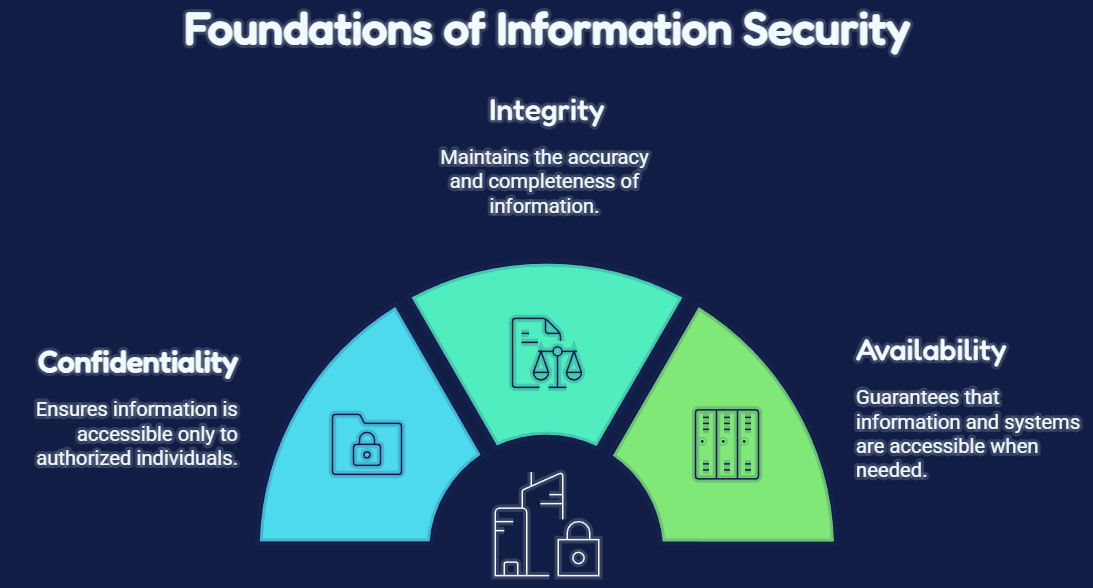
Every control, clause, and requirement in ISO 27001 exists to protect three fundamental properties of information — collectively known as the CIA triad:
-
Confidentiality — information is accessible only to those authorised to access it.
-
Integrity — information is accurate and complete, and can only be modified by authorised parties.
-
Availability — information and systems are accessible to authorised users when needed.
Risk assessment under ISO 27001 evaluates every identified threat against these three properties. Controls are selected and implemented to address specific threats to confidentiality, integrity, or availability — not applied uniformly across the board.
How ISO 27001 is structured:
Key Components of ISO 27001
ISO 27001 is built on several core components that serve as the foundation for a robust ISMS. These components are critical for managing and protecting information security effectively:
-
Information Security Management System (ISMS): An ISMS is a comprehensive approach that covers processes, technologies, and people, ensuring that information is managed securely. The ISMS is designed to be scalable, adaptable, and tailored to the organization’s unique needs.
-
Risk Assessment and Treatment: Organizations must conduct risk assessments to identify potential threats and vulnerabilities. This process includes identifying information assets, assessing associated risks, and implementing measures to treat or mitigate those risks.
-
Annex A Controls: ISO 27001 includes 93 security controls outlined in Annex A. These controls are categorized across domains such as access control, cryptography, physical security, communications security, and more. Organizations select and implement appropriate controls based on their risk assessment.
-
Statement of Applicability (SoA): The Statement of Applicability identifies which Annex A controls are applicable and why they were selected or omitted. It serves as the foundational document for ISO 27001 implementation and is critical for audits.
-
Continuous Improvement (PDCA Cycle): ISO 27001 promotes a culture of continuous improvement through the Plan-Do-Check-Act (PDCA) cycle. This involves planning security measures, implementing them, evaluating their effectiveness, and making necessary adjustments to enhance security.
The Purpose of ISO 27001
ISO 27001 exists to give organisations a structured, auditable way to protect sensitive information -ensuring it stays confidential, accurate, and accessible only to those authorised to use it. It does this through an Information Security Management System (ISMS): a documented, continuously maintained framework covering the people, processes, and technology responsible for information security.
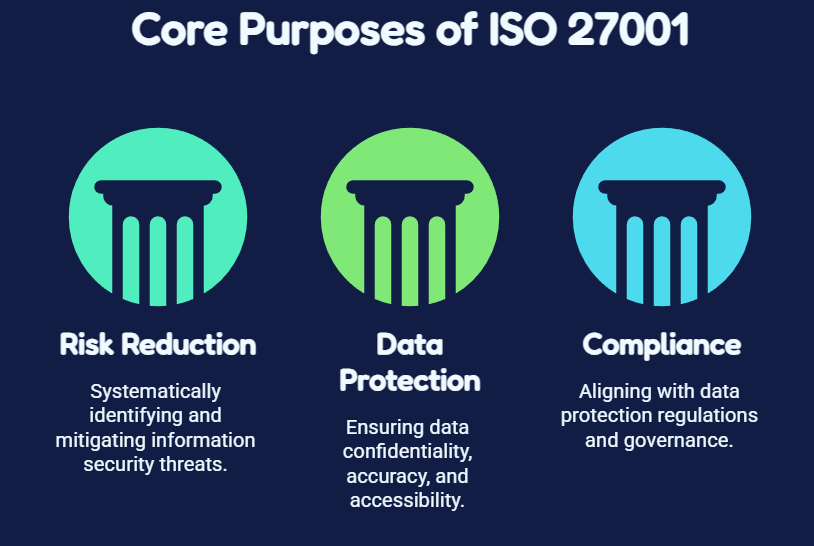
The standard serves three core purposes:
-
Reducing information security risk. ISO 27001 requires organisations to systematically identify their information assets, assess threats and vulnerabilities, and implement controls to treat each identified risk. This replaces informal assumptions about what is protected with a documented, reviewable process.
-
Protecting data and maintaining trust. By implementing controls that guard against breaches, unauthorised access, and data loss, organisations can demonstrate to customers, partners, and regulators that sensitive information is handled responsibly — backed by independent audit, not self-assessment.
-
Supporting compliance and governance. ISO 27001 aligns closely with the requirements of GDPR, India’s DPDP Act, and other data protection regulations. Organisations that implement an ISMS satisfy a significant portion of their regulatory obligations through the same controls, without building separate compliance programs.
Beyond these three objectives, ISO 27001 builds security into how an organisation operates day to day — through defined responsibilities, staff awareness training, and a cycle of monitoring and improvement — rather than treating it as a function owned by a single team.
How ISO 27001 Is Enforced
ISO 27001 is a voluntary international standard, not a government regulation. There is no single authority that mandates or polices its implementation. Instead, the framework operates through three layers of oversight:
-
The International Organisation for Standardisation (ISO). ISO is an independent, non-governmental body that develops and publishes international standards, including ISO 27001, in collaboration with technical experts and industry bodies across member countries. ISO defines the requirements — it does not issue certificates or conduct audits.
-
Accredited certification bodies. Certification is awarded by independent bodies accredited under ISO/IEC 17021 and ISO/IEC 27006 — the standards that govern how certification audits must be conducted. These bodies carry out the two-stage initial certification audit and the annual surveillance audits required to maintain the certificate. The accreditation of certification bodies is itself overseen by national accreditation authorities, adding a further layer of independent verification.
-
Internal auditors and compliance teams. Alongside external audits, ISO 27001 requires organisations to conduct their own internal audits on a regular schedule. Internal audit teams assess whether the ISMS is operating as designed, identify nonconformities, and generate corrective actions. This internal oversight function is what keeps the ISMS current between external audits — and is one of the primary things surveillance auditors look for evidence of.
The result is a system of layered accountability: ISO sets the standard, accredited bodies verify conformance, and internal teams maintain it continuously.
Industries That Benefit from ISO 27001
ISO 27001 is sector-agnostic by design – any organisation that stores, processes, or transmits sensitive information has a use for it. That said, some industries face elevated risk exposure or regulatory pressure that makes certification particularly valuable.
Financial services. Banks, insurance companies, and investment firms handle high volumes of sensitive personal and transactional data, making them consistent targets for fraud and cyberattacks. ISO 27001 provides the control framework to protect this data systematically and supports compliance with sector-specific financial regulations.
Healthcare and life sciences. Patient records, clinical trial data, and medical research represent some of the most sensitive categories of personal information in existence. Healthcare organisations use ISO 27001 to protect this data from unauthorised access, support HIPAA compliance, and maintain patient trust in environments where a breach can have direct consequences beyond financial loss.
Technology and SaaS. Software companies and SaaS providers hold customer data, source code, and proprietary systems that are attractive targets. For these organisations, ISO 27001 also serves a commercial function — enterprise buyers in this space increasingly require certification as a vendor qualification condition before contracts are signed.
Government and public sector. Public institutions manage citizen data, national infrastructure information, and in some cases classified information. ISO 27001 gives government bodies a structured approach to protecting this data against both external threats and internal mishandling.
Telecommunications. Telecom providers process communication logs, location data, and personal identifiers at scale. ISO 27001 supports the security of both network infrastructure and the customer data flowing through it.
Manufacturing and industrial. Manufacturers protecting proprietary product designs, supply chain relationships, and operational technology systems benefit from ISO 27001’s controls around intellectual property and third-party security — areas where informal protection is frequently insufficient.
Legal and professional services. Law firms and consultancies operate under strict client confidentiality obligations. ISO 27001 formalises the controls that protect sensitive client information and provides an independently verified assurance that those controls are operating — which matters increasingly to enterprise clients during vendor due diligence.
The common thread across all of these is not industry type — it is the presence of information that, if compromised, would cause measurable harm. That is the relevant threshold, and ISO 27001 is built around it.
“The ISO 27001 Certification Process”
There are 2 stages in the certification process in year 1: Stage 1 & Stage 2 Audit followed by 2 annual surveillance audits. The Stage 1 Audit evaluates your existing processes and reports on any areas of improvement, and the Stage 2 audit determines if those areas have been implemented and your ISMS meets the standards of ISO 27001. After 2 annual surveillance audits in Year 2 and Year 3, the organization needs to begin the triennial cycle again by undergoing a re-certification audit.
Stage 1 Audit (Year 1)
The initial examination is referred to as a “Stage 1” audit. During this stage, the organization’s documentation and procedures are evaluated to assess how well the organization already meets the ISO 27001 criteria. The length of the evaluation is determined by the size of the organization and the industry in which it operates.
When the Stage 1 evaluation is completed, a closing meeting is held to summarize the findings. The ISO Lead Auditors submit a report outlining what transpired during the assessment along with any areas of improvement. These are referred to as” areas of concern that could be classified as nonconformity during Stage
Stage 2 Audit (Year 1)
During this stage, the auditor observes organizational procedures in operation. This also includes meetings with both managers and employees. The auditor evaluates if the procedures have been clearly understood and if the checks and controls are sufficient to limit the risks of a data security breach, as required by ISO 27001.
If the lead auditor discovers no issues, they confirm that the ISMS fulfills the necessary ISO 27001 criteria. The certification committee examines their recommendation and issue the Initial Audit ISO 27001 certificate. However, If the auditor discovers nonconformities, they are included in a detailed report. They need to be addressed before getting certified. Once the issues are resolved, the organization is officially recognized as “ISO/IEC 27001:2013 certified”.
Ongoing Surveillance Audits (Year 2 & 3) and Re-certification Audit (Year Annual audits are planned between the certification body and the organization to guarantee compliance and to schedule the re-certification process every 3 years.
7 Benefits of ISO 27001 Certification
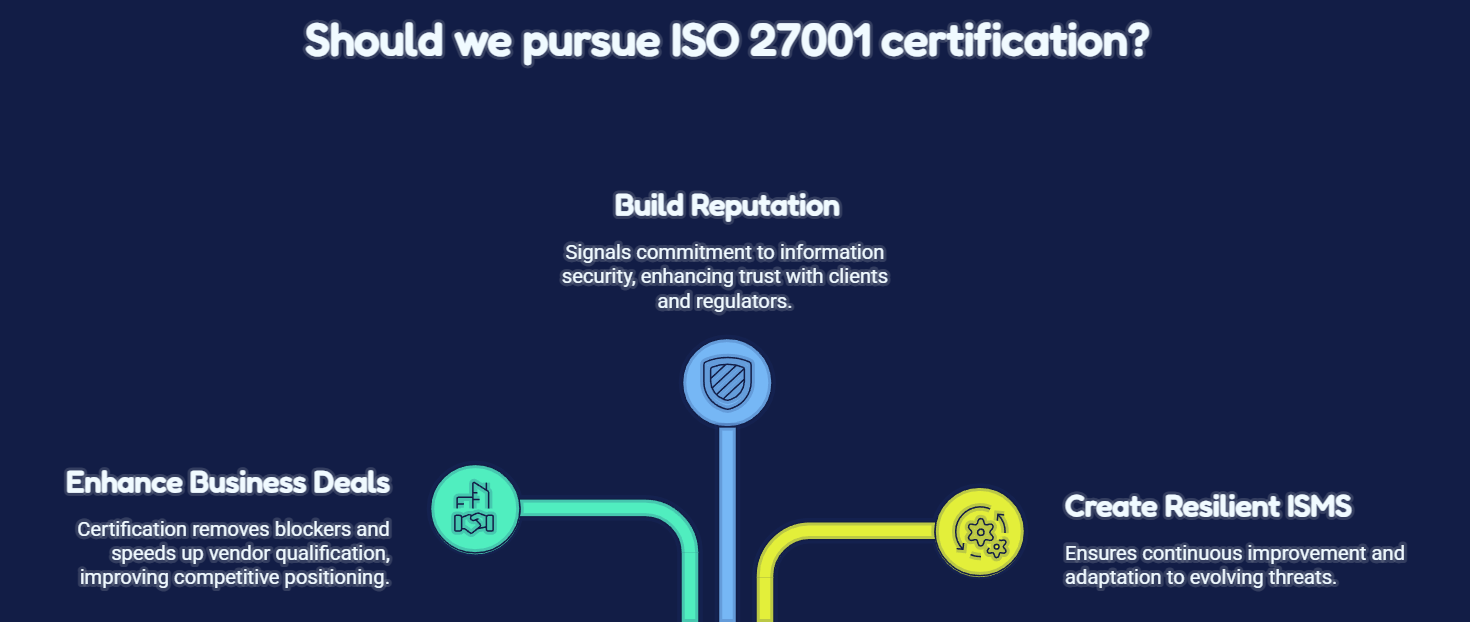
ISO 27001 certification is not mandatory in most countries – organizations can choose to implement the standard’s controls without pursuing formal certification. In many B2B contexts, demonstrating compliance with ISO 27001 controls is sufficient. But a growing number of enterprise deals, government contracts, and cross-border partnerships require the certificate itself – specifically because it brings an independent, annually audited third party into the picture, rather than relying on self-reported compliance.
For organisations that do pursue certification, the returns go well beyond a document on the wall.
-
Win business deals and strengthen competitive positioning ISO 27001 certification removes a common blocker in enterprise sales cycles. Procurement teams that require it will not move forward without it — and organisations that hold it move through vendor qualification faster than those that don’t.
-
Build and protect business reputation Certification signals to clients, partners, and regulators that information security is treated as a business priority, not an afterthought. In an environment where a single breach can generate lasting reputational damage, that signal carries real weight.
-
Create a resilient, continuously improving ISMS The standard does not just require controls to be implemented — it requires them to be monitored, reviewed, and improved on a defined cycle. The result is a security program that adapts as the organisation and its threat landscape evolve, rather than becoming outdated between audits.
-
Align security with business operations ISO 27001 integrates information security into the organisation’s processes, roles, and decision-making — rather than isolating it within a single team. Every category of organisational data, from HR records to customer databases to supplier contracts, falls within scope.
-
Reduce the risk of breaches and the cost of penalties Structured risk assessment and treatment means threats are identified and addressed before they result in incidents. Where incidents do occur, documented response procedures reduce their scope and duration — both of which affect the financial and regulatory consequences.
-
Satisfy legal, regulatory, and contractual requirements ISO 27001 controls map directly to the requirements of GDPR, India’s DPDP Act, and a range of sector-specific regulations. Organisations implementing an ISMS satisfy a significant portion of these obligations through the same work, without maintaining separate compliance programs for each framework.
-
Get an independent, credible review of your security posture The certification audit is conducted by an accredited third party with no stake in the outcome. That independence is what makes the certificate meaningful to external parties — and it is what distinguishes certification from internal assessments or self-attestation.
How long does it take to get ISO 27001 Certified?
This is most likely the second most often asked question concerning ISO 27001. Most companies anticipate the duration for compliance to be a couple of weeks. However, this is not realistic. The actual duration to implement ISO 27001 controls and prepare for certification ranges from a few months for small businesses to more than a year for larger corporations. The certification process takes a few weeks once your organization is fully prepared.
We recommend a strong focus on quality while conducting your initial gap analysis and risk assessment, designing the ISMS and ensuring that the safeguards and controls are compliant with ISO 27001 standards. Organizations that prioritize speed and cost-savings above quality, may pay a higher price by having to re-do the process. This also results in a high level of confusion in the workforce who may be accustomed to the original insecure way of maintaining information.
Timelines for ISO 27001 Implementation and Certification
The primary implementation effort is focused on the ISO 27001 “Plan” and “Do” phases of a PDCA cycle. These are the first two obligatory stages when a risk assessment is performed and all safeguards (security controls) are applied.
The size of the organization determines the duration of these two phases:
1-20 employees |
Up to 3 months |
|---|---|
1-20 employees |
Up to 3 months |
20 – 50 employees |
3 – 5 months |
50 – 200 employees |
5 – 8 months |
>200 employees |
8 – 20 months |
These are rough estimates since the actual duration varies from organization to organization. In our experience as a Certifying Body, it usually takes 3- 5 months on average. However, these estimates may be realistic if a consultant or an online tool is used to assist with implementation. It may take longer if the preparation is done solely in-house by employees who are not well-versed with the most recent ISO 27001 standards.
Following implementation, the certification process is often separated into three steps:
1) A review of the documentation – The certification auditor will inspect all of your management system documentation to ensure that everything is in place to meet the criteria. This takes 1-3 days on average.
2) A certification audit – The certification auditors will check all of your processes at your site, comparing them to what was documented and verifying compliance. The Initial Audit ISO 27001 Certificate will be issued based on the auditor’s recommendations and report. The Certificate is valid for three years, subject to successful annual surveillance audits. The duration is based on the number of employees. For small-medium organizations, this takes 5-15 days on average.
3) Surveillance and maintenance audits – There will be surveillance audits for the next 2 years after the Initial Audit. At the end of 3 years, the certified organization will have to undergo recertification. During this time, certification auditors will visit and evaluate a sample of system procedures to ensure that you maintain the system. The complete system is meant to be audited during monitoring, but not all at once.
Surveillance and maintenance audits usually take 30% – 40% of the time taken for the certification audit, approximately 2-5 days.
What is the cost of ISO 27001 certification?
This is a critical question while considering ISO 27001. Once an organization decides to proceed with ISO 27001, they need to evaluate cost estimates for implementation/compliance and certification. These are 2 separate processes. While it is not possible to give a fixed amount, we have observed a trend.
Service |
Criteria |
Cost Estimate (USD) |
|---|---|---|
ISO 27001 Implementation / Compliance |
Small-Medium organizations |
$ 10,000 – $ 20,000 * |
ISO 27001 Certification (Stage 1, Stage 2, and Reporting) |
The cost is based on the number of employees and number of days |
$ 10,000 – $ 20,000 * |
To get a customized quote for your organization, we encourage you to schedule a meeting or request a quote.
*Disclaimer:
The cost estimates are based on the maturity level of the security architecture, the time required for readiness assessment, stage 1 and stage 2 audits, and the number of employees. They are, at best, only an estimate. Organizations are required to request a quote to obtain the actual cost they will incur and the duration of each service, as well as to select the engagement model best suited to their environment.
Penalties for Non-Compliance with ISO 27001
While there are no direct legal penalties associated specifically with ISO 27001 non-compliance, the consequences of information security failures can be significant:
-
Data Breaches and Financial Loss: Failing to implement proper information security measures can lead to data breaches, resulting in financial losses, including costs related to breach management, regulatory fines, and compensation to affected clients.
-
Legal Consequences: Lack of compliance with ISO 27001 may lead to failure in meeting regulatory requirements, such as GDPR, CCPA, or HIPAA. This can result in significant legal penalties and litigation costs.
-
Loss of Business Opportunities: Many businesses require their partners or vendors to be ISO 27001 certified. Non-compliance could mean a loss of contracts or partnerships and missed business opportunities.
-
Reputation Damage: Failure to protect sensitive data can damage an organization’s reputation. Customers, stakeholders, and partners may lose trust, and the organization may face negative publicity that impacts its standing in the marketplace.
Employee Responsibilities under ISO 27001
Employees are at the core of maintaining ISO 27001 compliance. Below are some of the essential responsibilities you should be aware of:
-
Follow Security Policies and Procedures: Employees must be familiar with and adhere to all information security policies and procedures. This includes access control policies, password management, and restrictions on sharing data without authorization.
-
Participate in Risk Management: Employees should report potential security risks or vulnerabilities to the compliance or IT security team. Identifying risks early helps prevent incidents and ensures corrective actions can be taken.
-
Use Strong Authentication and Access Control: Access to sensitive information should be restricted to authorized personnel only. Employees must use strong, unique passwords and refrain from sharing login credentials. Multi-factor authentication (MFA) should be enabled where possible.
-
Secure Devices and Workspaces: Keep devices such as laptops and workstations locked when not in use. Do not leave documents containing sensitive information unattended. Ensure physical security by locking office spaces or using access-controlled areas.
-
Report Security Incidents Immediately: If you encounter a security incident, such as phishing attempts, lost devices, or unauthorized access, report it immediately to your information security officer. Prompt reporting helps contain threats before they escalate.
-
Stay Up to Date on Security Awareness & Phishing Awareness Training: Complete any security awareness and phishing awareness training required by the company. Training helps you recognize threats like phishing and understand the best practices for handling information securely.
Best Practices for Compliance with ISO 27001
-
Follow a Clean Desk Policy: Keep your workspace free of sensitive information when not in use. Lock documents in secure storage and avoid leaving personal data visible on desks.
-
Encrypt Sensitive Data: Always use encryption for data that is being transmitted externally or stored in a potentially insecure location. Encryption is crucial for preventing unauthorized access to information.
-
Use VPN for Remote Work: Employees working remotely must use Virtual Private Networks (VPN) to connect securely to the company network. This ensures that sensitive data is not exposed when using external networks.
-
Practice Vigilance Against Social Engineering: Be cautious when handling unsolicited emails, calls, or messages. Always verify the identity of individuals requesting sensitive information. Avoid phishing and social engineering attacks by following protocols for verifying authenticity.
-
Monitor Access and Activity: Maintain an understanding of who has access to sensitive information and log any actions involving this information. Monitoring helps ensure that data is accessed only by authorized individuals and provides an audit trail in case of a security incident.
-
Audit and Evaluate the ISMS Regularly: Regular internal audits help assess the effectiveness of the ISMS. Participation in these audits ensures that everyone complies with ISO 27001 standards and that potential gaps are addressed.